


-
!["La Porta di Vertine" Chianti Classico DOCG 2023 (BIO)]()
“La Porta di Vertine” Chianti Classico DOCG 2023 (BIO)
. SUPERIORE.DE
- Wine & Maturation
- Grape variety: 100% Sangiovese
- Cultivation: biological
- Maturation: 50/50 cement tank/barrique
- Filtration: yes
- Alcohol content: 13,50 % vol
- Closure: Diam
- Serving & Storage
- Serving temperature: 16‑18 °C
- Storage potential: 2033+
- Analytical Values
- Total extract: 29,96 g/l
- Total acidity: 5,89 g/l
- Residual sugar: 1,06 g/l
- Sulfite: 59 mg/l
- pH value: 3,34
- Allergens & Nutrition
- Eco-Control-No.: IT‑BIO‑014
- Allergens
contains sulphites
stored air-conditioned0,75 l · 26,53 €/l · Price (DE) incl. VAT, excl. Shippingavailable immediately
!["Bertinga" Rosso Toscana IGT 2019]()
“Bertinga” Rosso Toscana IGT 2019
. SUPERIORE.DE
- Wine & Maturation
- Grape varieties: 50% Sangiovese, 50% Merlot
- Filtration: yes
- Alcohol content: 14,00 % vol
- Closure: Diam
- Serving & Storage
- Serving temperature: 16‑18 °C
- Storage potential: 2038+
- Analytical Values
- Total extract: 30,45 g/l
- Total acidity: 5,66 g/l
- Residual sugar: 1,15 g/l
- Sulfite: 69 mg/l
- pH value: 3,37
- Allergens & Nutrition
- Allergens
contains sulphites
stored air-conditioned0,75 l · 50,67 €/l · Price (DE) incl. VAT, excl. Shippingavailable immediately


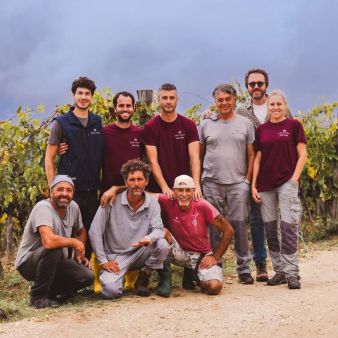
Some wineries begin with a name, others with an idea. Bertinga began with a vineyard whose quality was already well established. When Maxim Kashirin and Anatoly Korneev acquired the historic Bertinga site from Castello di Ama in 2015, they were not buying an unknown piece of land, but one of the most remarkable vineyards in Gaiole in Chianti. Their ambition was equally considerable: not simply to produce another Chianti Classico, but to reveal the character of this landscape through wines free to follow a path of their own.
The two founders had known the world of Italian wine for decades. The acquisition of Bertinga was followed in 2016 by the vineyards of Vertine and Adine, two further distinctive sites in the eastern part of Chianti Classico. Together, they form the foundation of an estate whose identity is shaped not by a long family history, but by an intimate understanding of its soils, vines and exposures. Three vineyards, two grape varieties and a clear conviction about just how much personality a sense of place can give a wine.
Three vineyards, three distinct characters
A closer look at Bertinga's vineyards makes it easy to understand why there is no single formula here. The parcels lie at different elevations, face different directions and have soils that can vary considerably even over short distances. Sangiovese and Merlot respond to these conditions in their own individual ways. It is precisely these differences that the team seeks to preserve and express as faithfully as possible in the cellar.
The vineyard that gives the estate its name covers nine hectares at an elevation of around 420 metres. Its five parcels lie above a deeply cut valley and have varying exposures. Limestone-rich soils, some with a substantial clay content, shape the vines. The more clay-rich sections offer particularly favourable conditions for Merlot. One such parcel produces Volta di Bertinga, a varietal Merlot that emphasises structure, depth and the distinctive character of its site rather than exuberant fruit. The Bertinga blend, meanwhile, brings together Merlot and Sangiovese, demonstrating how naturally the two varieties can complement one another here.
Higher up, at around 500 metres, lies Vertine. This three-hectare, south-facing Sangiovese vineyard follows the slope beneath the medieval fortified village. Galestro and Alberese, the characteristic schistose marl and limestone formations of Chianti Classico, define its geological foundations. This is the birthplace of La Porta di Vertine, the estate's Chianti Classico DOCG. It represents the more classical side of Bertinga, firmly rooted in the region's winemaking tradition despite the estate's distinctive stylistic approach.
Adine is the highest and, in some respects, the most demanding of the three sites. Steep slopes, stony clay-limestone soils of marine origin and the elevation create distinctive conditions for Sangiovese. On the uppermost terrace, at around 540 metres, the grapes for Punta di Adine are grown. Produced only in selected vintages, this single-vineyard wine expresses the concentrated yet vibrant character of high-altitude Sangiovese. Above the vineyards stands the winery, surrounded by a landscape of woodland, ancient paths and small medieval settlements.
Precision rather than a formula
The vineyards are farmed organically, with both viticulture and winemaking certified accordingly. For head of production Elisa Ascani, however, this means much more than simply following a fixed set of rules. Each parcel is considered individually, with soil management and vineyard care adapted to its particular needs. What makes sense on one slope may be entirely inappropriate just a few hundred metres away. In a landscape where altitude, exposure and soil composition vary so markedly, this attention to detail is essential.
The identity of each parcel is also preserved during the initial stages of winemaking. The grapes are carefully selected and vinified separately, using stainless steel and concrete vessels, among others. Different sizes of wooden barrels are employed for maturation. French oenologist Stéphane Derenoncourt has advised the project since its beginnings. His experience with complex terroirs complements the work of Elisa Ascani and her team. The aim is not to impose the same stylistic signature on every wine, but to bring out its origins and the particular character of each vintage.
Chianti Classico at heart, Toscana IGT by conviction
The range expresses this philosophy in different ways. Sassi Chiusi offers an introduction to the world of Bertinga, while the Bertinga blend places the interplay of Sangiovese and Merlot centre stage. Volta di Bertinga and Punta di Adine take the idea a step further: as single-varietal, single-vineyard wines, each gives one grape variety and one precisely defined parcel the opportunity to speak for itself. La Porta di Vertine, meanwhile, represents the estate's classical, Sangiovese-led side through its Chianti Classico DOCG designation.
The fact that much of the range is released as Toscana IGT is no contradiction of its origins, but rather an expression of creative freedom. Bertinga uses the possibilities offered by this classification to interpret Sangiovese and Merlot independently of the requirements of the Chianti Classico DOCG. What unites the wines remains the vineyard: the limestone-rich and clay soils, the elevated sites, their differing exposures and that interplay of structure and freshness which makes great red wines from Gaiole so compelling.
Bertinga is a remarkable example of how a young winery does not necessarily have to start from scratch. The vineyards bring their own history; the team gives them a new voice. And therein lies the fascination of this estate: it trusts in its origins without allowing tradition to impose limitations. The result is a collection of distinctive Tuscan red wines that seek to impress not through power alone, but through character, precision and an unmistakable sense of place. SUPERIORE.DE

Facts
- Founded: 2015
- Owners: Maxim Kashirin and Anatoly Korneev
- Oenologist: Stéphane Derenoncourt (consultant), Elisa Ascani (head of production)
- Annual production: approx. 80,000 bottles
- Vineyard area: approx. 24 hectares
- Organic viticulture
- 24 Years of Expertise
- 3,500+ Wines in Stock
- 350+ Winemakers
- 28,000+ Positive Reviews
- Fully Air-Conditioned Storage