


-
!["La Manina" Bianco Vigneti delle Dolomiti IGT 2025 (BIO)]()
“La Manina” Bianco Vigneti delle Dolomiti IGT 2025 (BIO)
La Manina, a vibrant white wine from biodynamic vineyards in the Dolomites, is characterised by its freshness and true expression of its terroir. It displays great precision and an invigorating vigour – more than just unpretentious, it perfectly embodies the house style and possesses an attractive personality. After being hand-harvested, the wine ferments at controlled temperatures in stainless steel. This is followed by a few months' ageing on fine lees to enhance its texture and structure.
- Grape varieties: 43% Pinot Bianco, 36% Chardonnay, 21% Sauvignon
- Cultivation: biodynamic
- Maturation: 6 months stainless steel tank on the fine yeast
- Vegan: yes
- Filtration: yes
- Alcohol content: 12,50 % vol
- Serving temperature: 8‑10 °C
- Storage potential: 2029+
- Closure: natural cork
- Total extract: 22,19 g/l
- Total acidity: 5,60 g/l
- Residual sugar: 0,60 g/l
- Sulfite: 84 mg/l
- pH value: 3,34
- Eco-Control-No.: IT‑BIO‑013
- Allergens
contains sulphites - Nutritional Information per 100 ml
- Energy in kcal: 74 kcal
- Energy in kJ: 309 kJ
- Carbohydrates: 1,10 g
- Of which sugar: 0,10 g
stored air-conditioned0,75 l · 18,53 €/l · Price (DE) incl. VAT, excl. Shippingavailable immediately
![Moscato Giallo Alto Adige DOC 2024 (BIO)]()
Moscato Giallo Alto Adige DOC 2024 (BIO)
Goldmuskateller is one of South Tyrol's oldest grape varieties, which until a few years ago was still regarded as temperamental and demanding. Manincor demonstrates what this diva is capable of when given the right sites: Mareit Leiten at 350 metres, extremely steep and south-facing with warm gravelly soils and moraine deposits. Added to this are Vogelleiten and Panholzer, with loamy limestone gravel soil – sites where the Muskateller's exuberant growth is tamed and it reaches perfect ripeness. The destemmed berries macerate for twelve hours in the press to extract aroma and structure from the skins. Fermentation takes place in wooden barrels and steel tanks, largely spontaneously with wild yeasts. During the five-month ageing on the fine lees, the aroma and flavour refine – the wine develops that balance between fruit and minerality which characterises dry Muskateller.
- Grape variety: 100% Moscato
- Cultivation: biodynamic
- Maturation: 5 months stainless steel on the fine lees
- Vegan: yes
- Filtration: yes
- Alcohol content: 12,50 % vol
- Serving temperature: 8‑10 °C
- Storage potential: 2029+
- Closure: Diam
- Food recommendations
asian cuisine, strong hard cheese - Total extract: 21,65 g/l
- Total acidity: 5,61 g/l
- Residual sugar: 0,60 g/l
- Sulfite: 79 mg/l
- pH value: 3,30
- Eco-Control-No.: IT‑BIO‑013
- Allergens
contains sulphites - Nutritional Information per 100 ml
- Energy in kcal: 77 kcal
- Energy in kJ: 320 kJ
- Carbohydrates: 1,20 g
- Of which sugar: 0,10 g
![Moscato Giallo Alto Adige DOC 2025 (BIO)]()
Moscato Giallo Alto Adige DOC 2025 (BIO)
Goldmuskateller is one of South Tyrol's oldest grape varieties, which until a few years ago was still regarded as temperamental and demanding. Manincor demonstrates what this "diva" is capable of when given the right sites: Mareit Leiten at 350 metres, with an extremely steep south-facing slope featuring warm gravelly soils and moraine deposits. Added to this are Vogelleiten and Panholzer, with loamy limestone gravel soils – sites where the Muscat's exuberant growth is tamed and perfect ripeness is achieved. The destemmed berries macerate for twelve hours in the press to extract aroma and structure from the skins. Fermentation takes place in wooden barrels and steel tanks, largely spontaneously with wild yeasts. During the five-month ageing on the fine lees, the aroma and flavour become more refined – and the wine develops that balance between fruit and minerality which characterises dry Muscat wines.
- Grape variety: 100% Moscato
- Cultivation: biodynamic
- Maturation: 5 months stainless steel on the fine lees
- Vegan: yes
- Filtration: yes
- Alcohol content: 12,00 % vol
- Serving temperature: 8‑10 °C
- Storage potential: 2030+
- Closure: Diam
- Food recommendations
asian cuisine, strong hard cheese - Total extract: 21,60 g/l
- Total acidity: 4,60 g/l
- Residual sugar: 0,40 g/l
- Sulfite: 78 mg/l
- pH value: 3,33
- Eco-Control-No.: IT‑BIO‑013
- Allergens
contains sulphites - Nutritional Information per 100 ml
- Energy in kcal: 71 kcal
- Energy in kJ: 296 kJ
- Carbohydrates: 1,10 g
- Of which sugar: 0,10 g
stored air-conditioned0,75 l · 23,33 €/l · Price (DE) incl. VAT, excl. Shippingavailable immediately
!["der Keil" Vernatsch Lago di Caldaro DOC 2024 (BIO)]()
“der Keil” Vernatsch Lago di Caldaro DOC 2024 (BIO)
The Vernatsch from Manincor comes from the monopoly position "der Keil" on Lake Kaltern – one of the warmest vineyards in South Tyrol. At an altitude of 250 metres, old vines are rooted in traditional pergola training on calcareous, sandy loam soils. The south-facing aspect with a direct view of the lake ensures optimum heat accumulation and perfect ripening conditions. After a wet spring in 2024 and a hot summer, the golden autumn brought physiologically ripe grapes with moderate alcohol and a cool character. The grapes were harvested by hand in mid-September at an ideal degree of ripeness and a yield of 60 hectolitres per hectare. The destemmed grapes ferment spontaneously with wild yeasts in open wooden vats. During the one-week mash fermentation at a moderate 24°C, the cap is gently punctured only once a day – minimal intervention for maximum fruit clarity. The wine then matures for five months on the fine lees in large wooden barrels, where the flavours are refined and the natural elegance of the Vernatsch comes to full fruition.
- Grape variety: 100% Vernatsch
- Cultivation: biodynamic
- Maturation: 5 months in large wooden barrels on the fine lees
- Vegan: yes
- Filtration: yes
- Alcohol content: 12,50 % vol
- Serving temperature: 16‑18 °C
- Storage potential: 2030+
- Closure: natural cork
- Food recommendations
schüttelbrot and bacon - Total extract: 29,57 g/l
- Total acidity: 5,20 g/l
- Residual sugar: 0,90 g/l
- Sulfite: 82 mg/l
- pH value: 3,38
- Eco-Control-No.: IT‑BIO‑013
- Allergens
contains sulphites - Nutritional Information per 100 ml
- Energy in kcal: 76 kcal
- Energy in kJ: 319 kJ
- Carbohydrates: 1,10 g
- Of which sugar: 0,10 g
!["Il Conte" Rosso Vigneti delle Dolomiti IGT 2024 (BIO)]()
“Il Conte” Rosso Vigneti delle Dolomiti IGT 2024 (BIO)
Here the name becomes the programme: Michael Graf Goëss-Enzenberg gave this wine its title because it tastes like Manincor itself. The essence of the hills that surround the estate, the view over Lake Kaltern, the strength and warmth of the warmest vineyards in South Tyrol – all come together in this glass. Grapes from Manincor and Panholzerhof, both at 250 metres, south-eastern slopes with sandy clay soils full of limestone gravel and glacial deposits.
- Grape varieties: 41% Lagrein, 29% Merlot, 17% Cabernet Franc, 4% Syrah, 4% Tempranillo, 5% Petit Verdot
- Cultivation: biodynamic
- Maturation: 12 months used barrique
- Vegan: yes
- Filtration: yes
- Alcohol content: 13,00 % vol
- Serving temperature: 16‑18 °C
- Storage potential: 2031+
- Closure: natural cork
- Food recommendations
meat dishes - Total extract: 29,48 g/l
- Total acidity: 5,70 g/l
- Residual sugar: 0,90 g/l
- Sulfite: 76 mg/l
- pH value: 3,36
- Eco-Control-No.: IT‑BIO‑013
- Allergens
contains sulphites - Nutritional Information per 100 ml
- Energy in kcal: 76 kcal
- Energy in kJ: 320 kJ
- Carbohydrates: 1,20 g
- Of which sugar: 0,10 g
stored air-conditioned0,75 l · 26,53 €/l · Price (DE) incl. VAT, excl. Shippingavailable immediately
!["La Contessa" Alto Adige Terlano DOC 2025 (BIO)]()
“La Contessa” Alto Adige Terlano DOC 2025 (BIO)
La Contessa is a South Tyrolean white wine with character and heritage, produced from biodynamically cultivated vineyards near Kaltern. Grown on loamy-sandy soils at an altitude of 300–400 metres, this blend of Pinot Blanc, Chardonnay and Sauvignon Blanc combines alpine freshness with southern charm. Spontaneously fermented and aged partly in wood and partly in stainless steel, the wine is complex and precise: delicate fruity notes of apple, citrus and lemon balm, accompanied by salty minerality and lively acidity. Finely balanced on the palate, dry and invigorating – an expressive, biodynamic white wine with cool elegance and a South Tyrolean character. SUPERIORE.DE
- Grape varieties: 55% Pinot Bianco, 28% Chardonnay, 17% Sauvignon
- Cultivation: biodynamic
- Maturation: 5 months large wooden barrel
- Vegan: yes
- Filtration: yes
- Alcohol content: 12,50 % vol
- Serving temperature: 10‑12 °C
- Storage potential: 2030+
- Closure: natural cork
- Food recommendations
light, festive cuisine - Total extract: 22,48 g/l
- Total acidity: 6,30 g/l
- Residual sugar: 0,90 g/l
- Sulfite: 79 mg/l
- pH value: 3,33
- Eco-Control-No.: IT‑BIO‑013
- Allergens
contains sulphites - Nutritional Information per 100 ml
- Energy in kcal: 74 kcal
- Energy in kJ: 310 kJ
- Carbohydrates: 1,10 g
- Of which sugar: 0,10 g
stored air-conditioned0,75 l · 26,53 €/l · Price (DE) incl. VAT, excl. Shippingavailable immediately
!["La Rosé de Manincor" Rosato Vigneti delle Dolomiti IGT 2025 (BIO)]()
“La Rosé de Manincor” Rosato Vigneti delle Dolomiti IGT 2025 (BIO)
La Rosé de Manincor is produced using the classic saignée method – by drawing off the juice from the estate's finest red wine batches. The grapes come from the Manincor, Seehof, Panholzerhof and Mazzon vineyards, situated at altitudes of between 250 and 500 metres. Rich clay soils, interspersed with limestone gravel and glacial rock deposits, define its character. The composition of the cuvée varies slightly from year to year – in 2025 it consists of 30% Cabernet Franc, 25% Merlot, 20% Pinot Nero, 13% Vernatsch, 4% Tempranillo, 4% Syrah and 4% Petit Verdot. After six to twelve hours of maceration, the must is racked off – the part that makes the red wines more concentrated and gives the rosé its colour, structure and richness of aroma. Fermentation takes place in wooden casks, partly spontaneously with wild yeasts. The wine is then aged on the fine lees for five months, during which time the aromas refine and that creamy texture develops which characterises La Rosé.
- Grape variety: 30% Cabernet Franc, 25% Merlot, 20% Pinot Nero, 13% Vernatsch, 4% Tempranillo, 4% Syrah and 4% Petit Verdot
- Cultivation: biodynamic
- Maturation: 5 months in large wooden barrels on the fine lees
- Vegan: yes
- Filtration: yes
- Alcohol content: 13,00 % vol
- Serving temperature: 8‑10 °C
- Storage potential: 2030+
- Closure: Diam
- Food recommendations
seasoned starters, fried fish - Total extract: 22,65 g/l
- Total acidity: 5,30 g/l
- Residual sugar: 0,90 g/l
- Sulfite: 73 mg/l
- pH value: 3,29
- Eco-Control-No.: IT‑BIO‑013
- Allergens
contains sulphites - Nutritional Information per 100 ml
- Energy in kcal: 76 kcal
- Energy in kJ: 319 kJ
- Carbohydrates: 1,10 g
- Of which sugar: 0,10 g
stored air-conditioned0,75 l · 28,00 €/l · Price (DE) incl. VAT, excl. Shippingavailable immediately
!["Ebeneich" Bianco Mitterberg IGT 2024 (BIO)]()
“Ebeneich” Bianco Mitterberg IGT 2024 (BIO)
For a biodynamic winegrower, 2024 presented one of the greatest challenges of recent years. The exceptionally wet months of May, June and July brought immense pressure from downy mildew and powdery mildew, which even the normally hardy PIWI varieties struggled to withstand. Only experience and consistent work in the vineyard ensured the vines came through this phase virtually unscathed. Late frost had already significantly reduced the harvest yield – in the end, it stood at a modest 27 hectolitres per hectare. However, the short, hot weeks from mid-July to the end of August, followed by a lovely autumn lasting until the end of September, produced grapes of a quality that exceeded all expectations.
- Grape variety: 68% Souvignier Gris and 32% Bronner
- Cultivation: biodynamic
- Maturation: aged for 10 months in a wooden cask on the fine lees
- Filtration: yes
- Alcohol content: 13,00 % vol
- Serving temperature: 10‑12 °C
- Storage potential: 2033+
- Closure: natural cork
- Food recommendations
delicious fish dishes, shellfish and crustaceans, grilled asparagus, vegetarian dishes - Total extract: 23,14 g/l
- Total acidity: 5,60 g/l
- Residual sugar: 1,30 g/l
- Sulfite: 76 mg/l
- pH value: 3,35
- Eco-Control-No.: IT‑BIO‑013
- Allergens
contains sulphites - Nutritional Information per 100 ml
- Energy in kcal: 80 kcal
- Energy in kJ: 333 kJ
- Carbohydrates: 1,20 g
- Of which sugar: 0,20 g
stored air-conditioned0,75 l · 37,33 €/l · Price (DE) incl. VAT, excl. Shippingavailable immediately
!["Tannenberg" Sauvignon Bianco Alto Adige Terlano DOC 2024 (BIO)]()
“Tannenberg” Sauvignon Bianco Alto Adige Terlano DOC 2024 (BIO)
Tannenberg – a parcel within the Lieben Aich vineyard that stands alone. While the Lieben Aich represents the entire Tenuta, this Sauvignon concentrates on a specific parcel: the one with the most pronounced mineral structure. South-western slope, 300 metres above sea level, warm and breezy microclimate. The soils of sandy loam over porphyry weathered rock are water-permeable and low in nutrients – conditions that require concentration. 2024 was a challenging vintage: a wet spring, then a hot and dry summer, followed by a golden autumn that allowed for perfect physiological ripeness. In mid-September, the grapes showed ripe fruit, cool character and moderate alcohol – ideal conditions for long-lasting wines with tension. The yield per hectare was 43 hectolitres. Vinification follows Manincor's biodynamic philosophy: the destemmed berries macerate on the press for twelve hours to extract flavour and structure from the skins. Spontaneous fermentation with the grapes' own yeasts takes place in wooden barrels, followed by nine months of ageing on the fine lees. The phases of the moon determine sowing, cultivation and harvesting: Rudolf Steiner's principles, consistently implemented. 11,900 bottles and 217 magnums were filled.
- Grape variety: 100% Sauvignon
- Cultivation: biodynamic
- Maturation: 10 months in wooden barrel on the fine lees
- Filtration: yes
- Alcohol content: 12,50 % vol
- Serving temperature: 10‑12 °C
- Storage potential: 2032+
- Closure: natural cork
- Food recommendations
shellfish and crustaceans, vegetarian dishes - Total extract: 25,97 g/l
- Total acidity: 6,42 g/l
- Residual sugar: 1,05 g/l
- Sulfite: 82 mg/l
- pH value: 3,44
- Eco-Control-No.: IT‑BIO‑013
- Allergens
contains sulphites - Nutritional Information per 100 ml
- Energy in kcal: 77 kcal
- Energy in kJ: 321 kJ
- Carbohydrates: 1,10 g
- Of which sugar: 0,10 g
stored air-conditioned0,75 l · 37,33 €/l · Price (DE) incl. VAT, excl. Shippingavailable immediately
!["Eichhorn" Pinot Bianco Alto Adige Terlano DOC 2025 (BIO)]()
“Eichhorn” Pinot Bianco Alto Adige Terlano DOC 2025 (BIO)
Eichhorn Vineyard – the name evokes South Tyrol, with its centuries-old vines rooted in sandy loam soils on weathered volcanic porphyry. As with the Sauvignon, this plot is also situated within the Tenuta Lieben Aich estate in Terlan, 300 metres above sea level, facing south-west towards the mild air currents. But whilst Tannenberg aims for maximum minerality, the Eichhorn seeks a balance between alpine clarity and Mediterranean richness. Here, Pinot Bianco – or "Weißburgunder", as the South Tyroleans call it – matures into a variety that oscillates between restraint and expression.
- Grape variety: 100% Pinot Bianco
- Cultivation: biodynamic
- Maturation: 9 months in large wooden barrels on the fine lees
- Filtration: yes
- Alcohol content: 12,50 % vol
- Serving temperature: 8‑10 °C
- Storage potential: 2033+
- Closure: natural cork
- Total extract: 22,78 g/l
- Total acidity: 5,90 g/l
- Residual sugar: 0,79 g/l
- Sulfite: 73 mg/l
- pH value: 3,33
- Eco-Control-No.: IT‑BIO‑013
- Allergens
contains sulphites - Nutritional Information per 100 ml
- Energy in kcal: 79 kcal
- Energy in kJ: 333 kJ
- Carbohydrates: 1,20 g
- Of which sugar: 0,10 g
stored air-conditioned0,75 l · 38,67 €/l · Price (DE) incl. VAT, excl. Shippingavailable immediately
!["Rubatsch" Lagrein Alto Adige DOC 2022 (BIO)]()
“Rubatsch” Lagrein Alto Adige DOC 2022 (BIO)
Rubatsch is a vineyard in Terlan at 250 metres, on a south-western slope with sandy soil on weathered porphyry rock. Two thirds of the Lagrein vines for this wine are rooted here, while the remaining third comes from the Seehof vineyard in Caldaro, where the soil is loamier and heavier. Two soils, two characters, one indigenous grape variety that belongs to South Tyrol like the Dolomites belong to the horizon.
- Grape variety: 100% Lagrein
- Cultivation: biodynamic
- Maturation: 16 months 90/10 used/new barrique
- Vegan: yes
- Filtration: yes
- Alcohol content: 12,50 % vol
- Serving temperature: 16‑18 °C
- Storage potential: 2034+
- Closure: Diam
- Food recommendations
game from the grill - Total extract: 28,35 g/l
- Total acidity: 6,01 g/l
- Residual sugar: 1,16 g/l
- Sulfite: 66 mg/l
- pH value: 3,52
- Eco-Control-No.: IT‑BIO‑013
- Allergens
contains sulphites
stored air-conditioned0,75 l · 45,33 €/l · Price (DE) incl. VAT, excl. Shippingavailable immediately
!["Cassiano" Rosso Vigneti delle Dolomiti IGT 2023 (BIO)]()
“Cassiano” Rosso Vigneti delle Dolomiti IGT 2023 (BIO)
Named after Cassian, the son of Count Michael Goëss-Enzenberg, who was born in 1996, the same year that Manincor opened its own winery. A name that stands for new beginnings, for the future, for the next generation. The cuvée combines six international grape varieties from the estate's best red wine sites: Manincor, Seehof and Panholzerhof, between 250 and 280 metres above sea level. Exposed to the south-east with a view of the lake, the vines are rooted in strong sandy loam soils interspersed with limestone gravel and glacial rock deposits – these plots are among the warmest sites in South Tyrol. Each grape variety is vinified separately. Mash fermentation takes place spontaneously in wooden vats with wild yeasts. The 16-month maturation in barriques (one third new wood) refines the structure without dominating the fruit. Blending only takes place shortly before bottling – the art of composition, in which character and individuality merge with solemnity and elegance.
- Grape varieties: 35% Merlot, 35% Cabernet Franc, 9% Syrah, 8% Tempranillo, 7% Petit Verdot, 6% Cabernet Sauvignon
- Cultivation: biodynamic
- Maturation: 18 months used/new barrique
- Vegan: yes
- Filtration: yes
- Alcohol content: 14,00 % vol
- Serving temperature: 16‑18 °C
- Storage potential: 2036+
- Closure: natural cork
- Total extract: 30,15 g/l
- Total acidity: 5,68 g/l
- Residual sugar: 1,38 g/l
- Sulfite: 67 mg/l
- pH value: 3,33
- Eco-Control-No.: IT‑BIO‑013
- Allergens
contains sulphites - Nutritional Information per 100 ml
- Energy in kcal: 82 kcal
- Energy in kJ: 344 kJ
- Carbohydrates: 1,20 g
- Of which sugar: 0,10 g
!["Mason" Pinot Nero Alto Adige DOC 2023 (BIO)]()
“Mason” Pinot Nero Alto Adige DOC 2023 (BIO)
A sunny high plateau at an altitude of 400 to 450 metres, gently sloping towards the south and constantly bathed in fresh air – this is the site from which Manincor's Pinot Nero originates. This airy position ensures healthy grapes and a consistent ripening period – ideal conditions for a grape variety that forgives no negligence. The vines are deeply rooted in stony moraine gravel, interlaced with dolomite, porphyry, gneiss and granite. The barren, mineral-rich soil lends the wines tension, precision and unmistakable depth. Manincor relies on small-berried, compact French clones, with deliberately low yields – yet every grape seed is packed with concentration.
- Grape variety: 100% Pinot Nero
- Cultivation: biodynamic
- Maturation: 16 months in 80/20 used/new barriques
- Vegan: yes
- Filtration: yes
- Alcohol content: 13,00 % vol
- Serving temperature: 16‑18 °C
- Storage potential: 2035+
- Closure: natural cork
- Food recommendations
pan‑fried and grilled red meat, game dishes, mature soft cheeses - Total extract: 29,47 g/l
- Total acidity: 5,60 g/l
- Residual sugar: 0,30 g/l
- Sulfite: 72 mg/l
- pH value: 3,38
- Eco-Control-No.: IT‑BIO‑013
- Allergens
contains sulphites
stored air-conditioned0,75 l · 46,67 €/l · Price (DE) incl. VAT, excl. Shippingavailable immediately
!["Sophie" Chardonnay Alto Adige Terlano DOC 2025 (BIO)]()
“Sophie” Chardonnay Alto Adige Terlano DOC 2025 (BIO)
Countess Sophie Goëss-Enzenberg, who runs the estate together with her husband Michael, gave this Chardonnay her name. A wine that combines elegance with determination, finesse with power. Half the grapes come from one of two contrasting worlds: Terlan Lieben Aich at 300 metres, facing west, where loamy sandy soil on volcanic porphyry nourishes Chardonnay and Sauvignon Blanc. And Kaltern Mazzon – Manincor's steepest vineyard, the 'Leiten' with gradients of up to 100 per cent. Here, Chardonnay and Viognier are rooted at altitudes of between 350 and 400 metres in calcareous loess-loam, facing south-west towards the light. Two soils, two microclimates, one vision. The destemmed berries macerate for four hours in the press – longer than for the Eichhorn, shorter than for the Sauvignons. Finesse is the guiding principle; the pressing process is slow and meticulous. Spontaneous fermentation with wild yeasts takes place in wooden barrels of various sizes, followed by nine months' ageing on the fine lees. Here, the aroma and structure develop into the density that characterises Sophie.
- Grape varieties: 93% Chardonnay, 3% Viognier, 4% Sauvignon
- Cultivation: biodynamic
- Maturation: 9 months in large wooden barrels on the fine lees
- Filtration: yes
- Alcohol content: 13,50 % vol
- Serving temperature: 10‑12 °C
- Storage potential: 2035+
- Closure: natural cork
- Total extract: 23,74 g/l
- Total acidity: 5,70 g/l
- Residual sugar: 1,80 g/l
- Sulfite: 82 mg/l
- pH value: 3,36
- Eco-Control-No.: IT‑BIO‑013
- Allergens
contains sulphites - Nutritional Information per 100 ml
- Energy in kcal: 80 kcal
- Energy in kJ: 333 kJ
- Carbohydrates: 1,20 g
- Of which sugar: 0,20 g
stored air-conditioned0,75 l · 50,67 €/l · Price (DE) incl. VAT, excl. Shippingavailable immediately
!["Il Conte" Rosso Vigneti delle Dolomiti IGT 2022 (BIO) <br>MAGNUM]()
“Il Conte” Rosso Vigneti delle Dolomiti IGT 2022 (BIO) · MAGNUM
Here the name becomes the programme: Michael Graf Goëss-Enzenberg gave this wine its title because it tastes like Manincor itself. The essence of the hills that surround the estate, the view over Lake Kaltern, the strength and warmth of the warmest vineyards in South Tyrol – all come together in this glass. Grapes from Manincor and Panholzerhof, both at 250 metres, south-eastern slopes with sandy clay soils full of limestone gravel and glacial deposits. Lagrein, Merlot, Cabernet Sauvignon – three grape varieties, one home. Each batch is vinified separately, partly spontaneously with wild yeasts in wooden, concrete and stainless steel vats. Ten days of gentle maceration, only dipped once a day for fine-grained tannins. Matured for twelve months in used wooden barrels of various sizes.
- Grape varieties: 43% Lagrein, 36% Merlot, 21% Cabernet Sauvignon
- Cultivation: biodynamic
- Maturation: 12 months used barrique
- Vegan: yes
- Filtration: yes
- Alcohol content: 13,00 % vol
- Serving temperature: 16‑18 °C
- Storage potential: 2031+
- Closure: natural cork
- Food recommendations
meat dishes - Total extract: 29,11 g/l
- Total acidity: 5,47 g/l
- Residual sugar: 0,37 g/l
- Sulfite: 76 mg/l
- pH value: 3,35
- Eco-Control-No.: IT‑BIO‑013
- Allergens
contains sulphites - Nutritional Information per 100 ml
- Energy in kcal: 79 kcal
- Energy in kJ: 331 kJ
- Carbohydrates: 1,10 g
- Of which sugar: 0,10 g
!["La Rosé de Manincor" Rosato Vigneti delle Dolomiti IGT 2025 (BIO) <br>MAGNUM]()
“La Rosé de Manincor” Rosato Vigneti delle Dolomiti IGT 2025 (BIO) · MAGNUM
La Rosé de Manincor is produced using the traditional saignée method – by drawing off the juice from the estate's finest red wine batches. The grapes come from the Manincor, Seehof, Panholzerhof and Mazzon vineyards, situated at altitudes of between 250 and 500 metres. Rich clay soils, interspersed with limestone gravel and glacial rock deposits, define its character. The composition of the cuvée varies slightly from year to year – in 2025, it consists of 30% Cabernet Franc, 25% Merlot, 20% Pinot Nero, 13% Vernatsch, 4% Tempranillo, 4% Syrah and 4% Petit Verdot. After six to twelve hours of maceration, the must is racked off – that part which makes the red wines more concentrated and gives the rosé its colour, structure and richness of aroma. Fermentation takes place in wooden barrels, partly spontaneously with wild yeasts. The wine then matures on its fine lees for five months, during which time the aromas refine and the creamy texture that characterises La Rosé develops.
- Grape variety: 30% Cabernet Franc, 25% Merlot, 20% Pinot Nero, 13% Vernatsch, 4% Tempranillo, 4% Syrah and 4% Petit Verdot
- Cultivation: biodynamic
- Maturation: 5 months in large wooden barrels on the fine lees
- Vegan: yes
- Filtration: yes
- Alcohol content: 13,00 % vol
- Serving temperature: 8‑10 °C
- Storage potential: 2032+
- Closure: Diam
- Food recommendations
seasoned starters, fried fish - Total extract: 22,65 g/l
- Total acidity: 5,30 g/l
- Residual sugar: 0,90 g/l
- Sulfite: 73 mg/l
- pH value: 3,29
- Eco-Control-No.: IT‑BIO‑013
- Allergens
contains sulphites - Nutritional Information per 100 ml
- Energy in kcal: 76 kcal
- Energy in kJ: 319 kJ
- Carbohydrates: 1,10 g
- Of which sugar: 0,10 g
!["Lieben Aich" Sauvignon Bianco Alto Adige Terlano DOC 2023 (BIO)]()
“Lieben Aich” Sauvignon Bianco Alto Adige Terlano DOC 2023 (BIO)
Dear Aich – the name sounds like old South Tyrolean history, and that's exactly what it is. The Tenuta Lieben Aich in Terlan, at an altitude of 300 metres, was once part of the estate with which Hieronymus Manincor was rewarded for his services to Austria in 1608 and elevated to the nobility. The family has been producing wine for over 300 years. The "Man-in-cor" coat of arms – hand on heart – still adorns the façade of the ancestral home on Lake Kaltern. The south-west facing vineyards benefit from a warm, breezy microclimate and sandy soils of volcanic origin: porphyry weathered rock that combines minerality and drainage. 2023 presented the winegrowers with challenges – wet spring, hot and dry summer, then a golden autumn that allowed for perfect ripeness. Aromas, sugar and acidity were in perfect balance by mid-September. Yield: 41 hectolitres per hectare. The destemmed grapes macerate on the skins for twelve hours – an unusual step for white wine, which extracts flavour and structure from the skins. Spontaneous fermentation with wild yeasts takes place in wooden barrels, followed by ten months of ageing on the fine lees in large oak barrels.
- Grape variety: 100% Sauvignon
- Cultivation: biodynamic
- Maturation: 10 months in wooden barrels on the fine lees
- Vegan: yes
- Filtration: yes
- Alcohol content: 13,00 % vol
- Serving temperature: 10‑12 °C
- Storage potential: 2036+
- Closure: natural cork
- Food recommendations
shellfish and crustaceans, vegetarian dishes - Total extract: 26,55 g/l
- Total acidity: 6,28 g/l
- Residual sugar: < 2,00 g/l
- Sulfite: 89 mg/l
- pH value: 3,39
- Eco-Control-No.: IT‑BIO‑013
- Allergens
contains sulphites
stored air-conditioned0,75 l · 78,67 €/l · Price (DE) incl. VAT, excl. Shippingavailable immediately
!["Tannenberg" Sauvignon Bianco Alto Adige Terlano DOC 2023 (BIO) <br>MAGNUM]()
“Tannenberg” Sauvignon Bianco Alto Adige Terlano DOC 2023 (BIO) · MAGNUM
"Silent greatness. Noble is he who is self-sufficient. Perhaps a little demanding and in any case sensitive. But has many sought-after qualities: Clarity, freshness, complexity." Michael Graf Goëss-Enzenberg, Weingut Manincor
- Grape variety: 100% Sauvignon
- Cultivation: biodynamic
- Maturation: 10 months in wooden barrel on the fine lees
- Filtration: yes
- Alcohol content: 13,00 % vol
- Serving temperature: 10‑12 °C
- Storage potential: 2032+
- Closure: natural cork
- Food recommendations
shellfish and crustaceans, vegetarian dishes - Total extract: 27,65 g/l
- Total acidity: 6,51 g/l
- Residual sugar: 1,01 g/l
- Sulfite: 86 mg/l
- pH value: 3,45
- Eco-Control-No.: IT‑BIO‑013
- Allergens
contains sulphites
!["Eichhorn" Pinot Bianco Alto Adige Terlano DOC 2024 (BIO) <br>MAGNUM]()
“Eichhorn” Pinot Bianco Alto Adige Terlano DOC 2024 (BIO) · MAGNUM
Eichhorn vineyard – the name sounds like South Tyrol, like centuries-old vines rooted in sandy loam soils on volcanic porphyry weathered rock. As with the Sauvignon, this parcel is also located within the Tenuta Lieben Aich in Terlan, 300 metres above sea level, south-west exposed to the mild breeze. But where Tannenberg aims for maximum mineral tension, Eichhorn seeks a balance between Alpine clarity and Mediterranean fullness. This is where Pinot Bianco – pinot Bianco, as South Tyroleans call it – a variety that oscillates between restraint and expression. After a wet spring and hot summer, 2024 brought a golden autumn that allowed for physiologically perfectly ripe grapes. The grapes were harvested by hand at the end of September, striking an ideal balance between ripeness, freshness and moderate alcohol – a vintage that combines cool character with ripe fruit. The yield was 50 hectolitres per hectare. The destemmed berries remain in the press for eight hours for maceration – this is shorter than for Sauvignons because Pinot Blanc is more subtle in its use of structure. Spontaneous fermentation with wild yeasts in wooden barrels, followed by nine months of ageing on the fine lees.
- Grape variety: 100% Pinot Bianco
- Cultivation: biodynamic
- Maturation: 9 months in large wooden barrels on the fine lees
- Filtration: yes
- Alcohol content: 13,00 % vol
- Serving temperature: 8‑10 °C
- Storage potential: 2034+
- Closure: natural cork
- Total extract: 23,61 g/l
- Total acidity: 5,80 g/l
- Residual sugar: 0,70 g/l
- Sulfite: 69 mg/l
- pH value: 3,34
- Eco-Control-No.: IT‑BIO‑013
- Allergens
contains sulphites - Nutritional Information per 100 ml
- Energy in kcal: 79 kcal
- Energy in kJ: 333 kJ
- Carbohydrates: 1,20 g
- Of which sugar: 0,10 g
!["Castel Campan" Rosso Vigneti delle Dolomiti IGT 2020 (BIO)]()
“Castel Campan” Rosso Vigneti delle Dolomiti IGT 2020 (BIO)
"You really ought to set aside this much time. Time and attention for the very best of our Merlot and Cabernet Franc. Perfect harmony, achieved only after 10 years of bottle ageing. Dense right down to the tips of your hair." Michael Graf Goëss-Enzenberg, Weingut Manincor
- Grape varieties: 70% Merlot, 30% Cabernet Franc
- Cultivation: biodynamic
- Maturation: 20 months used/new barrique
- Vegan: yes
- Filtration: yes
- Alcohol content: 14,00 % vol
- Serving temperature: 18‑20 °C
- Storage potential: 2035+
- Closure: natural cork
- Total extract: 29,73 g/l
- Total acidity: 5,60 g/l
- Residual sugar: <0,10 g/l
- Sulfite: 75 mg/l
- pH value: 3,35
- Eco-Control-No.: IT‑BIO‑013
- Allergens
contains sulphites
stored air-conditioned0,75 l · 93,32 €/l · Price (DE) incl. VAT, excl. Shippingavailable immediately
!["Rubatsch" Lagrein Alto Adige DOC 2021 (BIO) <br>MAGNUM]()
“Rubatsch” Lagrein Alto Adige DOC 2021 (BIO) · MAGNUM
"Colour and aroma that tell of blue berries from deep forests, velvety and length that make you forget time. Made from the autochthonous Lagrein grape." Michael Graf Goëss-Enzenberg, Weingut Manincor
- Grape variety: 100% Lagrein
- Cultivation: biodynamic
- Maturation: 16 months 90/10 used/new barrique
- Vegan: yes
- Filtration: yes
- Alcohol content: 13,00 % vol
- Serving temperature: 16‑18 °C
- Storage potential: 2035+
- Closure: Diam
- Food recommendations
game from the grill - Total extract: 28,00 g/l
- Total acidity: 6,10 g/l
- Residual sugar: 1,10 g/l
- Sulfite: 63 mg/l
- pH value: 3,56
- Eco-Control-No.: IT‑BIO‑013
- Allergens
contains sulphites
!["Mason di Mason" Pinot Nero Alto Adige DOC 2022 (BIO)]()
“Mason di Mason” Pinot Nero Alto Adige DOC 2022 (BIO)
Mazzon refers to Manincor itself as "Mason" to distinguish it from the larger vineyard of the same name situated above Neumarkt. Four hectares in this unique vineyard are planted with Pinot Nero: a south-facing high plateau at an altitude of 400 to 450 metres, bathed in sunshine and constantly exposed to the wind – ideal conditions for the tightly clustered grapes of this variety. The soil is sandy loam, interspersed with dolomite, porphyry, gneiss and granite, ranging from fine-grained material to fist-sized stones. The highest-altitude plot is home to the oldest vines, from which Manincor crafts this selection in top vintages: a Grand Cru within a Grand Cru. 2022 brought the winemaker great joy: an early year, warm in summer, with sufficient and well-distributed rainfall, cool nights and sunny days in autumn. Physiological ripeness, sugar content and acidity were in perfect balance – ripe fruit, a cool character and moderate alcohol levels characterise this well-balanced vintage. On 22 September, the Pinot Nero was harvested at perfect ripeness, with a yield of 31 hectolitres per hectare.
- Grape variety: 100% Pinot Nero
- Cultivation: biodynamic
- Maturation: 12 months 75/25 used/new barrique
- Vegan: yes
- Filtration: yes
- Alcohol content: 13,50 % vol
- Serving temperature: 16‑18 °C
- Storage potential: 2039+
- Closure: natural cork
- Food recommendations
pan‑fried and grilled red meat, game dishes, mature soft cheeses - Total extract: 29,78 g/l
- Total acidity: 5,70 g/l
- Residual sugar: 0,90 g/l
- Sulfite: 72 mg/l
- pH value: 3,35
- Eco-Control-No.: IT‑BIO‑013
- Allergens
contains sulphites
stored air-conditioned0,75 l · 104,00 €/l · Price (DE) incl. VAT, excl. Shippingavailable immediately
!["Castel Campan" Rosso Vigneti delle Dolomiti IGT 2023 (BIO)]()
“Castel Campan” Rosso Vigneti delle Dolomiti IGT 2023 (BIO)
Two vineyards, two roles. The Cabernet Franc comes from the highest vineyard on the Manincor hill, the Langegeben, where the cooler location lends the vines a delicate, precise fruitiness and elegant spice. The small proportion of Merlot comes from the heart of the Tatzenschroat, a warm south-east-facing slope at 250 metres, planted with the estate's oldest Merlot vines – they give the wine the extra depth, body and smoothness that the Cabernet Franc alone could not provide. 2023 demanded everything a biodynamic winegrower could muster in terms of diligence and meticulous attention to detail. A wet spring, a hot, dry summer – the vines coped well with both, and a golden autumn brought them to perfect ripeness.
- Grape varieties: 87% Cabernet Sauvignon, 13% Merlot
- Cultivation: biodynamic
- Maturation: 20 months used/new barrique
- Vegan: yes
- Filtration: yes
- Alcohol content: 14,00 % vol
- Serving temperature: 18‑20 °C
- Storage potential: 2038+
- Closure: natural cork
- Food recommendations
beef ribeye, roast game, matured mountain cheese, braised veal cheeks - Total extract: 30,15 g/l
- Total acidity: 5,10 g/l
- Residual sugar: 0,70 g/l
- Sulfite: 75 mg/l
- pH value: 3,35
- Eco-Control-No.: IT‑BIO‑013
- Allergens
contains sulphites
stored air-conditioned0,75 l · 105,33 €/l · Price (DE) incl. VAT, excl. Shippingavailable immediately
!["Sophie" Chardonnay Alto Adige Terlano DOC 2024 (BIO) <br>MAGNUM]()
“Sophie” Chardonnay Alto Adige Terlano DOC 2024 (BIO) · MAGNUM
Countess Sophie Goëss-Enzenberg, who runs the estate together with her husband Michael, gave her name to this Chardonnay. A wine that combines elegance with determination, finesse with power. Half the grapes come from one of two contrasting worlds: Terlan Lieben Aich at 300 metres, facing west, where loamy sandy soil on volcanic porphyry nourishes Chardonnay and Sauvignon Blanc. And Kaltern Mazzon – Manincor's steepest vineyard, the 'Leiten' with gradients of up to 100 per cent. Here, Chardonnay and Viognier are rooted at altitudes of between 350 and 400 metres in calcareous loess-loam, facing south-west towards the light. Two soils, two microclimates, one vision. The destemmed berries macerate for four hours in the press – longer than for the Eichhorn, shorter than for the Sauvignons. Finesse is the guiding principle; the pressing process is slow and meticulous. Spontaneous fermentation with wild yeasts takes place in wooden barrels of various sizes, followed by nine months' ageing on the fine lees. Here, the aroma and structure develop into the density that characterises Sophie.
- Grape varieties: 92% Chardonnay, 5% Viognier, 3% Sauvignon
- Cultivation: biodynamic
- Maturation: 9 months in large wooden barrels on the fine lees
- Filtration: yes
- Alcohol content: 13,00 % vol
- Serving temperature: 10‑12 °C
- Storage potential: 2036+
- Closure: natural cork
- Total extract: 23,74 g/l
- Total acidity: 5,85 g/l
- Residual sugar: 0,86 g/l
- Sulfite: 79 mg/l
- pH value: 3,36
- Eco-Control-No.: IT‑BIO‑013
- Allergens
contains sulphites - Nutritional Information per 100 ml
- Energy in kcal: 80 kcal
- Energy in kJ: 333 kJ
- Carbohydrates: 1,20 g
- Of which sugar: 0,20 g



Sustainable and ecological management in close connection with expressive regional wines - this is, so to speak, the creed of the Counts Enzenberg. Michael and Sophie Goëss-Enzenberg have been working uncompromisingly to achieve their ambitious and top-quality goals since they took over the more than 400-year-old Manincor winery in 1996, which is beautifully situated on a gentle hill above Lake Caldaro. With 50 hectares of vineyards, the winery is the largest winery in South Tyrol that exclusively processes its own grapes.
In 2005 Manincor started to work biodynamically. Two years later, the winegrowers and their colleagues founded the group "Respekt" in order - as it says - "to find a sustainable way to authentic quality with like-minded people". Since the 2009 vintage, the family business has been completely certified in accordance with EU organic guidelines and by the Demeter Association.
The Manincor Winery combines tradition and modernity in a unique and extremely consistent way. The almost invisible new wine cellar, which was completed in 2004, is an architectural masterpiece and one of the top locations. Around 3,000 square metres of space on three underground floors offer ample space for large wooden barrels, barriques, fermentation containers, stainless steel tanks and presses as well as for the bottling plant and bottle storage. Thanks to the charismatic cellar master and estate director Helmuth Zozin, a luminary in the wine world and a connoisseur of the biodynamic production philosophy, the vineyards and cellars are always up to date.
The fine, elegant drops from the northern Italian wine house are of impressive contour and clarity. Count Goëss-Enzenberg, also president of the Association of Independent Wine Growers of South Tyrol, divides the range of his wines into three lines: Hand, heart and crown. Connoisseurs attest the whites a unique refined elegance and naturalness, the reds are classified as unmistakable in their character. More and more, Manincor's noble wines are being appreciated for their high awards and best ratings in wine guides and trade journals. Thus, Slow Winethe winery regularly awards with the snail (Chiocciola), which stands for characteristics such as good, clean and genuine. The Gambero Rossocompany received the Special Award "Sustainable Winery of the Year 2016". The Goëss-Enzenberg family has defined the most important goals for the coming years as follows: they want to become as energy self-sufficient as possible and continue to work at full speed on biodiversity. SUPERIORE.DE
"Owner Michael Goëss-Enzenberg and director Helmuth Zozin have found a common denominator in the cellar: Respect for nature and respect for biodynamic principles without ifs or buts." Gambero Rosso
About resppekt-BIODYN:
resppekt-BIODYN is an association of 23 wineries from Austria, Germany, Italy and Hungary - people who have committed themselves to the goal of producing wine of the highest quality using biodynamic methods.
"To act with respect is an ideal of quality for us. A quality ideal for products and processes in agriculture, a quality ideal for our work and of course for all personal areas of life. We are constantly searching for the highest quality, combined with the highest imaginable respect for nature, our earth and mankind. resppekt-BIODYN is inspired by Rudolf Steiner's ideas and translates them into the 21st century."
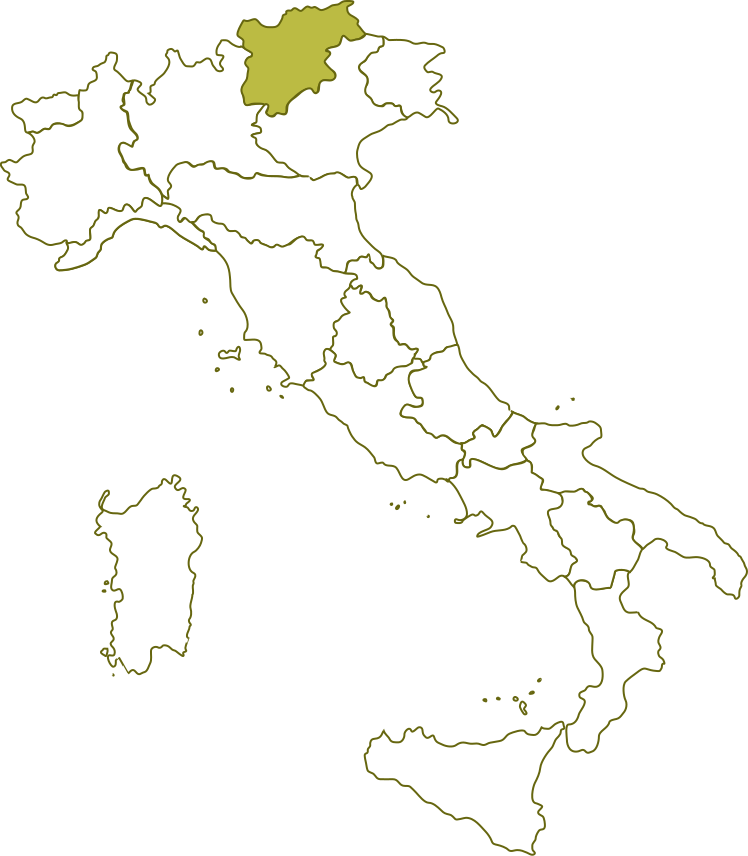
Facts
- Year of foundation: 1996
- Owners: Michael and Sophie Goëss-Enzenberg
- Oenologist: Helmuth Zozin
- Annual production: approx. 300,000 bottles
- Vineyard: approx. 50 hectares
- Bio-certified according to ABCert
- Biodynamic according to respect-BIODYN
- 24 Years of Expertise
- 3,500+ Wines in Stock
- 350+ Winemakers
- 28,000+ Positive Reviews
- Fully Air-Conditioned Storage