


-
!["Fuori Misura" Rosato Toscana IGT 2024 (BIO)]()
“Fuori Misura” Rosato Toscana IGT 2024 (BIO)
Dark salmon pink colour. Strong berry nose, fresh on the palate, with authentic Sangiovese fruit and the unmistakable character of this exceptional wine. A highly respectable, stylish rosato that tastes of pure Tuscany with its bright acidity and is an excellent accompaniment to Mediterranean dishes. SUPERIORE.DE
- Grape varieties: 93% Sangiovese, 5% Canaiolo, 2% Merlot
- Cultivation: biological
- Maturation: 5 months stainless steel
- Filtration: no
- Alcohol content: 13,50 % vol
- Serving temperature: 10‑12 °C
- Storage potential: 2028+
- Closure: Diam
- Total extract: 24,96 g/l
- Total acidity: 6,95 g/l
- Residual sugar: 1,02 g/l
- Sulfite: 87 mg/l
- pH value: 3,22
- Eco-Control-No.: IT‑BIO‑014
- Allergens
contains sulphites - Nutritional Information per 100 ml
- Energy in kcal: 89 kcal
- Energy in kJ: 374 kJ
- Carbohydrates: 1,30 g
stored air-conditioned0,75 l · 15,99 €/l · Price (DE) incl. VAT, excl. Shippingavailable immediately
!["Fuori Misura" Rosato Toscana IGT 2025 (BIO)]()
“Fuori Misura” Rosato Toscana IGT 2025 (BIO)
Fuori Misura – beyond all measure. The name is no mere flourish. It is a description. This Rosato is not made in the same way as other rosés. It is not a by-product, nor the result of a separate decision. It is a saignée – a bleeding – from the very same fermentation vats in which the Chianti Classico, the Riserva Le Baròncole and the Percarlo are being produced at the same time. The must is drawn off 12 to 24 hours after crushing. To this are added 10% freshly pressed grapes, which macerate for up to 12 days. Sangiovese, Canaiolo – the very soul of the estate, seen in a different light.
- Grape varieties: 93% Sangiovese, 5% Canaiolo, 2% Merlot
- Cultivation: biological
- Maturation: 5 months stainless steel
- Filtration: no
- Alcohol content: 14,00 % vol
- Serving temperature: 10‑12 °C
- Storage potential: 2029+
- Closure: Diam
- Food recommendations
tonno alla livornese, roasted poultry, salumi toscani, medium‑aged pecorino, antipasti misti - Total extract: 26,25 g/l
- Total acidity: 6,58 g/l
- Residual sugar: 1,15 g/l
- Sulfite: 85 mg/l
- pH value: 3,31
- Eco-Control-No.: IT‑BIO‑014
- Allergens
contains sulphites - Nutritional Information per 100 ml
- Energy in kcal: 82 kcal
- Energy in kJ: 345 kJ
- Carbohydrates: 1,20 g
stored air-conditioned0,75 l · 17,20 €/l · Price (DE) incl. VAT, excl. Shippingavailable immediately
![Chianti Classico DOCG 2023 (BIO)]()
Chianti Classico DOCG 2023 (BIO)
Multi-layered aroma, lots of dark cherry fruit, delicate herbal spice and cedar flavours. Juicy dark wild cherries on the palate, ripe, perfectly integrated tannins, elegant and delicate, fine mineral spice, surprisingly full-bodied and animating. A representative of the appellation that opens up beautifully and hits the right notes, like something out of a picture book! SUPERIORE.DE
- Grape varieties: 95% Sangiovese, 5% Canaiolo
- Cultivation: biological
- Maturation: 10 months tonneau/barrique
- Filtration: no
- Alcohol content: 14,00 % vol
- Serving temperature: 16‑18 °C
- Storage potential: 2033+
- Closure: natural cork
- Total extract: 29,92 g/l
- Total acidity: 5,95 g/l
- Residual sugar: 0,87 g/l
- Sulfite: 75 mg/l
- pH value: 3,33
- Eco-Control-No.: IT‑BIO‑014
- Allergens
contains sulphites - Nutritional Information per 100 ml
- Energy in kcal: 84 kcal
- Energy in kJ: 353 kJ
- Carbohydrates: 1,20 g
![Chianti Classico DOCG 2024 (BIO)]()
Chianti Classico DOCG 2024 (BIO)
San Giusto a Rentennano – the name is of Etruscan origin and embodies centuries of history. This medieval estate lies in the southernmost corner of Chianti Classico, where the region meets the upper reaches of the Arbia and the hills become more remote, quieter and rougher. A Cistercian monastery – San Giusto alle Monache – once stood here. In 1204, the Florentines fortified the area as a border outpost against Siena. The underground vaults from that period now serve as the storage cellars for Martini di Cigala. The family has owned the estate since 1914. Luca, Francesco and Elisabetta now run it guided by the conviction that has defined the estate since the early 1980s: Sangiovese needs no shortcuts. It needs low yields, fully ripe harvestand time. Organically farmed since 2006, with green pruning in July and August reducing yields by 30 to 50 per cent. 95% Sangiovese, 5% Canaiolo, harvested by hand.
- Grape varieties: 95% Sangiovese, 5% Canaiolo
- Cultivation: biological
- Maturation: 10‑12 months tonneau/barrique
- Filtration: no
- Alcohol content: 13,50 % vol
- Serving temperature: 18‑20 °C
- Storage potential: 2034+
- Closure: natural cork
- Food recommendations
bistecca alla fiorentina, pappardelle al cinghiale, scottiglia, matured pecorino toscano - Total extract: 29,87 g/l
- Total acidity: 5,89 g/l
- Residual sugar: 0,85 g/l
- Sulfite: 74 mg/l
- pH value: 3,35
- Eco-Control-No.: IT‑BIO‑014
- Allergens
contains sulphites - Nutritional Information per 100 ml
- Energy in kcal: 83 kcal
- Energy in kJ: 345 kJ
- Carbohydrates: 1,20 g
stored air-conditioned0,75 l · 28,00 €/l · Price (DE) incl. VAT, excl. Shippingavailable immediately
![Olio Extra Vergine di Oliva 2025 (BIO)]()
Olio Extra Vergine di Oliva 2025 (BIO)
San Giusto a Rentennano | Tuscany
The eleven hectares of olive groves at San Giusto a Rentennano are located in the middle of the same hills that give the estate's wines their identity. Organically cultivated, harvested by hand – the same care that the estate has applied to its wines for decades is applied here to the olives. The result: an extra virgin with a clear character. Freshly pressed, unfiltered in the style of the house – intense, with the bite of an early harvested Tuscan olive and a grassy freshness that reveals its origins.
- Cultivation: biological
- Filtration: no
- Closure: twist lock
- Food recommendations
bruschetta, crostini al fegatini, ribollita, panzanella, with pasta - Ingredients list
80% Frantoio, 10% Leccino, 7% Moraiolo, 3% Pendolino - Note
Please protect from light and heat. - Nutritional Information per 100 ml
- Energy in kcal: 828 kcal
- Energy in kJ: 3404 kJ
- Fat: 92,00 g
- Of which saturated fat : 15,00 g
- Carbohydrates: 0 g
- Of which sugar: 0 g
- Proteins: 0 g
- Salt: 0 g
- Best Before: 12/2027
- Eco-Control-No.: IT‑BIO‑014
stored air-conditioned0,75 l · 38,67 €/l · Price (DE) incl. VAT, excl. Shippingavailable immediately
!["Le Baròncole" Chianti Classico Riserva DOCG 2022 (BIO)]()
“Le Baròncole” Chianti Classico Riserva DOCG 2022 (BIO)
Le Baròncole Riserva captivates right from the nose with its juicy fruit and stone fruit aromas, and carries this lovely impression through to the palate. Cherries, sour cherries and blackberries – very juicy and powerful on the palate – fill the mouth completely, whilst remaining lively and elegant throughout. Silky, fine-grained tannins and a long, balsamic finish leave you longing for the next glass. A fine wine. Good ageing potential. SUPERIORE.DE
- Grape varieties: 97% Sangiovese, 3% Canaiolo
- Cultivation: biological
- Maturation: 20 months tonneau/barrique
- Filtration: no
- Alcohol content: 14,50 % vol
- Serving temperature: 16‑18 °C
- Storage potential: 2038+
- Closure: natural cork
- Total extract: 30,81 g/l
- Total acidity: 5,89 g/l
- Residual sugar: < 1,00 g/l
- Sulfite: 79 mg/l
- pH value: 3,34
- Eco-Control-No.: IT‑BIO‑014
- Allergens
contains sulphites - Nutritional Information per 100 ml
- Energy in kcal: 89 kcal
- Energy in kJ: 374 kJ
- Carbohydrates: 1,30 g
stored air-conditioned0,75 l · 52,00 €/l · Price (DE) incl. VAT, excl. Shippingavailable immediately
Limitation of 6 articles per customer!["Le Baròncole" Chianti Classico Riserva DOCG 2023 (BIO)]()
“Le Baròncole” Chianti Classico Riserva DOCG 2023 (BIO)
Le Baròncole – the little manors. The name refers to the feudal division of this land in the Middle Ages, to landowners who were small enough to be forgotten, but large enough to leave their mark on the landscape. Today, Le Baròncole is the name of the finest Chianti Classico from San Giusto a Rentennano – a Riserva produced only in years when the terroir warrants it. The estate overlooks the upper Arbia Valley at an altitude of 270 metres. The soils are diverse – sand, clay, limestone and mineral-rich deposits – and characterised by a microclimate that experiences marked temperature fluctuations between day and night. In such locations, Sangiovese ripens differently to elsewhere: more slowly, with greater tension, and with a freshness not found in the Maremma or the lower Chianti region. 97% Sangiovese, 3% Canaiolo, hand-harvested in September when the Martini di Cigalas grapes are at their best. Aged for 16 to 20 months in large oak casks and French barriques, depending on the vintage, followed by a further six months' bottle ageing.
- Grape varieties: 97% Sangiovese, 3% Canaiolo
- Cultivation: biological
- Maturation: 16‑20 months tonneau/barrique
- Filtration: no
- Alcohol content: 14,50 % vol
- Serving temperature: 18‑20 °C
- Storage potential: 2039+
- Closure: natural cork
- Food recommendations
piccione arrosto, cinghiale in umido, tagliata di chianina, tartufo nero su pasta - Total extract: 30,19 g/l
- Total acidity: 5,92 g/l
- Residual sugar: < 1,00 g/l
- Sulfite: 78 mg/l
- pH value: 3,33
- Eco-Control-No.: IT‑BIO‑014
- Allergens
contains sulphites - Nutritional Information per 100 ml
- Energy in kcal: 89 kcal
- Energy in kJ: 373 kJ
- Carbohydrates: 1,30 g
stored air-conditioned0,75 l · 52,00 €/l · Price (DE) incl. VAT, excl. Shippingavailable immediately
![Chianti Classico DOCG 2024 (BIO) <br>MAGNUM]()
Chianti Classico DOCG 2024 (BIO) · MAGNUM
San Giusto a Rentennano – the name is of Etruscan origin, and it embodies the passage of centuries. This medieval estate lies in the southernmost corner of Chianti Classico, where the region meets the upper reaches of the Arbia and the hills become more remote, quieter and rougher. A Cistercian monastery – San Giusto alle Monache – once stood here. In 1204, the Florentines fortified the site as a border outpost against Siena. The underground vaults dating from that period now serve as the cellars of Martini di Cigala. The family has owned the estate since 1914. Luca, Francesco and Elisabetta now run it guided by the conviction that has defined the estate since the early 1980s: Sangiovese needs no shortcuts. It requires low yields, fully ripe harvestand time. Organically farmed since 2006, with green pruning in July and August reducing yields by 30 to 50 per cent. 95% Sangiovese, 5% Canaiolo, harvested by hand.
- Grape varieties: 95% Sangiovese, 5% Canaiolo
- Cultivation: biological
- Maturation: 10‑12 months tonneau/barrique
- Filtration: no
- Alcohol content: 13,50 % vol
- Serving temperature: 18‑20 °C
- Storage potential: 2036+
- Closure: natural cork
- Food recommendations
bistecca alla fiorentina, pappardelle al cinghiale, scottiglia, matured pecorino toscano - Total extract: 29,87 g/l
- Total acidity: 5,89 g/l
- Residual sugar: 0,85 g/l
- Sulfite: 74 mg/l
- pH value: 3,35
- Eco-Control-No.: IT‑BIO‑014
- Allergens
contains sulphites - Nutritional Information per 100 ml
- Energy in kcal: 83 kcal
- Energy in kJ: 345 kJ
- Carbohydrates: 1,20 g
!["VinSanGiusto" Passito Bianco Toscana IGT 2018 (BIO) dolce <br>in gift box]()
“VinSanGiusto” Passito Bianco Toscana IGT 2018 (BIO) dolce · in gift box
There are wines that you count – by points, by vintages and, every now and then, by price. And then there's VinSanGiusto. That one is counted and judged by rare experiences. Malvasia and Trebbiano are harvested by hand once the grapes have reached the desired level of ripeness. Then comes the most unusual part: the grapes are dried on racks in well-ventilated rooms. Not just a few weeks – around 140 days. For almost five months, they lose water, concentrating their sugars, acids and aromas. Then they are pressed. What follows is a true anachronism in the best sense of the word. The must is transferred to small chestnut barrels – 40 to 180 Liters – and stored in attics, where it is exposed to seasonal temperature fluctuations. Summer and winter, heat and cold, year after year. Six years. During this time, it ferments and develops slowly, without any intervention. 40% of the liquid evaporates, which also explains its extraordinary concentration. No rush, no control, no shortcuts. Then comes filtration: drop by drop through Dutch cloth. Then 18 months in the bottle. And not a single gram of added sulphur.
- Grape varieties: 92% Malvasia, 8% Trebbiano
- Cultivation: biological
- Maturation: > 6 years 60/90/120l wooden barrel
- Filtration: yes
- Alcohol content: 10,00 % vol
- Serving temperature: 14‑16 °C
- Storage potential: 2046+
- Closure: natural cork
- Food recommendations
gorgonzola dop, matured parmigiano reggiano, dried figs - Total extract: 61,22 g/l
- Total acidity: 6,66 g/l
- Residual sugar: 420,00 g/l
- Sulfite: 142 mg/l
- pH value: 3,59
- Eco-Control-No.: IT‑BIO‑014
- Allergens
contains sulphites - Nutritional Information per 100 ml
- Energy in kcal: 246 kcal
- Energy in kJ: 1030 kJ
- Carbohydrates: 50,00 g
- Of which sugar: 45,00 g
stored air-conditioned0,375 l · 157,33 €/l · Price (DE) incl. VAT, excl. Shippingavailable immediately
Limitation of 2 articles per customer!["Percarlo" Sangiovese di Toscana IGT 2022 (BIO)]()
“Percarlo” Sangiovese di Toscana IGT 2022 (BIO)
1983 was the first year. Luca Martini di Cigala, who was at that time in the process of taking over an estate that was still selling its wine in bulk to Antinori and Ruffino, decided to do the opposite of what many of his contemporaries were doing: no international grape varieties, no modernisation of the label, no barriques full of vanilla. A single wine, from a single vineyard, made from a single grape variety. Sangiovese. San Giusto a Rentennano. – Percarlo made its debut with the 1983 vintage – and immediately began to rewrite the history of Chianti Classico. The wine's philosophy is that of its maker: the vineyard comes before the cellar. The grapes for Percarlo are not selected by plot; instead, every bunch of grapes is examined, every vine, every site. The yield is one kilogram per vine. This has been the approach since 2001, because Martini di Cigala recognised how inconsistent Sangiovese can be from vine to vine, even within the same plot. The soils that give Percarlo its character date predominantly from the Pliocene – layers of sand and stones, two to five metres deep, resting on a bed of clay and earth. Mineral-rich, well-drained, with the ability to influence the Sangiovese over the years.
- Grape variety: 100% Sangiovese
- Cultivation: biological
- Maturation: 20‑22 months tonneau/barrique
- Filtration: no
- Alcohol content: 15,00 % vol
- Serving temperature: 18‑20 °C
- Storage potential: 2044+
- Closure: natural cork
- Food recommendations
fassona beef, tuscan‑style rabbit, black truffle on pici, mature pecorino from pienza - Total extract: 30,87 g/l
- Total acidity: 5,99 g/l
- Residual sugar: 1,15 g/l
- Sulfite: 75 mg/l
- pH value: 3,35
- Eco-Control-No.: IT‑BIO‑014
- Allergens
contains sulphites
stored air-conditioned0,75 l · 126,67 €/l · Price (DE) incl. VAT, excl. Shippingavailable immediately
Limitation of 4 articles per customer!["Percarlo" Sangiovese di Toscana IGT 2021 (BIO)]()
“Percarlo” Sangiovese di Toscana IGT 2021 (BIO)
Sangiovese in purezza. Wonderfully spicy aroma, dark forest berries and cherries, some graphite and cedar wood. Silky elegance on the palate, juicy, dark berries, paired with an animating interplay of fruit and acidity that really lets the wine dance across the tongue. Percarlo has depth and length as well as potential for many years in the cellar. One of the great single-varietal Sangiovese wines of central Tuscany. SUPERIORE.DE
- Grape variety: 100% Sangiovese
- Cultivation: biological
- Maturation: 22 months tonneau/barrique
- Filtration: no
- Alcohol content: 15,00 % vol
- Serving temperature: 18‑20 °C
- Storage potential: 2043+
- Closure: natural cork
- Total extract: 31,29 g/l
- Total acidity: 6,03 g/l
- Residual sugar: 1,12 g/l
- Sulfite: 73 mg/l
- pH value: 3,37
- Eco-Control-No.: IT‑BIO‑014
- Allergens
contains sulphites
stored air-conditioned0,75 l · 132,00 €/l · Price (DE) incl. VAT, excl. Shippingavailable immediately
Limitation of 4 articles per customer!["La Ricolma" Merlot di Toscana IGT 2022 (BIO)]()
“La Ricolma” Merlot di Toscana IGT 2022 (BIO)
One of Italy's finest Merlots: its inviting bouquet is almost reminiscent of a Burgundy, with notes of raspberries and, as the wine opens up, the typical black forest berries and a delicate peppery spice. On the palate, too, there is a generous variety of flavours, combining power and depth with finesse and elegance. Not at all coarse, but harmonious, beautifully rounded by ripe, silky tannins and very long on the finish. A true rarity – not least because only around 5,000 bottles were produced, meaning it is virtually impossible to come across it for a tasting. SUPERIORE.DE
- Grape variety: 100% Merlot
- Cultivation: biological
- Maturation: 22 months 225l wooden barrel
- Filtration: no
- Alcohol content: 14,50 % vol
- Serving temperature: 18‑20 °C
- Storage potential: 2041+
- Closure: natural cork
- Total extract: 32,61 g/l
- Total acidity: 6,11 g/l
- Residual sugar: < 1,00 g/l
- Sulfite: 77 mg/l
- pH value: 3,34
- Eco-Control-No.: IT‑BIO‑014
- Allergens
contains sulphites - Nutritional Information per 100 ml
- Energy in kcal: 89 kcal
- Energy in kJ: 374 kJ
- Carbohydrates: 1,30 g
stored air-conditioned0,75 l · 185,33 €/l · Price (DE) incl. VAT, excl. Shipping6 units available
Limitation of 2 articles per customer!["Percarlo" Sangiovese di Toscana IGT 2022 (BIO) <br>MAGNUM in OWC]()
“Percarlo” Sangiovese di Toscana IGT 2022 (BIO) · MAGNUM in OWC
1983 was the first year. Luca Martini di Cigala, who was in the process of taking over an estate that was still selling its wine in bulk to Antinori and Ruffino, decided to do the opposite of what many of his contemporaries were doing: no international grape varieties, no modernisation of the label, no barriques full of vanilla. A single wine, from a single vineyard, from a single grape variety. Sangiovese. San Giusto a Rentennano. – Percarlo made its debut with the 1983 vintage – and immediately began to rewrite the history of Chianti Classico. The wine's philosophy is that of its maker: the vineyard comes before the cellar. The grapes for Percarlo are not selected by plot; instead, every bunch of grapes is inspected, every vine, every plot. The yield is one kilogram per vine. This has been the approach since 2001, because Martini di Cigala realised just how inconsistent Sangiovese can be from vine to vine, even within the same plot. The soils that give Percarlo its character date predominantly from the Pliocene – layers of sand and stones, two to five metres deep, resting on a bed of clay. Mineral-rich, well-drained, with the ability to influence the Sangiovese over the years.
- Grape variety: 100% Sangiovese
- Cultivation: biological
- Maturation: 20‑22 months tonneau/barrique
- Filtration: no
- Alcohol content: 15,00 % vol
- Serving temperature: 18‑20 °C
- Storage potential: 2046+
- Closure: natural cork
- Food recommendations
fassona beef, tuscan‑style rabbit, black truffle on pici, mature pecorino from pienza - Total extract: 30,87 g/l
- Total acidity: 5,99 g/l
- Residual sugar: 1,15 g/l
- Sulfite: 75 mg/l
- pH value: 3,35
- Eco-Control-No.: IT‑BIO‑014
- Allergens
contains sulphites
stored air-conditioned1,5 l · 132,67 €/l · Price (DE) incl. VAT, excl. Shipping8 units available
Limitation of 1 articles per customer!["Percarlo" Sangiovese di Toscana IGT 2022 (BIO) <br>Double MAGNUM in OWC]()
“Percarlo” Sangiovese di Toscana IGT 2022 (BIO) · Double MAGNUM in OWC
1983 was the first year. Luca Martini di Cigala, who was at that time in the process of taking over an estate that was still selling its wine in bulk to Antinori and Ruffino, decided to do the opposite of what many of his contemporaries were doing: no international grape varieties, no modernisation of the label, no barriques full of vanilla. A single wine, from a single vineyard, made from a single grape variety. Sangiovese. San Giusto a Rentennano. – Percarlo made its debut with the 1983 vintage – and immediately began to rewrite the history of Chianti Classico. The wine's philosophy is that of its maker: the vineyard comes before the cellar. The grapes for Percarlo are not selected by plot; instead, every bunch of grapes is inspected, every vine, every site. The yield is one kilogram per vine. This has been the approach since 2001, because Martini di Cigala realised how inconsistent Sangiovese can be from vine to vine, even within the same plot. The soils that characterise the Percarlo date predominantly from the Pliocene – layers of sand and stones, two to five metres deep, resting on a bed of clay. Mineral-rich, well-drained, with the ability to influence the Sangiovese over the years.
- Grape variety: 100% Sangiovese
- Cultivation: biological
- Maturation: 20‑22 months tonneau/barrique
- Filtration: no
- Alcohol content: 15,00 % vol
- Serving temperature: 18‑20 °C
- Storage potential: 2048+
- Closure: natural cork
- Food recommendations
fassona beef, tuscan‑style rabbit, black truffle on pici, mature pecorino from pienza - Total extract: 30,87 g/l
- Total acidity: 5,99 g/l
- Residual sugar: 1,15 g/l
- Sulfite: 75 mg/l
- pH value: 3,35
- Eco-Control-No.: IT‑BIO‑014
- Allergens
contains sulphites
stored air-conditioned3 l · 133,00 €/l · Price (DE) incl. VAT, excl. Shipping2 units available
Limitation of 1 articles per customer!["Percarlo" Sangiovese di Toscana IGT 2022 (BIO) <br>JEROBOAM 5 liters in OWC]()
“Percarlo” Sangiovese di Toscana IGT 2022 (BIO) · JEROBOAM 5 liters in OWC
1983 was the first year. Luca Martini di Cigala, who was at the time in the process of taking over an estate that was still selling its wine in bulk to Antinori and Ruffino, decided to do the opposite of what many of his contemporaries were doing: no international grape varieties, no modernisation of the label, no barriques full of vanilla. A single wine, from a single vineyard, made from a single grape variety. Sangiovese. San Giusto a Rentennano. – Percarlo made its debut with the 1983 vintage – and immediately began to rewrite the history of Chianti Classico. The wine's philosophy is that of its maker: the vineyard comes before the cellar. The grapes for Percarlo are not selected by plot; instead, every bunch of grapes is examined, every vine, every site. The yield is one kilogram per vine. This has been the approach since 2001, because Martini di Cigala recognised how inconsistent Sangiovese can be from vine to vine, even within the same plot. The soils that give Percarlo its character date predominantly from the Pliocene – layers of sand and stones, two to five metres deep, resting on a bed of clay. Mineral-rich, well-drained, with the ability to influence the Sangiovese over the years.
- Grape variety: 100% Sangiovese
- Cultivation: biological
- Maturation: 20‑22 months tonneau/barrique
- Filtration: no
- Alcohol content: 15,00 % vol
- Serving temperature: 18‑20 °C
- Storage potential: 2050+
- Closure: natural cork
- Food recommendations
fassona beef, tuscan‑style rabbit, black truffle on pici, mature pecorino from pienza - Total extract: 30,87 g/l
- Total acidity: 5,99 g/l
- Residual sugar: 1,15 g/l
- Sulfite: 75 mg/l
- pH value: 3,35
- Eco-Control-No.: IT‑BIO‑014
- Allergens
contains sulphites
stored air-conditioned5 l · 139,80 €/l · Price (DE) incl. VAT, excl. Shipping2 units available
Limitation of 1 articles per customer


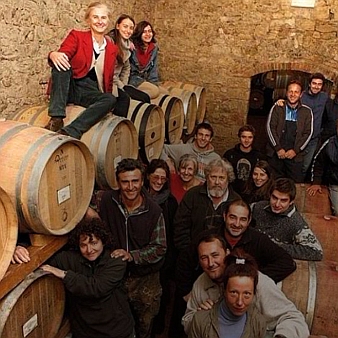
The history of this exceptional vineyard is extraordinary even in Tuscany, which is now truly not poor in history. The name San Giusto a Rentennano testifies to its Etruscan origin. The oldest part of the splendid property was a monastery in the Middle Ages, first mentioned in 1204, later converted into a fortress whose towers and battlements still dominate the hills of southern Tuscany near Gaiole in Chianti.
In 1957 Enrico Martini di Cigala inherited the farm and concentrated on wine and olive growing. Since 1992 six of his nine children have shared the work: Elisabetta, Francesco and Luca Martini di Cigala manage the 31 hectares of wine and 11 hectares of olives from a total of 160 hectares of land, including forests, fields and abundant natural land. Since 2001 the farm has been gradually converted to organic farming, first the olive groves, then the vineyards - and since 2006 all the land on the estate has been certified. Organic farming is lived here. Power generation from solar energy, own composting, consistent waste avoidance and recyclable packaging. Simply exemplary.
The hills around Gaiole are among the most exciting growing areas in Tuscany because nowhere else are the geological conditions so varied. Every few hundred meters the underground changes, every few meters into the depth the vines root in different formations. From sand, loess and clay to volcanic rock formations, from calcareous soils to rocky rocks with argillites and calcium. Here one can actually speak of minerality. In addition, there is the unique, cooler micro-climate on the vineyards up to 300m above sea level, which are partly surrounded by forest and protected. During the day Mediterranean, warm breezes blow up from the nearby Tyrrhenian Sea, in the nights it cools down strongly by the wooded mountains. This interplay helps enormously to achieve the juicy fruit and a delicate and elegant structure of the wines.
Since 1999 the oenologist Attilio Pagli has determined the style of the wines, supported in the cellar by the fabulous Anita Anichini and in the vineyards by the agronomist Ruggero Mazzili. Quality is rigorously observed in the vineyards, at least one third thinned out and harvested relatively late so that only physiologically fully ripe grapes are harvested. The batches from the individual layers are carefully fermented separately in the cellar only with our own yeasts spontaneously. And although the lion's share of the red wines is Sangiovese (sometimes with a mini-portion of max. 5% Canaiolo), here is never pepped up with international varieties, and yet the wines are completely different.
Already the "normal" Chianti Classico differs from almost all others by its elegance. The Chianti Classico Riserva "Le Baròncole" is captivating with its fruit and depth and the already legendary "percarlo"A selection of the oldest vineyards with calcareous soils dating back to the Pliocene, the Sangiovese Sangiovese has been one of the best pure varieties in Italy for several decades.
Beside the dominating Sangiovese there are still small vineyards, which were planted with Merlot. The Merlot di Toscana IGT is made from these single vineyard grapes. "La Ricolma"who can easily compete with most Supertuscans. In a few vineyards, Malvasia and a little Trebbiano are cultivated, from which the rare sweet wine, which is sold out much too quickly every year, is made. "VinSanGiusto" is pressed. The grapes are dried for about 140 days before maturing in tiny chestnut barrels (40-180 l) for six (!) years. Almost 40% of the quantity escapes. This results in this incomparable concentration.
This unique style of the wines is reflected in the numerous international and Italian awards. And since there is hardly any well-known Italian restaurant that does not have the wines of San Giusto a Rentennano on the menu, there are unfortunately only very few bottles for the export. These small quantities are therefore always sold out quickly. SUPERIORE.DE

Facts
- Year founded: 1914
- Owner: Family Martini di Cigala
- Oenologist: Attilio Pagli and Anita Anichini
- Agronomist: Ruggero Mazzili
- Annual production: approx. 80,000 bottles
- Vineyard: approx. 31 hectares
- Organic cultivation certified QC & I
- 24 Years of Expertise
- 3,500+ Wines in Stock
- 350+ Winemakers
- 28,000+ Positive Reviews
- Fully Air-Conditioned Storage