


-
![Brunello di Montalcino DOCG 2021]()
Brunello di Montalcino DOCG 2021
In 1970, Caparzo produced its first Brunello, at a time when there were just thirteen wineries in Montalcino – one of the appellation's historic estates. What continues to set Caparzo's Brunello apart to this day is the provenance of its Sangiovese grapes: The estate is one of the few in Montalcino to own vineyards spread across various geographical zones throughout the entire appellation. Rather than drawing from a single terroir, this Brunello combines the microclimates of four vineyards into a complex whole: "Caparzo" itself in the north at 220 metres, sandy-clay Pliocene sediments; "La Caduta" in the south-west at 300 metres, loose, stony sandstone-schist; "Il Cassero" in the south at 270 metres, Pliocene sediments with a sandy, stony and schistose matrix; and "San Piero-Caselle" in the east at 250 metres, sandy-clayey.
- Grape variety: 100% Sangiovese
- Maturation: 24 months allier barrel
- Filtration: yes
- Alcohol content: 14,00 % vol
- Serving temperature: 18‑20 °C
- Storage potential: 2042+
- Closure: natural cork
- Food recommendations
roasts and grilled dishes on skewers, game, braised meat, matured cheese - Total extract: 30,15 g/l
- Total acidity: 5,92 g/l
- Residual sugar: 0,96 g/l
- Sulfite: 80 mg/l
- pH value: 3,44
- Allergens
contains sulphites
stored air-conditioned0,75 l · 38,67 €/l · Price (DE) incl. VAT, excl. Shippingavailable immediately
![Brunello di Montalcino DOCG 2021 (BIO)]()
Brunello di Montalcino DOCG 2021 (BIO)
The Ghezzi family has been cultivating the extensive estate on the south-western slope of Montalcino since 1957 – 530 hectares in total, 50 of which are planted with Sangiovese Grosso alone, on clayey-limestone soils with silt and fossil inclusions. A Brunello that combines the power of the south with the elegance of careful clonal selection comes from this sunny, warm location on the Ombrone. 20 to 30 days of maceration, fermentation at 26–28 °C, followed by 24 months in oak barrels and a full year of ageing in the bottle. The 2021 vintage is considered a classic great Annata: late frost in April noticeably reduced the yields, a warm but never overheated summer and two saving August rains brought the grapes to full, slow phenolic ripeness.
- Grape variety: 100% Sangiovese
- Cultivation: biological
- Maturation: 24 months in oak barrels
- Filtration: yes
- Alcohol content: 14,50 % vol
- Serving temperature: 18‑20 °C
- Storage potential: 2041+
- Closure: natural cork
- Total extract: 30,06 g/l
- Total acidity: 5,89 g/l
- Residual sugar: 0,69 g/l
- Sulfite: 71 mg/l
- pH value: 3,39
- Eco-Control-No.: IT‑BIO‑004
- Allergens
contains sulphites
stored air-conditioned0,75 l · 42,67 €/l · Price (DE) incl. VAT, excl. Shippingavailable immediately
![Brunello di Montalcino DOCG 2021]()
Brunello di Montalcino DOCG 2021
Montalcino is a hill. To be more precise: a single large cone of limestone, marl, slate and sand that rises above the Val d'Orcia – exposed to the north, south-east and south-west, characterised by three completely different climates. Most of the producers in the appellation have access to one of these slopes. Val di Suga has all three. Vigna del Lago in the north-west, Poggio al Granchio in the south-east, Vigna Spuntali in the south-west. Three soils, three microclimates, three characters – and a single winery that unites them all under one roof. The basic Brunello is the result of this unique position: a cuvée from all three sites that does not aim for simplification, but for synthesis. Fermentation takes eight to twelve days at a controlled temperature, with maceration lasting a further two to three weeks. Maturation in traditional 50-hectolitre Slavonian oak barrels for 24 months, followed by six months in concrete and then the bottle. The 2021 vintage brought a late frost in April – the harvest was reduced, the quality concentrated. A dry summer without extreme heat, a long, even autumn. The Consorzio and a jury of eight Masters of Wine agreed on three words to characterise the vintage: fragrant, precise, vertical.
- Grape variety: 100% Sangiovese
- Maturation: 24/6 months oak barrel/concrete tank
- Filtration: yes
- Alcohol content: 14,00 % vol
- Serving temperature: 18‑20 °C
- Storage potential: 2043+
- Closure: natural cork
- Food recommendations
braised beef cheeks with red wine reduction and celeriac puree - Total extract: 29,97 g/l
- Total acidity: 5,98 g/l
- Residual sugar: 0,78 g/l
- Sulfite: 48 mg/l
- pH value: 3,42
- Allergens
contains sulphites
stored air-conditioned0,75 l · 45,33 €/l · Price (DE) incl. VAT, excl. Shippingavailable immediately
![Brunello di Montalcino DOCG 2019 (BIO)]()
Brunello di Montalcino DOCG 2019 (BIO)
Poggio Landi comprises 75 hectares of vineyards, stretching from the historic vineyards in the north of Montalcino to the distinctive southern terraces. This expanse encompasses variations in soil, aspect and altitude – from 300 to 500 metres – providing the winemaker with a wealth of biodiversity that he utilises as if it were an instrument. The soils consist of Pliocene clays with marl, a geological composition that lends the Sangiovese structure and depth. 2019 played its part. A regular climate with no adverse conditions, a bountiful harvest of healthy, ripe grapes: what sounds so simple here is rare in Montalcino. Two weeks of spontaneous fermentation with indigenous yeasts, followed by 38 months in large French oak barrels of 30 and 54 hectolitres, and at least 6 months' bottle ageing.
- Grape variety: 100% Sangiovese
- Cultivation: biological
- Maturation: 38‑month‑old oak cask
- Filtration: yes
- Alcohol content: 14,00 % vol
- Serving temperature: 16‑18 °C
- Storage potential: 2038+
- Closure: natural cork
- Food recommendations
chianina steak, wild boar in sauce, pici with black truffle - Total extract: 29,95 g/l
- Total acidity: 5,82 g/l
- Residual sugar: 1,36 g/l
- Sulfite: 74 mg/l
- pH value: 3,42
- Eco-Control-No.: IT‑BIO‑006
- Allergens
contains sulphites
stored air-conditioned0,75 l · 49,33 €/l · Price (DE) incl. VAT, excl. Shippingavailable immediately
![Brunello di Montalcino DOCG 2021 (BIO)]()
Brunello di Montalcino DOCG 2021 (BIO)
Sometimes a great vintage needs a little scare first. In April 2021, the thermometer dropped to minus seven degrees in parts of Montalcino – late frost, which hit the more sensitive sites and reduced the harvest to around 15 per cent below the previous year. What was a loss for some farms proved to be a gift for quality. Fewer grapes, more concentration. The surviving vines seemed to know what was at stake. The rest of the year followed the textbook pattern of classic Brunello meteorology: regular spring, hot and dry summer – then two decisive rain events in the second half of August, which gave the vineyards water and the grapes their final aromatic complexity. The September nights cooled the Sant'Angelo vineyard in Colle to temperatures that distinguish phenolic ripeness from genuine elegance. Harvest did not start until mid to late September – patiently waited, fully redeemed.
- Grape variety: 100% Sangiovese
- Cultivation: biological
- Maturation: 36 months in oak barrels
- Vegan: yes
- Filtration: yes
- Alcohol content: 14,50 % vol
- Serving temperature: 18‑20 °C
- Storage potential: 2042+
- Closure: natural cork
- Total extract: 30,06 g/l
- Total acidity: 5,93 g/l
- Residual sugar: 1,32 g/l
- Sulfite: 85 mg/l
- pH value: 3,32
- Eco-Control-No.: IT‑BIO‑004
- Allergens
contains sulphites - Nutritional Information per 100 ml
- Energy in kcal: 89 kcal
- Energy in kJ: 372 kJ
- Carbohydrates: 2,90 g
stored air-conditioned0,75 l · 50,67 €/l · Price (DE) incl. VAT, excl. Shippingavailable immediately
![Brunello di Montalcino "Ugolforte" DOCG 2018 (BIO)]()
Brunello di Montalcino “Ugolforte” DOCG 2018 (BIO)
On the classic bouquet, ripe cherry, tobacco and some damp earth. On the palate, first the pure Sangiovese feeling: beautiful small red berries, wild cherry, lively acidity. Then an impenetrable mesh of red and black fruits, which together with a fine web of tannins and minerals reveal more and more of themselves. Compressed and with each sip more open and present, the beautifully diversified taste components present themselves until they then lead into an aristocratically long and fresh finish with a hint of liquorice. SUPERIORE.DE
- Grape variety: 100% Sangiovese
- Cultivation: biological
- Maturation: 30 months oak barrel
- Filtration: yes
- Alcohol content: 14,00 % vol
- Serving temperature: 18‑20 °C
- Storage potential: 2043+
- Closure: natural cork
- Total extract: 29,94 g/l
- Total acidity: 5,90 g/l
- Residual sugar: 1,28 g/l
- Sulfite: 90 mg/l
- pH value: 3,50
- Eco-Control-No.: IT‑BIO‑006
- Allergens
contains sulphites
stored air-conditioned0,75 l · 52,00 €/l · Price (DE) incl. VAT, excl. Shippingavailable immediately
![Brunello di Montalcino DOCG 2020 (BIO)]()
Brunello di Montalcino DOCG 2020 (BIO)
When we discovered this winery by chance at the beginning of the 2000s, we were immediately impressed by the modesty and purism of the Biliorsi winemaking family. This is still the case today, they remain true to themselves and their philosophy and in good years, they produce just 10,000 bottles of a "slightly different" Brunello in the cellar.
- Grape variety: 100% Sangiovese
- Cultivation: biological
- Maturation: wooden barrel
- Filtration: yes
- Alcohol content: 14,50 % vol
- Serving temperature: 18‑20 °C
- Storage potential: 2038+
- Closure: natural cork
- Total extract: 29,94 g/l
- Total acidity: 5,97 g/l
- Residual sugar: 0,86 g/l
- Sulfite: 81 mg/l
- pH value: 3,39
- Eco-Control-No.: IT‑BIO‑006
- Allergens
contains sulphites
stored air-conditioned0,75 l · 52,00 €/l · Price (DE) incl. VAT, excl. Shippingavailable immediately
![Brunello di Montalcino DOCG 2020 (BIO)]()
Brunello di Montalcino DOCG 2020 (BIO)
Pliocene clays retain moisture. In a dry, hot year like 2020, this is not merely an agricultural detail, but a survival strategy. The clay soils of Poggio Landi, situated 300 to 500 metres above Torrenieri, provided a natural buffer against the summer drought that put large parts of Montalcino under strain that year. The organically farmed vines, with their deeper, more active root systems, played their part. The result is a Brunello full of concentration and character. Herbal and spicy notes on the nose – wild herbs, fennel and oregano – followed by sweet cherry and tamarind. Two weeks of spontaneous fermentation, 38 months in large French oak barrels, and 6 months in bottle.
- Grape variety: 100% Sangiovese
- Cultivation: biological
- Maturation: 38‑month‑old oak cask
- Filtration: yes
- Alcohol content: 14,50 % vol
- Serving temperature: 16‑18 °C
- Storage potential: 2039+
- Closure: natural cork
- Food recommendations
grilled beef, game, pappardelle with wild boar sauce, braised beef in barolo - Total extract: 30,18 g/l
- Total acidity: 5,79 g/l
- Residual sugar: 1,31 g/l
- Sulfite: 76 mg/l
- pH value: 3,39
- Eco-Control-No.: IT‑BIO‑006
- Allergens
contains sulphites
![Brunello di Montalcino DOCG 2021 (BIO)]()
Brunello di Montalcino DOCG 2021 (BIO)
In April 2021, temperatures in Montalcino dropped below zero. The vines, which had already begun to bud, were hit by the frost. What followed was a season of recovery: a rainy spring gave the vines the strength they needed to withstand a long, hot summer. Significant temperature fluctuations between day and night preserved freshness and aromatic precision. The harvest: concentrated, fragrant, healthy. In Montalcino, 2021 is regarded as a classic, elegant vintage. Not the opulence of 2019, nor the concentration of 2020, but balance. 100% Sangiovese, organically grown, spontaneous fermentation, 38 months in large French oak barrels (30 and 54 hectolitres), at least 6 months in bottle.
- Grape variety: 100% Sangiovese
- Cultivation: biological
- Maturation: 38‑month‑old oak cask
- Filtration: yes
- Alcohol content: 14,00 % vol
- Serving temperature: 16‑18 °C
- Storage potential: 2040+
- Closure: natural cork
- Food recommendations
pici with wild boar ragù, chianina tagliata, black truffle, matured tuscan pecorino - Total extract: 29,99 g/l
- Total acidity: 5,91 g/l
- Residual sugar: 1,25 g/l
- Sulfite: 75 mg/l
- pH value: 3,36
- Eco-Control-No.: IT‑BIO‑006
- Allergens
contains sulphites - Nutritional Information per 100 ml
- Energy in kcal: 77 kcal
- Energy in kJ: 320 kJ
- Carbohydrates: 0,70 g
stored air-conditioned0,75 l · 54,67 €/l · Price (DE) incl. VAT, excl. Shippingavailable immediately
![Brunello di Montalcino DOCG 2020]()
Brunello di Montalcino DOCG 2020
The road to Sant'Angelo in Colle leads to the south-west side of the Montalcino hill. Here lies the Tenuta Il Poggione – one of the oldest and most reliable houses in the appellation. Lavinio Franceschi, a Florentine landowner, bought the estate at the end of the 19th century after, it is said, hearing about the beauty of these hills from a shepherd. He was one of the first to market Brunello under this name and one of the founders of the consortium. Today, the fourth generation – leopoldo and Livia Franceschi – run the estate with 140 hectares of vines, the oldest vines up to 60 years old and a philosophy that has not fundamentally changed in a century.
- Grape variety: 100% Sangiovese
- Maturation: 30 months large wooden barrel
- Filtration: no
- Alcohol content: 14,50 % vol
- Serving temperature: 18‑20 °C
- Storage potential: 2046+
- Closure: natural cork
- Food recommendations
bistecca di chianina, pappardelle al ragù di cinghiale, matured pecorino di pienza - Total extract: 30,55 g/l
- Total acidity: 5,94 g/l
- Residual sugar: 0,65 g/l
- Sulfite: 76 mg/l
- pH value: 3,41
- Allergens
contains sulphites
stored air-conditioned0,75 l · 56,00 €/l · Price (DE) incl. VAT, excl. Shippingavailable immediately
![Brunello di Montalcino "Ugolforte" DOCG 2020 (BIO)]()
Brunello di Montalcino “Ugolforte” DOCG 2020 (BIO)
In the 12th century, a man named Ugolforte led the rebellion of the citizens of Montalcino against the superior power of Siena. A bandit for some, a freedom fighter for others – his name has survived the centuries in the stories told in the hills. Today it is on the label of a Brunello that carries this indomitable spirit. Tenuta San Giorgio is located in Castelnuovo dell'Abate, in the south-east of Montalcino, just a few kilometres from the thousand-year-old Abbey of Sant'Antimo. Founded in 1982 – in the same year that Grattamacco bottled its first vintage – the winery joined the ColleMassari group of the Tipa-Bertarelli family in 2016. Since then, it has shared the terroir with the legendary Poggio di Sotto: the same slopes, the same winds, the same philosophy. 28 hectares of Sangiovese on south-eastern slopes between 300 and 450 metres, embedded in 110 hectares of forest, which protects biodiversity and shapes the microclimate. The soils read like a geological poem: clay, galestro, tuff, red earth, white biancane, the proud Calanchi – and Monte Amiata, the extinct volcano, watches over everything.
- Grape variety: 100% Sangiovese
- Cultivation: biological
- Maturation: 30 months oak barrel
- Filtration: yes
- Alcohol content: 13,50 % vol
- Serving temperature: 18‑20 °C
- Storage potential: 2045+
- Closure: natural cork
- Total extract: 29,97 g/l
- Total acidity: 5,93 g/l
- Residual sugar: 1,16 g/l
- Sulfite: 85 mg/l
- pH value: 3,45
- Eco-Control-No.: IT‑BIO‑006
- Allergens
contains sulphites
stored air-conditioned0,75 l · 57,33 €/l · Price (DE) incl. VAT, excl. Shippingavailable immediately
![Brunello di Montalcino DOCG 2020]()
Brunello di Montalcino DOCG 2020
Fanti's Brunello di Montalcino 2020 is delicately flavoured, haunting floral and seductive from the first swirl of the glass. A hint of icing sugar gives way to bright cherries, candied oranges, mint leaves and lavender, creating an extrovert yet delicious picture. In the mouth, it is seamless and silky, with a subtle hint of citrus and vibrant acids introducing ripe red notes of black berries with herbs. Rounded tannins emerge on the finish with hints of liquorice and violets. As always, very well made. SUPERIORE.DE
- Grape variety: 100% Sangiovese
- Maturation: 28 months 50/50 barrique/large oak barrel
- Vegan: yes
- Filtration: yes
- Alcohol content: 15,00 % vol
- Serving temperature: 18‑20 °C
- Storage potential: 2039+
- Closure: natural cork
- Total extract: 30,76 g/l
- Total acidity: 5,20 g/l
- Residual sugar: 1,40 g/l
- Sulfite: 89 mg/l
- pH value: 3,34
- Allergens
contains sulphites
stored air-conditioned0,75 l · 57,33 €/l · Price (DE) incl. VAT, excl. Shippingavailable immediately
![Brunello di Montalcino "Ugolforte" DOCG 2021 (BIO)]()
Brunello di Montalcino “Ugolforte” DOCG 2021 (BIO)
Ugolforte was a resistance fighter. In the 12th century, he led the people of Montalcino against the Sienese occupying forces – a local hero whose name lives on to this day: in a Brunello. The most striking contradiction dates back to 2010. That was when Tenuta San Giorgio began officially supplying the Ugolforte to the Pontifical Swiss Guard – that 500-year-old corps which guards the Pope in the Vatican. The estate says that shared values, and the symbolism of St George himself – virtue and courage, good triumphing over evil – guided the decision. The wine of the medieval rebel in the service of Christendom's oldest army.
- Grape variety: 100% Sangiovese
- Cultivation: biological
- Maturation: 30 months oak barrel
- Filtration: yes
- Alcohol content: 14,00 % vol
- Serving temperature: 18‑20 °C
- Storage potential: 2046+
- Closure: natural cork
- Food recommendations
braised wild boar, roast lamb, chianina steak, pasta with truffles - Total extract: 30,02 g/l
- Total acidity: 5,89 g/l
- Residual sugar: 1,06 g/l
- Sulfite: 82 mg/l
- pH value: 3,41
- Eco-Control-No.: IT‑BIO‑006
- Allergens
contains sulphites
stored air-conditioned0,75 l · 57,33 €/l · Price (DE) incl. VAT, excl. Shippingavailable immediately
![Brunello di Montalcino DOCG 2021]()
Brunello di Montalcino DOCG 2021
In 1980, Filippo Fanti bottled his first Brunello. He had taken over the estate in the early 1970s, replanted the vineyards, studied the soil plot by plot – and then waited for the first harvest he deemed worthy. This first vintage was no trial run. It was a declaration of intent. Since then, Tenuta Fanti has not missed a single vintage. Castelnuovo dell'Abate is the southernmost sub-region of Montalcino – closer to the sea, warmer and more Mediterranean than the northern vineyards, watched over by the Abbey of Sant'Antimo, a silent witness to centuries of history. Fanti owns 10 hectares of Sangiovese here, spread across various hillside plots at altitudes between 350 and 430 metres above sea level. Slate, galestro, clay, tuff – the soils vary from plot to plot, giving the Brunello that complexity which has always characterised the estate. Elisa Fanti, who joined the team in 2007, has fine-tuned the style: less intrusive oak, clearer fruit, greater transparency. 2021 was a year of great harmony in Montalcino: consistent ripeness, pronounced structure, elegant tannins.
- Grape variety: 100% Sangiovese
- Maturation: 28 months 50/50 barrique/oakwood barrel
- Vegan: yes
- Filtration: yes
- Alcohol content: 15,50 % vol
- Serving temperature: 18‑20 °C
- Storage potential: 2042+
- Closure: natural cork
- Food recommendations
cinghiale in umido, bistecca alla fiorentina - Total extract: 30,59 g/l
- Total acidity: 5,78 g/l
- Residual sugar: 1,32 g/l
- Sulfite: 87 mg/l
- pH value: 3,36
- Allergens
contains sulphites - Nutritional Information per 100 ml
- Energy in kcal: 88 kcal
- Energy in kJ: 369 kJ
- Carbohydrates: 0,70 g
stored air-conditioned0,75 l · 58,67 €/l · Price (DE) incl. VAT, excl. Shippingavailable immediately
![Brunello di Montalcino DOCG 2021]()
Brunello di Montalcino DOCG 2021
Tenuta Il Poggione is situated on the south-western slope of the Montalcino hill, in Sant'Angelo in Colle – one of the most historically significant areas within the appellation. Lavinio Franceschi laid the foundations here at the end of the 19th century, as a founding member of the Brunello Consortium and one of the first to market this wine under its current name. Today, his descendants, Leopoldo and Livia, cultivate 140 hectares of vines, with vines up to 60 years old, and adhere to a winemaking philosophy characterised by classical rigour: natural yeasts, large French oak barrels, and time.
- Grape variety: 100% Sangiovese
- Maturation: 30 months large wooden barrel
- Filtration: no
- Alcohol content: 14,50 % vol
- Serving temperature: 18‑20 °C
- Storage potential: 2047+
- Closure: natural cork
- Food recommendations
piccione arrosto con salsa al tartufo, financiera toscana, matured castelmagno - Total extract: 30,39 g/l
- Total acidity: 6,01 g/l
- Residual sugar: 0,72 g/l
- Sulfite: 75 mg/l
- pH value: 3,38
- Allergens
contains sulphites
stored air-conditioned0,75 l · 60,00 €/l · Price (DE) incl. VAT, excl. Shippingavailable immediately
![Brunello di Montalcino DOCG 2021]()
Brunello di Montalcino DOCG 2021
In 1985, estate manager Giuseppe Bianchini inherited the estate from the childless Countess Elda Ciacci Piccolomini d'Aragona – a vote of confidence that is renewed every year. Today, his children Paolo and Lucia continue the legacy, 55 hectares in the privileged area of Castelnuovo dell'Abate, in the shadow of the Romanesque Abbey of Sant'Antimo. The 2021 vintage is considered one of the most brilliant of the last decade: bright September days and cool nights gave the Sangiovese that rare balance of aromatic precision and tannic finesse. 24 months in large Slavonian barrels, then further rest in the bottle.
- Grape variety: 100% Sangiovese
- Maturation: 24 months oak barrel
- Filtration: yes
- Alcohol content: 15,00 % vol
- Serving temperature: 18‑20 °C
- Storage potential: 2045+
- Closure: natural cork
- Total extract: 29,97 g/l
- Total acidity: 5,91 g/l
- Residual sugar: 1,19 g/l
- Sulfite: 84 mg/l
- pH value: 3,40
- Allergens
contains sulphites
stored air-conditioned0,75 l · 60,00 €/l · Price (DE) incl. VAT, excl. Shippingavailable immediately
![Brunello di Montalcino DOCG 2019]()
Brunello di Montalcino DOCG 2019
Piancornello's Brunello di Montalcino 2019 is initially elegantly restrained with rosy flowers, nuances of cherry and worn leather, contrasted by a hint of sour citrus fruit. It then impresses on the palate with a silky texture and cool radiance, while the lively acidity brings out ripe red berries and minerals. The finish is structured, very savoury with notes of plum and liquorice that linger incredibly long under a hint of violet-tinged flowers. A beautiful, taut and firm Brunello from an equally beautiful vintage. SUPERIORE.DE
- Grape variety: 100% Sangiovese
- Maturation: 24 months oak barrel
- Filtration: yes
- Alcohol content: 14,50 % vol
- Serving temperature: 18‑20 °C
- Storage potential: 2040+
- Closure: natural cork
- Total extract: 29,97 g/l
- Total acidity: 5,96 g/l
- Residual sugar: 0,95 g/l
- Sulfite: 72 mg/l
- pH value: 3,35
- Allergens
contains sulphites
stored air-conditioned0,75 l · 61,33 €/l · Price (DE) incl. VAT, excl. Shippingavailable immediately
![Brunello di Montalcino DOCG 2020]()
Brunello di Montalcino DOCG 2020
Dark and seductive with a blend of crushed plums, brown spices, cedar and a hint of cocoa. Its textures are like pure silk bordering on velvet, with a gentle blend of ripe cherries and redcurrants, underlined by salty minerals, while notes of citrus contrast towards the end. A web of fine tannin runs through the final, creating a gentle textural pull that balances balsamic herbs and a hint of mocha as blue and violet-coloured flowers slowly fade away. SUPERIORE.DE
- Grape variety: 100% Sangiovese
- Maturation: 24 months slav. oak barrel
- Filtration: yes
- Alcohol content: 14,50 % vol
- Serving temperature: 18‑20 °C
- Storage potential: 2044+
- Closure: natural cork
- Total extract: 29,97 g/l
- Total acidity: 6,02 g/l
- Residual sugar: 1,18 g/l
- Sulfite: 63 mg/l
- pH value: 3,42
- Allergens
contains sulphites
stored air-conditioned0,75 l · 61,33 €/l · Price (DE) incl. VAT, excl. Shippingavailable immediately
![Brunello di Montalcino "40° Vendemmia" DOCG 2021]()
Brunello di Montalcino “40° Vendemmia” DOCG 2021
Forty vintages. You have to let that melt in your mouth: When Pierluigi Talenti left the mountains of his native Romagna in the early 1950s and came to the hills of Montalcino, he not only found work at Sant'Angelo in Colle, but also his life's work. For over four decades, he shaped one of the appellation's most famous addresses as cellar master of Il Poggione – and is still considered one of the founding fathers of modern Brunello. He selected his own Sangiovese clones, set new quality standards and became a role model for an entire generation. In 1980, at the end of this era, he bought the Podere Pian di Conte – an old estate with a round tower overlooking the Orcia Valley – and began to press his own Brunello. Pierluigi died in 1999. Since then, grandson Riccardo has run the estate with the same tenacity, advised by Carlo Ferrini and supported by the knowledge that there is something special in these soils of sandy loam, clay and galestro.
- Grape variety: 100% Sangiovese
- Maturation: 24 months slav. oak barrel
- Filtration: yes
- Alcohol content: 14,50 % vol
- Serving temperature: 18‑20 °C
- Storage potential: 2045+
- Closure: natural cork
- Total extract: 29,93 g/l
- Total acidity: 5,94 g/l
- Residual sugar: 1,14 g/l
- Sulfite: 69 mg/l
- pH value: 3,40
- Allergens
contains sulphites
stored air-conditioned0,75 l · 61,33 €/l · Price (DE) incl. VAT, excl. Shippingavailable immediately
![Brunello di Montalcino DOCG 2020]()
Brunello di Montalcino DOCG 2020
Generous Brunello made from grapes from different vineyards in various sub-zones in Montalcino with the classic aura of its vintage. The aromatically intense bouquet opens with a scent of violets and then develops flavours of wild berries, vanilla, tobacco and chocolate. The flavour is characterised by a good balance between a full, juicy body, soft tannins and well-integrated alcohol. SUPERIORE.DE
- Grape variety: 100% Sangiovese
- Maturation: 24 months slav. oak barrel
- Filtration: yes
- Alcohol content: 15,00 % vol
- Serving temperature: 18‑20 °C
- Storage potential: 2044+
- Closure: natural cork
- Food recommendations
roast, noble game, mature cheese - Total extract: 30,61 g/l
- Total acidity: 5,85 g/l
- Residual sugar: 1,18 g/l
- Sulfite: 63 mg/l
- pH value: 3,48
- Allergens
contains sulphites
stored air-conditioned0,75 l · 61,33 €/l · Price (DE) incl. VAT, excl. Shippingavailable immediately
![Brunello di Montalcino DOCG 2021]()
Brunello di Montalcino DOCG 2021
Altesino has undoubtedly helped write the history of Brunello. The house was the first to introduce the cru concept in Montalcino, the first to introduce barrique ageing for IGT wines – and was the first to offer its Brunello for subscription. And yet the Annata Brunello is the most honest proof of what Altesino stands for: a style that aims for elegance and finesse, not power for its own sake. Four parcels – altesino, Castelnuovo dell'Abate, Macina and Pianezzine – give the wine its foundation: 100% Sangiovese Grosso from older vines on pliocenic, clay-sandy soils in the eastern hills of Montalcino, at 220 to 280 metres.
- Grape variety: 100% Sangiovese
- Maturation: 24 months in oak barrels
- Filtration: yes
- Alcohol content: 14,00 % vol
- Serving temperature: 18‑20 °C
- Storage potential: 2045+
- Closure: natural cork
- Food recommendations
osso bucco, arrosto di manzo, bistecca fiorentina - Total extract: 30,06 g/l
- Total acidity: 5,92 g/l
- Residual sugar: 1,09 g/l
- Sulfite: 67 mg/l
- pH value: 3,45
- Allergens
contains sulphites - Nutritional Information per 100 ml
- Energy in kcal: 87 kcal
- Energy in kJ: 367 kJ
stored air-conditioned0,75 l · 61,33 €/l · Price (DE) incl. VAT, excl. Shippingavailable immediately
![Brunello di Montalcino DOCG 2020]()
Brunello di Montalcino DOCG 2020
When Sergio Rossi took over Podere Colombaio from the Biondi-Santi family in 1976, nobody could have guessed that the Milanese advertising expert would become one of the architects of modern Montalcino. He was one of the 24 founders of the Consorzio, one of the first 35 Brunello bottlers of an appellation that will number over 250 by 2024. What he brought with him: the legendary Sangiovese clones of Biondi-Santi, planted on marl and limestone in Canalicchio – vines that are now over forty years old. Brunello 2020 unites two souls: the cool elegance of the north from the historic Canalicchio parcels and the sun-kissed vigour of Castelnuovo dell'Abate in the south. The wine rests for three years in large Slavonian barrels and a further eight months in the bottle – time that you can taste.
- Grape variety: 100% Sangiovese
- Maturation: 36 months wooden barrel
- Filtration: yes
- Alcohol content: 14,50 % vol
- Serving temperature: 18‑20 °C
- Storage potential: 2046+
- Closure: natural cork
- Total extract: 30,87 g/l
- Total acidity: 5,97 g/l
- Residual sugar: 1,20 g/l
- Sulfite: 79 mg/l
- pH value: 3,40
- Allergens
contains sulphites
stored air-conditioned0,75 l · 62,67 €/l · Price (DE) incl. VAT, excl. Shippingavailable immediately
![Brunello di Montalcino DOCG 2019]()
Brunello di Montalcino DOCG 2019
Brilliant, dark ruby colour. Deep bouquet of rich blackberry and cherry flavours with mentholated herbal notes that give it lift, while notes of cedar and clove develop in the glass. On the palate, the wine is a pure silk that slowly lays over the palate, with an admirable density and weight balanced by bright acidity and minerality. This still very young wine is full of potential with a core of dark primary fruit that already offers a good foretaste of the charm of later years. A finely woven tannin structure on the long final. Wonderful ageing potential. SUPERIORE.DE
- Grape variety: 100% Sangiovese
- Maturation: 36 months wooden barrel
- Filtration: yes
- Alcohol content: 14,50 % vol
- Serving temperature: 18‑20 °C
- Storage potential: 2045+
- Closure: natural cork
- Total extract: 31,65 g/l
- Total acidity: 5,93 g/l
- Residual sugar: 1,26 g/l
- Sulfite: 77 mg/l
- pH value: 3,42
- Allergens
contains sulphites
stored air-conditioned0,75 l · 62,67 €/l · Price (DE) incl. VAT, excl. Shippingavailable immediately
![Brunello di Montalcino DOCG 2020]()
Brunello di Montalcino DOCG 2020
Located in the south of Montalcino, Ciacci Piccolomini's sprawling estate is characterised by warm, fragrant afternoon breezes from the Mediterranean. The wines are typically very fragrant and have a higher alcohol content, but also plenty of freshness and focus. In the aromas we find sun-kissed cherries and raspberries, red roses, tobacco, sage and thyme. Light-footed on the palate with grainy tannins that dissolve easily, this wine is already very accessible. It is literally fuelled by the golden light that falls on this part of Tuscany in the last hours of the day. A wine full of personality and identity. SUPERIORE.DE
- Grape variety: 100% Sangiovese
- Maturation: 24 months oak barrel
- Filtration: yes
- Alcohol content: 15,50 % vol
- Serving temperature: 18‑20 °C
- Storage potential: 2044+
- Closure: natural cork
- Total extract: 30,29 g/l
- Total acidity: 5,89 g/l
- Residual sugar: 1,26 g/l
- Sulfite: 85 mg/l
- pH value: 3,42
- Allergens
contains sulphites
stored air-conditioned0,75 l · 62,67 €/l · Price (DE) incl. VAT, excl. Shippingavailable immediately


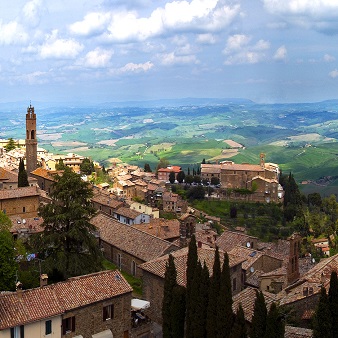
Brunello di Montalcino – one place, many expressions
Brunello di Montalcino is one of Italy's great red-wine classics. It is made exclusively from Sangiovese and only within the defined territory of Montalcino, south of Siena. One grape variety, a clearly delimited origin and long mandatory ageing periods create a narrow framework – and yet the wines can be remarkably different.
The reason lies in the interplay of many factors. Between roughly 120 and 650 metres above sea level, exposure, soils, wind, temperature and water availability change within a relatively small area. Vintage, individual parcel and the producer's decisions add further layers. Some Brunello show fragrance and fine tension relatively early, others begin more firmly and with greater depth; some rely on large casks and long periods of rest, while others interpret Sangiovese with smaller vessels or a different approach to extraction.
Brunello therefore cannot be reduced to either power or elegance. To understand it, it is worth looking more closely at place, vintage, ageing and the signature of the producer.
- Grape variety: exclusively Sangiovese
- Origin: defined production area of Montalcino
- Altitude: roughly 120 to 650 metres
- Ageing: at least 24 months in oak vessels and at least 4 months in bottle
- Riserva: longer mandatory ageing and at least 6 months in bottle
What is Brunello di Montalcino DOCG?
Brunello di Montalcino DOCG is a dry red wine made from 100 percent Sangiovese. In Montalcino, the grape variety has traditionally also been called "Brunello". The production zone covers the municipal territory of Montalcino within the boundaries defined by the Disciplinare as of 30 November 2011.
Brunello received DOC status in 1966, followed by DOCG in 1980. Today's regulations define grape variety, origin, yields, ageing, bottling and market release. The vintage must appear on the label; the terms "Vigna" or "Vigneto" may also be used under clearly defined conditions.
The legal framework is strict, but the style is not prescribed. The Disciplinare requires oak ageing, yet specifies neither barrel size nor a particular cellar philosophy. It is precisely within this framework that Brunello's diversity begins.
Montalcino – one hill country, many microclimates
Montalcino lies around 40 kilometres south of Siena, between the sea to the west and the central Apennines to the east. The production area is shaped by the valleys of the Orcia, Asso and Ombrone rivers and rises from lower sectors at around 120 metres to the highest vineyard sites at roughly 650 metres.
This difference in altitude alone creates very different conditions. It is joined by slopes facing numerous directions, winds of varying strength and small-scale differences in temperature and rainfall. Two vineyards may lie only a few kilometres apart and still experience a different growing season.
That is why the popular shorthand "north means finesse, south means power" is too simple. In individual cases it may describe a tendency, but Montalcino cannot reliably be divided into two taste zones. Altitude, exposure and the precise location can create substantial differences even within the same cardinal direction.
For Brunello, compass direction is therefore only part of the explanation. A map can help with orientation – but it cannot replace the individual vineyard or the producer's signature.
Sangiovese – and why it is called "Brunello" here
Brunello di Montalcino is made exclusively from Sangiovese. The term "Brunello" was long used in Montalcino as the local name for the form of Sangiovese cultivated there and was recognised in the 19th century as belonging to this grape variety.
The term "Sangiovese Grosso" is also still frequently encountered. It is understandable in everyday wine language, but it should not suggest that Brunello is made from a legally separate second grape variety. For the DOCG, the matter is unequivocal: Sangiovese is prescribed.
The variety often combines lively acidity with pronounced tannin and a broad aromatic spectrum. Young Brunello may show red cherry, sour cherry, floral notes, herbs and spices; with increasing maturity, depending on the wine, aromas such as tobacco, leather, balsamic notes and earthy tones may emerge.
But the same principle applies here: Sangiovese does not produce a fixed flavour profile. Origin, vintage, yield, harvest date, maceration and ageing all help determine whether a Brunello appears more transparent and taut or denser and broader.
Beneath the surface – soils, altitude and exposure
The hills of Montalcino are geologically diverse. Sandstone, calcareous rocks, Galestro, Alberese and soils with differing proportions of clay, sand and coarse material alternate throughout the area. Younger, looser deposits are more common in lower sectors, while stonier and shallower soils often appear higher on the slopes.
Yet these differences do not provide a ready-made flavour map. Limestone does not automatically mean finesse, clay does not inevitably mean power, and greater altitude does not by itself guarantee more elegance. Soil, exposure, water availability, wind and temperature act together – and the producer decides how these conditions are translated into wine.
For late-ripening Sangiovese in particular, differences in altitude and aspect can be especially relevant. They influence sunlight, day-night temperature ranges and the point at which the grapes reach the desired level of ripeness.
Brunello is therefore less the result of one single "great soil" than of a complex interaction between site and work.
No MGA – yet still precise origin
Unlike Barolo or Barbaresco, Brunello di Montalcino has no system of officially delimited MGA in the current Disciplinare and no official cru hierarchy. Vineyard and place names on the label should therefore not be equated with a state-sanctioned quality level.
Nevertheless, individual vineyards and historically named sites play an important role. Many producers vinify particular parcels separately and make their origin explicit on the label. Montosoli is one of the best-known examples and was among the early Brunello sites to be bottled separately as a distinct origin.
The regulations also recognise the terms "Vigna" and "Vigneto". They may be used together with a registered toponym or traditional name if origin, vinification and ageing are documented and handled separately in accordance with the rules. Lower maximum yields also apply to such wines.
But greater geographic precision does not automatically mean higher quality in Montalcino either. A single-vineyard name first tells us where the wine comes from – how convincing it is depends on the interplay of parcel, vintage and producer.
Ageing is part of Brunello's identity
Brunello di Montalcino must mature for at least 24 months in oak vessels of any size. Before release, it must also spend at least four months in bottle; for Brunello Riserva, the minimum bottle ageing is six months.
Regular Brunello may be released no earlier than 1 January of the fifth year after the harvest. For Riserva, release is delayed by one further year. This is why, when a new regular Brunello is released, the Riserva from the preceding vintage and the new Annata regularly arrive on the market at the same time.
What is particularly interesting is what the regulations leave open. Large botti or smaller barrels, longer oak ageing, additional time in neutral vessels or in bottle – producers have considerable freedom as long as the minimum requirements are met.
For the same reason, "Riserva" is not automatically a quality tier above every Brunello Annata. The designation first of all indicates longer legally required ageing. Whether a producer additionally selects special parcels or only makes a Riserva in certain vintages is a decision of the estate.
With Brunello, time is therefore not merely a marketing promise. It is part of the legal construction of the wine – and only after that does the individual decision begin as to how much additional ageing is appropriate.
Why Brunello can taste so different
Two Brunello may come from the same grape variety, the same vintage and the same DOCG and still taste surprisingly different. That is precisely the fascination of an origin that appears so tightly defined.
In the vineyard, differentiation begins with parcel, altitude, exposure, soil and microclimate. The vintage adds another layer: heat, rainfall, cool nights and the conditions during Sangiovese's long ripening period alter the relationship between fruit, acidity and tannin.
In the cellar, that differentiation continues. Harvest date, selection, maceration length, extraction, fermentation management, barrel size, age of the wood and length of maturation all shape the way a wine expresses its origin.
The old opposition between "traditionalists" and "modernists" has a historical basis, but it no longer explains today's Brunello landscape adequately. Many estates have changed, combined and refined their methods over decades. Large casks do not automatically mean a traditional style, and barriques do not automatically mean an opulent wine.
The more interesting question is therefore the same one here: how does this producer interpret this place in this vintage?
Brunello and the vintage
With Brunello, it is especially worthwhile to look at the vintage. Sangiovese reacts sensitively to the course of the growing season, and several years pass between harvest and market release. By the time a new Brunello appears, its development is already well under way.
A simple ranking of vintages is nevertheless of limited use. A warmer year may perform particularly well in higher or better-ventilated vineyards, while a cooler vintage may bring remarkable precision elsewhere. Producer and desired stage of maturity add further variables.
This is why a deep selection of vintages makes Brunello especially compelling. Alongside current releases, mature bottles can show how Sangiovese changes over time: primary fruit recedes, tannin becomes more integrated and the aromatic spectrum gains new layers.
Detailed assessments of the latest vintages and the Brunello and Riserva currently available can be found on our vintage pages:
This makes it possible to choose Brunello not only by producer or vineyard, but also according to whether you are looking for youthful tension, the first signs of bottle development or a clearly mature wine.
Brunello or Rosso di Montalcino?
Rosso di Montalcino DOC is also made exclusively from Sangiovese and comes from the same delimited area of origin. Even so, it is not simply a "little Brunello". The two wines follow different production rules and often fulfil different roles in a winery's range.
Rosso di Montalcino may be released from 1 September of the year after the harvest; there is no mandatory minimum period of oak ageing. This gives producers the possibility to show Sangiovese earlier and more directly.
Some Rosso come from younger vines or parcels deliberately intended for the wine, others from lots that an estate does not wish to use for Brunello. Still others are made with considerable ambition and longer maturation. Here too, there is no single stylistic model.
For anyone discovering a producer for the first time, Rosso often provides an earlier and more accessible introduction to the house style. Brunello, by contrast, places the same landscape of origin within a far longer legally defined ageing framework.
How Brunello became Brunello
Wine has been produced in Montalcino for centuries, but the history of Brunello as a distinct Sangiovese wine took shape in the 19th century. Clemente Santi was one of the decisive early figures: his "Vino Scelto" from the 1865 harvest won an award in 1869 and stands for the attempts to vinify Sangiovese on its own in Montalcino and make it capable of long ageing.
At Biondi-Santi | Il Greppo, this development was carried forward over subsequent generations. The 1888 vintage became a historical reference point and established the idea of Brunello as a long-lived, varietal Sangiovese that would shape the appellation for generations.
Brunello initially remained a rarity. Only in the second half of the 20th century did the number of producers broaden significantly. The DOC was recognised in 1966, the Consorzio del Vino Brunello di Montalcino was founded in 1967, and DOCG status followed in 1980.
Its worldwide success therefore did not come from nowhere. It grew out of a long process of grape selection, vineyard work, cellar technique and increasingly precise production rules. The fact that Montalcino now produces so many different expressions of Brunello is not a break with that history – it is its continuation.
Brunello – many distinctive signatures
The diversity of Brunello becomes especially tangible when different producers are compared side by side. Some estates shaped the history of the appellation, others brought particular vineyards into sharper focus or demonstrated through a highly individual cellar approach just how differently Sangiovese can speak within Montalcino.
Altesino is one of the early estates to have deliberately highlighted an individual origin. With Montosoli, a vineyard name became known far beyond Montalcino and, at the same time, showed how much precision of origin is possible even though the DOCG has no official cru hierarchy. Biondi-Santi | Il Greppo, by contrast, stands for the historical starting point of Brunello as a long-lived, varietal Sangiovese and for an idea of style in which time and bottle ageing have played a central role for generations.
Casanova di Neri combines several origins within Montalcino with different selections and an exceptional depth of vintages and bottle formats. Ciacci Piccolomini, with its vineyards around Castelnuovo dell'Abate, represents another perspective on the area and shows through Brunello, Riserva and selected sites how differentiated a single estate can be within the same DOCG.
Eredi Fuligni cultivates higher vineyards in the Cottimelli area north-east of Montalcino and is one of the classic reference points for a precise interpretation of Sangiovese built for long development. Giodo, in turn, shows how much experience with Sangiovese can flow into a deliberately focused Brunello concept: Carlo Ferrini combines careful parcel selection with highly precise cellar work.
Il Poggione is one of the historic pillars of the appellation and, in Sant'Angelo in Colle, stands for a classic Brunello tradition with long ageing in large casks. Lisini is likewise deeply rooted in this southern part of Montalcino; the estate was among the founding members of the Consorzio and combines historical continuity with a clear, long-lived Sangiovese signature.
Poggio Antico brings another facet of Montalcino into focus with high vineyards at around 500 metres and shows how strongly altitude, exposure and ageing can shape the expression of Brunello. Siro Pacenti stands for a particularly precise, technically considered interpretation in which smaller French oak barrels and strict selection are not ends in themselves, but part of an individual stylistic signature.
Valdicava, finally, places its vineyards in northern Montalcino and the Riserva Madonna del Piano at the centre of one of the area's distinctive origin perspectives around Montosoli. Together, these estates show that Brunello follows neither a single style nor a simple geographic template.
That is exactly why it is more useful not to sort Brunello according to a supposedly best producer. The more interesting question is which origin, cellar signature and stage of maturity best match your own taste.
Buying Brunello – origin, vintage and stage of maturity
With Brunello, choice means far more than the number of different labels. What matters is which producers, vintages, Riserva, vineyard selections and stages of maturity are actually available side by side.
At SUPERIORE.DE, the Brunello selection comprises more than 40 producers and several hundred items. Behind that figure are not only different wines, but also numerous vintages, Riserva and formats ranging from the classic 0.75-litre bottle to large formats. This depth makes comparisons possible that a single current vintage can hardly offer.
If you are new to Brunello, you can begin by comparing two or three producers with different signatures. Those who want to go deeper can place Annata and Riserva from the same estate side by side, compare several vineyard selections or follow the same wine across different vintages.
Brunello becomes especially fascinating with increasing bottle age. Alongside current releases, depending on availability, we also offer matured vintages. Age alone is not a quality criterion: the individual wine, the vintage and the storage conditions are decisive.
Our wines are stored under fully climate-controlled, light-protected and stable conditions until dispatch. For Brunello in particular, whose development over many years can be part of its appeal, this controlled storage provides the necessary basis for reliable bottle ageing.
In the end, a very large selection can be reduced to a few useful questions: which producer? Which origin? Which vintage? Annata or Riserva? Young, developing or already mature?
Answering these questions usually leads more directly to the right Brunello than scores, prestige or a ranking.
Discover Brunello di Montalcino and find the wine that best matches your idea of this great Tuscan Sangiovese classic.
If you would like to understand Brunello in greater depth, you will find answers here to the most important questions about Sangiovese, origin, ageing, Riserva, single vineyards, vintage, ageing potential and shipping.
Questions and answers about Brunello di Montalcino
What is Brunello di Montalcino?
Brunello di Montalcino is a dry red wine with DOCG status from Tuscany. It is made exclusively from Sangiovese and may only come from the defined production area of Montalcino.
Which grape variety is used for Brunello?
Brunello di Montalcino is made from 100 percent Sangiovese. In Montalcino, the grape variety has traditionally also been called "Brunello".
Is Sangiovese Grosso a separate Brunello grape variety?
No. "Sangiovese Grosso" is a traditional term commonly used around Montalcino, but the DOCG explicitly prescribes Sangiovese. Brunello is not a legally separate grape variety alongside Sangiovese.
Where is Brunello di Montalcino grown?
The production area covers the municipal territory of Montalcino within the boundaries defined by the Disciplinare. The landscape ranges from lower sectors at around 120 metres to vineyards at roughly 650 metres and includes numerous exposures, soils and microclimates.
How long must Brunello age?
Brunello must mature for at least 24 months in oak vessels and receive at least four months of bottle ageing before release. It may be marketed no earlier than 1 January of the fifth year after the harvest.
What does Riserva mean for Brunello?
Brunello Riserva is subject to longer mandatory ageing. The required bottle ageing is at least six months, and market release takes place one year later than for regular Brunello. Riserva is therefore first and foremost an ageing designation, not an automatic quality tier.
Does Brunello have official crus or MGA?
The current Disciplinare has no MGA and no official cru hierarchy. Producers may, however, highlight individual vineyards or traditional toponyms with the terms "Vigna" or "Vigneto" if the prescribed conditions are met.
What is the difference between Brunello and Rosso di Montalcino?
Both wines are made exclusively from Sangiovese and come from the same area of origin. Rosso di Montalcino can, however, be released much earlier and is not subject to a mandatory minimum period of oak ageing. Brunello, by contrast, has a considerably longer legally defined ageing framework.
Which Brunello vintage is the best?
There is no universally best vintage. Weather and the course of the growing season matter, but origin, producer and the desired stage of maturity influence the buying decision just as much. Some vintages are more open early on, while others reveal their strengths only with longer bottle ageing.
How long can Brunello age?
High-quality Brunello can have substantial ageing potential and, with the right origin, vintage quality and storage, develop over many years or even decades. A single number for all Brunello would nevertheless be too simplistic.
Should Brunello be decanted?
Young, still closed Brunello can benefit from air. With long-matured bottles, more restraint is advisable because a developed bouquet can be more sensitive to oxygen. The age and condition of the individual bottle should determine the approach.
What food goes well with Brunello?
Its acidity, tannin and aromatic depth make Brunello a strong partner for structured dishes. Braised beef, game, mushroom dishes, truffles and mature Pecorino are classic pairings. The important factor is the balance between the intensity of the dish and the structure of the wine.
Can I buy mature Brunello?
Yes. Depending on availability, SUPERIORE.DE offers not only current releases but also mature Brunello and Riserva from earlier vintages. With such wines, provenance, condition and traceable storage are particularly important.
Can I order Brunello online from SUPERIORE.DE?
Yes. Brunello di Montalcino can be ordered directly online from SUPERIORE.DE. Depending on availability, the selection includes numerous producers, vintages, Riserva, vineyard selections, mature bottles and different formats.
How is Brunello shipped?
Brunello is shipped insured in tested packaging suitable for bottle transport. Delivery times and shipping costs depend on the destination country and are shown transparently in the shop.
Brunello's greatness lies in its differences
At first glance, Brunello di Montalcino seems easy to explain: one place, one grape variety, one clearly defined legal framework. Yet it is precisely this concentration that makes its diversity so fascinating.
Sangiovese is the common language. Altitude, exposure, vineyard, vintage and producer change its tone and expression. A Brunello from Montosoli can show a different kind of tension from a wine from Castelnuovo dell'Abate; two neighbouring parcels can be just as different under different hands.
The deeper you go, the less useful simple oppositions such as traditional or modern, powerful or elegant become. The concrete places, the decisions in the cellar and the question of how a wine develops over years become far more interesting.
Brunello does not need a legend to be great. Its greatness appears where origin, Sangiovese and time come together. SUPERIORE.DE
- 24 Years of Expertise
- 3,500+ Wines in Stock
- 350+ Winemakers
- 28,000+ Positive Reviews
- Fully Air-Conditioned Storage