


-
![Amarone della Valpolicella Classico DOCG 2021]()
Amarone della Valpolicella Classico DOCG 2021
In 1886, Carlo Campagnola founded his winery in the Marano Valley, in the heart of Valpolicella Classico. In 1907, he won the first gold medal for the best Recioto at the Verona Wine Fair – since then, the family, now in its fifth generation, has continued what began as a small farm. The vineyards for this Amarone are located on calcareous slopes between 200 and 350 metres above sea level, where Corvina, Corvinone and Rondinella are harvested by hand at the end of September. The traditional appassimento drying process takes around 100 days until the grapes have lost 35–40% of their weight. Gentle pressing in December, 30 days of maceration, then ageing: 60% matures for 24 months in large Slavonian oak barrels, 40% for 18 months in new Allier oak barriques.
- Grape varieties: 40% Corvina, 35% Corvinone, 25% Rondinella
- Cultivation: conventional
- Maturation: 24/18 months in wooden barrel/barrique
- Vegan: yes
- Filtration: yes
- Alcohol content: 15,50 % vol
- Serving temperature: 18‑20 °C
- Storage potential: 2036+
- Closure: natural cork
- Total extract: 31,97 g/l
- Total acidity: 5,89 g/l
- Residual sugar: 5,88 g/l
- Sulfite: 98 mg/l
- pH value: 3,45
- Allergens
contains sulphites
stored air-conditioned0,75 l · 32,00 €/l · Price (DE) incl. VAT, excl. Shippingavailable immediately
!["Cavolo" Amarone della Valpolicella DOCG 2020]()
“Cavolo” Amarone della Valpolicella DOCG 2020
Cavolo Amarone is a selection of the best grapes from all the estate's vineyards. It opens with aromas of raspberry jam, dried cherries dusted with cinnamon and cocoa, and wafting notes of cedar and tobacco. The flavours of tart plums and fresh blackberries combine with bay leaf, chia spice, liquorice root and white pepper. Elegant on the palate, with fine tannins and a lively acidity that gives the wine a good basis for ageing. SUPERIORE.DE
- Grape varieties: 55% Corvina, 25% Corvinone, 20% Rondinella
- Cultivation: conventional
- Maturation: 48 months tonneau
- Filtration: yes
- Alcohol content: 16,00 % vol
- Serving temperature: 18‑20 °C
- Storage potential: 2037+
- Closure: natural cork
- Total extract: 33,30 g/l
- Total acidity: 6,55 g/l
- Residual sugar: 2,00 g/l
- Sulfite: 96 mg/l
- pH value: 3,42
- Allergens
contains sulphites
stored air-conditioned0,75 l · 37,33 €/l · Price (DE) incl. VAT, excl. Shippingavailable immediately
!["Selezione Antonio Castagnedi" Amarone della Valpolicella DOCG 2021]()
“Selezione Antonio Castagnedi” Amarone della Valpolicella DOCG 2021
Amarone Selezione Antonio Castagnedi delivers high quality at a fantastic price every year. If you've ever had the opportunity to stand in old, hand-fired brick drying sheds, three storeys high, filled with hot steam, leaves tied in bundles, stacked up and up and up, you'll know what this wine smells like. It is an extraordinary odour. It smells of steam-soaked red clay bricks, of tobacco leaves, green, yellow, gold, copper-coloured, brown and of earth, spices, dust and oven smoke. It is the smell of a good Amarone.
- Grape varieties: 35% Corvina, 35% Corvinone, 20% Rondinella, 5% Croatina, 5% Oseleta
- Cultivation: conventional
- Maturation: 24 months tonneau
- Filtration: yes
- Alcohol content: 15,00 % vol
- Serving temperature: 18‑20 °C
- Storage potential: 2039+
- Closure: natural cork
- Food recommendations
dark truffle dishes - Total extract: 41,54 g/l
- Total acidity: 6,64 g/l
- Residual sugar: 7,86 g/l
- Sulfite: 95 mg/l
- pH value: 3,55
- Allergens
contains sulphites
!["3 Cru" Amarone della Valpolicella Classico DOCG 2021]()
“3 Cru” Amarone della Valpolicella Classico DOCG 2021
The same triad – calcarole, Pojega, Rovereti – and yet a completely different wine. Where the 2019 offered warmth and richness, the 2021 is more about precision and classic contours. The April frost noticeably reduced yields, but what followed was a gift: a summer in which temperatures never exceeded the critical 33-degree threshold for Corvina. The vines ripened steadily, without heat stress, with cool nights that preserved acidity and flavour. The subsequent appassimento in the historic drying rooms of Pojega took place under ideal conditions – dry, cool and even. The winemakers of Valpolicella simply call 2021 "l'annata perfetta".
- Grape varieties: 40% Corvina, 30% Corvinone, 20% Rondinella, 10% Barbera
- Cultivation: conventional
- Maturation: 36 months barrique/oak barrel
- Filtration: yes
- Alcohol content: 16,00 % vol
- Serving temperature: 18‑20 °C
- Storage potential: 2037+
- Closure: natural cork
- Food recommendations
stews and casseroles with beef - Total extract: 32,89 g/l
- Total acidity: 6,02 g/l
- Residual sugar: 5,78 g/l
- Sulfite: 97 mg/l
- pH value: 3,46
- Allergens
contains sulphites - Nutritional Information per 100 ml
- Energy in kcal: 95 kcal
- Energy in kJ: 397 kJ
- Carbohydrates: 1,90 g
- Of which sugar: 0,60 g
stored air-conditioned0,75 l · 46,67 €/l · Price (DE) incl. VAT, excl. Shippingavailable immediately
![Amarone della Valpolicella Classico DOCG 2018]()
Amarone della Valpolicella Classico DOCG 2018
Amarone Classico is made from grapes grown in the vineyards of the classic Valpolicella area at the entrance to the Marano Valley. The drying process of the carefully selected grapes takes around 120 days. After fermentation, the wine matures for at least 3 years in wooden barrels.
- Grape varieties: 47% Corvina, 39% Corvinone, 6% Rondinella, 8% Other
- Cultivation: conventional
- Maturation: 12/24 months small / large wooden barrel
- Filtration: yes
- Alcohol content: 16,50 % vol
- Serving temperature: 18‑20 °C
- Storage potential: 2037+
- Closure: natural cork
- Total extract: 33,25 g/l
- Total acidity: 6,05 g/l
- Residual sugar: 2,25 g/l
- Sulfite: 88 mg/l
- pH value: 3,38
- Allergens
contains sulphites
stored air-conditioned0,75 l · 52,00 €/l · Price (DE) incl. VAT, excl. Shippingavailable immediately
![Amarone della Valpolicella Valpantena DOCG 2022]()
Amarone della Valpolicella Valpantena DOCG 2022
In the Valley of the Gods (Valpantena), Bertani has been writing perhaps the purest Amarone story in Italy since 1857. This northernmost subzone of Valpolicella is considered their secret cru, where marl-limestone on the eastern slope and clay-limestone on the western slope of the hills create a unique terroir. Here, far from the tourist trails, Corvina Veronese and Rondinella thrive on 15 to 20-year-old vines. After being harvested by hand in September, the grapes are left to rest for four months in the historic drying rooms of the Grezzana winery until the winter pressing begins. 30 months of ageing in Slavonian oak barrels and barriques give this Amarone its characteristic finesse – less opulent than the classics from Negrar, but more mineral and flavoursome.
- Grape varieties: 80% Corvina, 20% Rondinella
- Cultivation: conventional
- Maturation: 30 months in wooden barrels
- Filtration: no
- Alcohol content: 15,50 % vol
- Serving temperature: 18‑20 °C
- Storage potential: 2037+
- Closure: natural cork
- Total extract: 32,87 g/l
- Total acidity: 5,81 g/l
- Residual sugar: 5,79 g/l
- Sulfite: 97 mg/l
- pH value: 3,50
- Allergens
contains sulphites - Nutritional Information per 100 ml
- Energy in kcal: 91 kcal
- Energy in kJ: 381 kJ
- Carbohydrates: 1,40 g
- Of which sugar: 0,70 g
stored air-conditioned0,75 l · 52,00 €/l · Price (DE) incl. VAT, excl. Shippingavailable immediately
!["Caterina Zardini" Amarone della Valpolicella Classico Riserva DOCG 2020]()
“Caterina Zardini” Amarone della Valpolicella Classico Riserva DOCG 2020
At the beginning of the 20th century, Caterina Zardini lost her husband. What remained were ten children, a hundred hectares of land in the heart of Valpolicella Classica and a winery that her husband Carlo Campagnola had built up with passion – he had won the prize for the best Recioto in the region in 1907. Caterina could have handed over the estate. But she didn't. She took over the work and continued to run the winery with all her children, laying the foundations for five generations of a wine family that is still rooted in Marano di Valpolicella today. This Amarone bears her name, a tribute.
- Grape varieties: 80% Corvina, 20% Rondinella
- Cultivation: conventional
- Maturation: 18‑24 months barrique
- Vegan: yes
- Filtration: yes
- Alcohol content: 16,00 % vol
- Serving temperature: 18‑20 °C
- Storage potential: 2039+
- Closure: natural cork
- Food recommendations
brasato all'amarone, cinghiale al forno, matured asiago - Total extract: 33,58 g/l
- Total acidity: 5,96 g/l
- Residual sugar: 4,89 g/l
- Sulfite: 89 mg/l
- pH value: 3,52
- Allergens
contains sulphites - Nutritional Information per 100 ml
- Energy in kcal: 92 kcal
- Energy in kJ: 387 kJ
- Carbohydrates: 1,50 g
- Of which sugar: 0,50 g
stored air-conditioned0,75 l · 52,00 €/l · Price (DE) incl. VAT, excl. Shippingavailable immediately
![Amarone della Valpolicella Classico DOCG 2020]()
Amarone della Valpolicella Classico DOCG 2020
This immensely popular and elegant classic Amarone from Zenato hails from Sant'Ambrogio, the heart of the Valpolicella Classico region, where the family has been based since 1960. Corvina makes up eighty per cent of the blend, complemented by Rondinella, Oseleta and Croatina – all grown on the slopes of the Costalunga vineyard. Following the hand-harvest in October, the appassimento process begins: the grapes rest in shallow crates for four months, losing water whilst concentrating their sugar and aromas. Pressing does not take place until January, followed by slow fermentation in contact with the skins. The wine then matures for thirty-six months in large Slavonian oak barrels before being released following further bottle ageing.
- Grape varieties: 80% Corvina, 15% Rondinella, 5% Oseleta & Croatina
- Cultivation: conventional
- Maturation: 36 months oak barrel
- Vegan: yes
- Filtration: yes
- Alcohol content: 16,50 % vol
- Serving temperature: 18‑20 °C
- Storage potential: 2038+
- Closure: natural cork
- Total extract: 37,96 g/l
- Total acidity: 6,07 g/l
- Residual sugar: 5,47 g/l
- Sulfite: 75 mg/l
- pH value: 3,52
- Allergens
contains sulphites
stored air-conditioned0,75 l · 57,33 €/l · Price (DE) incl. VAT, excl. Shippingavailable immediately
!["Case Vecie" Amarone della Valpolicella DOCG 2018]()
“Case Vecie” Amarone della Valpolicella DOCG 2018
Amarone Case Vecie takes its name from the vineyard of the same name in the municipality of Grezzana in Valpantena. An exceptional plot of land where the grapes ripen slowly and consistently even in the most difficult years thanks to the altitude and exposure. The late harvest makes it possible to store the grapes in a cooler season and to carry out a slow and long drying process that develops the characteristic flavours. A wine that emphasises the natural characteristics of the high mountain climate: a true Amarone "delle vigne alte".
- Grape varieties: 39% Corvina, 30% Corvinone, 31% Rondinella
- Cultivation: conventional
- Maturation: 24/24 months small / large wooden barrel
- Filtration: yes
- Alcohol content: 16,50 % vol
- Serving temperature: 18‑20 °C
- Storage potential: 2040+
- Closure: natural cork
- Total extract: 34,72 g/l
- Total acidity: 5,89 g/l
- Residual sugar: 2,45 g/l
- Sulfite: 89 mg/l
- pH value: 3,45
- Allergens
contains sulphites
stored air-conditioned0,75 l · 62,67 €/l · Price (DE) incl. VAT, excl. Shippingavailable immediately
!["Manfro" Amarone della Valpolicella DOCG 2018]()
“Manfro” Amarone della Valpolicella DOCG 2018
Manfro's bouquet combines dark ripe fruits, sweet spices, some mocha with spicy herbs and violet flowers. Silky, full-bodied and energetic on the palate with cooling acidity and minerals that play superbly around the ripe black cherries. Finishes on an elegant bitter note, fresh with violet flowers and wild berries. SUPERIORE.DE
- Grape varieties: 75% Corvina, 15% Rondinella, 5% Croatina, 5% Oseleta
- Cultivation: conventional
- Maturation: 24 months tonneau
- Filtration: yes
- Alcohol content: 15,00 % vol
- Serving temperature: 18‑20 °C
- Storage potential: 2037+
- Closure: natural cork
- Total extract: 44,25 g/l
- Total acidity: 6,41 g/l
- Residual sugar: 8,25 g/l
- Sulfite: 105 mg/l
- pH value: 3,55
- Allergens
contains sulphites
stored air-conditioned0,75 l · 64,00 €/l · Price (DE) incl. VAT, excl. Shippingavailable immediately
!["Villa Rizzardi" Amarone della Valpolicella Classico Riserva DOCG 2020]()
“Villa Rizzardi” Amarone della Valpolicella Classico Riserva DOCG 2020
The Rizzardi family has been cultivating the hills of Pojega in the heart of Negrar since 1649. What began as a vineyard became, over generations, a place where landscape and wine become inseparable – the famous Giardino, the Teatro di Verzura, the villa itself. From the south-facing plots of this historic cru comes an Amarone Riserva that is only produced in vintages deemed worthy of the family. However, the fact that 2020 is one of them is anything but self-evident. Because 2020 was a testing year. Sunny spring, heavy summer rains, heat and coolness in constant alternation – valpolicella demanded experience and sensitivity. The old Corvinone vines in Pojega in particular, late-ripening and deeply rooted in the chalky clay, produced grapes of unusual concentration from the climatic contradiction. On its centenary, the Consorzio spoke of wines with "strong personality and remarkable balance" – at Villa Rizzardi, this hits the nail on the head.
- Grape varieties: 43% Corvina, 31% Corvinone, 16% Rondinella, 10% Barbera
- Cultivation: close to nature
- Maturation: 36 months wooden barrel
- Filtration: yes
- Alcohol content: 16,00 % vol
- Serving temperature: 18‑20 °C
- Storage potential: 2041+
- Closure: natural cork
- Food recommendations
braised beef/lamb - Total extract: 34,05 g/l
- Total acidity: 5,94 g/l
- Residual sugar: 3,97 g/l
- Sulfite: 87 mg/l
- pH value: 3,43
- Allergens
contains sulphites
!["Ansari" Amarone della Valpolicella DOCG 2019]()
“Ansari” Amarone della Valpolicella DOCG 2019
The three Tedeschi siblings Antonietta, Sabrina and Riccardo, who also select the three barrels from which the blend is made each year, give their name to the "Ansari", which is only available in small quantities. Rich bouquet of dried fruit, sultanas, rum pot and chocolate. Firm on the palate with an excellent structure, the opulent fruit centre is joined by balsamic, herbal notes and a piquant bitter note on the long finish. The perfect addition to the famous family winery's top-class Amarone range since the 2016 debut vintage. SUPERIORE.DE
- Grape varieties: 35% Corvina, 35% Corvinone, 20% Rondinella, 10% Rossignola, Oseleta, Negrara, Dindarella
- Cultivation: conventional
- Maturation: 36 months tonneau
- Filtration: yes
- Alcohol content: 16,50 % vol
- Serving temperature: 18‑20 °C
- Storage potential: 2037+
- Closure: natural cork
- Food recommendations
red meat and matured cheeses - Total extract: 40,96 g/l
- Total acidity: 6,41 g/l
- Residual sugar: 5,78 g/l
- Sulfite: 76 mg/l
- pH value: 3,44
- Allergens
contains sulphites
stored air-conditioned0,75 l · 65,33 €/l · Price (DE) incl. VAT, excl. Shippingavailable immediately
!["Campo dei Gigli" Amarone della Valpolicella Classico DOCG 2017]()
“Campo dei Gigli” Amarone della Valpolicella Classico DOCG 2017
The star from Tenuta Sant'Antonio: A rich dark ruby red, its bouquet of wild fruits, black pepper, tobacco and spices is a delight for the nose. Fruity and full-bodied, yet velvety and very sophisticated in its character - an austere, characterful and elegant Amarone, whose terrificfinish is accompanied by noble tannins. SUPERIORE.DE
- Grape varieties: 70% Corvina, 20% Rondinella, 5% Croatina, 5% Oseleta
- Cultivation: conventional
- Maturation: 18 months tonneau/barrique
- Filtration: yes
- Alcohol content: 15,50 % vol
- Serving temperature: 18‑20 °C
- Storage potential: 2037+
- Closure: natural cork
- Total extract: 42,55 g/l
- Total acidity: 5,78 g/l
- Residual sugar: 7,41 g/l
- Sulfite: 115 mg/l
- pH value: 3,60
- Allergens
contains sulphites
!["Campo dei Gigli" Amarone della Valpolicella Classico DOCG 2018]()
“Campo dei Gigli” Amarone della Valpolicella Classico DOCG 2018
In the gentle hills of Mezzane di Sotto, where the Monti Garbi rise majestically over the eastern Valpolicella, lies the centrepiece of the Tenuta Sant'Antonio: Campo dei Gigli – the field of lilies. The oldest vines of the brothers Armando, Tiziano, Paolo and Massimo Castagnedi are rooted here, on calcareous white soils with sandy-loamy inclusions at an altitude of 300 metres. A single vineyard that produces a unique wine. Since 1989, the Castagnedi family has embodied the revolution that changed Valpolicella forever: quality instead of quantity, while everyone else was still focussing on quantity. Forty-year-old vines, trained on the traditional Pergola Veronese with only 3,300 vines per hectare, bear the cuvée of 70% Corvina and Corvinone, 20% Rondinella and 5% each of Croatina and the rare Oseleta. The appassimento – the mystical drying period of at least three months – transforms the hand-picked grapes into concentrated essence.
- Grape varieties: 70% Corvina, 20% Rondinella, 5% Croatina, 5% Oseleta
- Cultivation: conventional
- Maturation: 18 months tonneau/barrique
- Filtration: yes
- Alcohol content: 15,50 % vol
- Serving temperature: 18‑20 °C
- Storage potential: 2038+
- Closure: natural cork
- Total extract: 41,33 g/l
- Total acidity: 6,02 g/l
- Residual sugar: 7,33 g/l
- Sulfite: 107 mg/l
- pH value: 3,57
- Allergens
contains sulphites
![Amarone della Valpolicella Classico DOCG 2021 <br>MAGNUM]()
Amarone della Valpolicella Classico DOCG 2021 · MAGNUM
In 1886, Carlo Campagnola founded his winery in the Marano Valley, in the heart of Valpolicella Classico. In 1907, he won the first gold medal for the best Recioto at the Verona Wine Fair – since then, the family, now in its fifth generation, has continued what began as a small farm. The vineyards for this Amarone are located on calcareous slopes between 200 and 350 metres above sea level, where Corvina, Corvinone and Rondinella are harvested by hand at the end of September. The traditional appassimento drying process takes around 100 days until the grapes have lost 35–40% of their weight. Gentle pressing in December, 30 days of maceration, then ageing: 60% matures for 24 months in large Slavonian oak barrels, 40% for 18 months in new Allier oak barriques.
- Grape varieties: 40% Corvina, 35% Corvinone, 25% Rondinella
- Cultivation: conventional
- Maturation: 24/18 months in wooden barrel/barrique
- Vegan: yes
- Filtration: yes
- Alcohol content: 15,50 % vol
- Serving temperature: 18‑20 °C
- Storage potential: 2038+
- Closure: natural cork
- Total extract: 31,97 g/l
- Total acidity: 5,89 g/l
- Residual sugar: 5,88 g/l
- Sulfite: 98 mg/l
- pH value: 3,45
- Allergens
contains sulphites
!["Morandina" Amarone della Valpolicella DOCG 2017]()
“Morandina” Amarone della Valpolicella DOCG 2017
"My personal challenge is to bring Amarone back to the table. A wonderful food companion that combines power and complexity with a crisp, soft sip." Graziano Prà
- Grape varieties: 35% Corvina, 35% Corvinone, 25% Rondinella, 5% Oseleta
- Cultivation: close to nature
- Maturation: 36 months tonneau/barrique
- Vegan: yes
- Filtration: yes
- Alcohol content: 17,00 % vol
- Serving temperature: 18‑20 °C
- Storage potential: 2039+
- Closure: Diam
- Total extract: 34,56 g/l
- Total acidity: 6,05 g/l
- Residual sugar: 5,15 g/l
- Sulfite: 97 mg/l
- pH value: 3,48
- Allergens
contains sulphites
stored air-conditioned0,75 l · 77,33 €/l · Price (DE) incl. VAT, excl. Shippingavailable immediately
!["Pietro dal Cero" Amarone della Valpolicella DOCG 2019]()
“Pietro dal Cero” Amarone della Valpolicella DOCG 2019
After the Second World War, Felice Dal Cero moved from Verona to Lugana di Sirmione on Lake Garda, where he began making wine. His son Pietro subsequently built up Ca’ dei Frati into one of Lombardy’s most prestigious estates – and, in 1969, was one of the co-signatories of the first Lugana DOC Disciplinare, the region’s first Denomination of Controlled Origin. When Pietro died in 2012, he left his children Igino, Gian Franco and Anna Maria not only a vineyard – but also a legacy. The siblings acquired further vineyards in Pian di Castagnè, in the eastern part of Valpolicella, near the Luxinum vineyard, on calcareous-marl soils with white and red flint fragments – —a terroir with a distinctly mineral character. It marked a return to their father’s roots. They therefore dedicated the wine they produce here to him: Pietro dal Cero – the father, to whom they gave back what he himself could never see again.
- Grape varieties: 70% Corvina, 20% Corvinone, 5% Rondinella, 5% Croatina
- Cultivation: conventional
- Maturation: 24/12 months wooden barrel/stainless steel
- Filtration: yes
- Alcohol content: 16,00 % vol
- Serving temperature: 18‑20 °C
- Storage potential: 2046+
- Closure: Nomacorc
- Food recommendations
roast wild boar, braised venison, matured alpine cheese, dark chocolate - Total extract: 39,15 g/l
- Total acidity: 7,14 g/l
- Residual sugar: 8,24 g/l
- Sulfite: 98 mg/l
- pH value: 3,54
- Allergens
contains sulphites - Nutritional Information per 100 ml
- Energy in kcal: 94 kcal
- Energy in kJ: 390 kJ
- Carbohydrates: 1,90 g
- Of which sugar: 0,50 g
stored air-conditioned0,75 l · 78,67 €/l · Price (DE) incl. VAT, excl. Shippingavailable immediately
![Amarone della Valpolicella Classico DOCG 2021]()
Amarone della Valpolicella Classico DOCG 2021
The Allegrini family has been contributing to the history of Valpolicella since the 16th century. Giovanni Allegrini, the visionary, is considered the architect of its rebirth. A man they called "il ragno delle botti", the cellar master spider, because he wandered restlessly between his barrels, always in search of perfection. His son Franco carried on the legacy, revolutionising the Appassimento with the construction of the Terre di Fumane – a state-of-the-art drying facility that precisely controls temperature, humidity and air circulation. Since 2022, the winery has been in the hands of the third generation: Francesco, Giovanni, Matteo and Silvia. The Amarone comes from vines that have been rooted for over 30 years on the hills of Fumane, between 450 and 520 metres above sea level, on clay and limestone soils of volcanic origin. Corvina Veronese and Corvinone each make up 45 per cent of the cuvée, supplemented by Rondinella and Oseleta. After the manual harvest in September, the transformation begins: the grapes rest for four months in the fruttaio, losing 40 to 45 per cent of their weight, concentrating sugar and aromas. Gentle pressing in January, followed by 25 days of maceration at a controlled temperature. Ageing: 18 months in new barriques, a further seven months in large barrels and finally 14 months in the bottle – a total of over three years before the wine leaves the winery.
- Grape varieties: 45% Corvina, 45% Corvinone, 5% Rondinella, 5% Oseleta
- Cultivation: conventional
- Maturation: 18/7 months in barrique/wood barrel
- Filtration: yes
- Alcohol content: 16,00 % vol
- Serving temperature: 18‑20 °C
- Storage potential: 2045+
- Closure: natural cork
- Total extract: 33,48 g/l
- Total acidity: 5,81 g/l
- Residual sugar: 3,89 g/l
- Sulfite: 78 mg/l
- pH value: 3,45
- Allergens
contains sulphites
stored air-conditioned0,75 l · 88,00 €/l · Price (DE) incl. VAT, excl. Shippingavailable immediately
!["Capitel Monte Olmi" Amarone della Valpolicella Classico Riserva DOCG 2018]()
“Capitel Monte Olmi” Amarone della Valpolicella Classico Riserva DOCG 2018
Capitel Monte Olmi 2018 takes things to another level. It coats the glass with a deep purple glow and exudes a dark and seductive bouquet of redcurrants, sultanas, black liquorice and a hint of spiced citrus. The brooding, velvety texture is complemented by juicy acids and tart red fruits that drench everything they touch, leaving a complex layer of savoury spices, minerals and fine tannins. This wine is structured, long and full of character, but with a balance that will carry it for many years in the cellar. SUPERIORE.DE
- Grape varieties: 30% Corvina, 30% Corvinone, 30% Rondinella, 10% Oseleta et Al.
- Cultivation: close to nature
- Maturation: 48 months in wooden barrel
- Vegan: yes
- Filtration: yes
- Alcohol content: 16,50 % vol
- Serving temperature: 18‑20 °C
- Storage potential: 2044+
- Closure: natural cork
- Total extract: 41 g/l
- Total acidity: 7,00 g/l
- Residual sugar: 4,50 g/l
- Sulfite: 85 mg/l
- pH value: 3,59
- Allergens
contains sulphites
stored air-conditioned0,75 l · 92,00 €/l · Price (DE) incl. VAT, excl. Shippingavailable immediately
!["Tenuta Missoj" Amarone della Valpolicella Riserva DOCG 2013 <br>in gift box]()
“Tenuta Missoj” Amarone della Valpolicella Riserva DOCG 2013 · in gift box
Tenuta Missoj is a small vineyard in Mizzole with just 3.5 hectares of vines and is owned by the Campagnola family. The vineyards extend at an altitude of 200 metres on a well-ventilated and exposed hill where the grapes can reach perfect and complete ripeness. The grapes for this Amarone Riserva come from single vineyards and the wine is aged for 24 months in new barriques made of Fleur de Quintessence oak in medium to lightly toasted Allier oak with very fine grain. Further ageing of the wine takes place in the bottle for another 12 months.
- Grape varieties: 70% Corvina, 20% Rondinella, 10% Croatina
- Cultivation: conventional
- Maturation: 24 months new barrique
- Filtration: yes
- Alcohol content: 17,00 % vol
- Serving temperature: 18‑20 °C
- Storage potential: 2038+
- Closure: natural cork
- Total extract: 36,00 g/l
- Total acidity: 5,60 g/l
- Residual sugar: 4,00 g/l
- Sulfite: 88 mg/l
- pH value: 3,45
- Allergens
contains sulphites
!["Calcarole" Amarone della Valpolicella Classico Riserva DOCG 2017]()
“Calcarole” Amarone della Valpolicella Classico Riserva DOCG 2017
Basically, Calcarole is not a vineyard. It is a limestone rock. A terraced massif above the Villa di Rovereti in Negrar, exposed to the south-west, rising to 230 metres – the warmest single vineyard in Valpolicella Classica and at the same time the origin of the most elegant Amarone produced by Guerrieri Rizzardi. The secret lies in this contradiction. Six parcels, planted between 1986 and 2000, are predominantly planted with Corvina, supplemented by Barbera and Sangiovese – varieties that hardly thrive in Valpolicella, but on the hot limestone of Calcarole contribute precisely the freshness that counterbalances the solar concentration. It was this vineyard that produced the first Amarone ever to be honoured as Gambero Rosso's "Vino Rosso dell'Anno" in 2009. Since then, Calcarole has received the Tre Bicchieri in nine out of eleven vintages.
- Grape varieties: 70% Corvina, 10% Barbera, 10% Rondinella, 7% Sangiovese, 3% Corvinone
- Cultivation: close to nature
- Maturation: 36 months wooden barrel
- Filtration: yes
- Alcohol content: 17,00 % vol
- Serving temperature: 18‑20 °C
- Storage potential: 2044+
- Closure: natural cork
- Food recommendations
boeuf stroganoff, curry dishes - Total extract: 33,65 g/l
- Total acidity: 5,65 g/l
- Residual sugar: 1,35 g/l
- Sulfite: 102 mg/l
- pH value: 3,44
- Allergens
contains sulphites
stored air-conditioned0,75 l · 104,00 €/l · Price (DE) incl. VAT, excl. Shippingavailable immediately
!["San Floriano" Amarone della Valpolicella Riserva DOCG 2015]()
“San Floriano” Amarone della Valpolicella Riserva DOCG 2015
Brigaldara's Amarone Riserva is a wine born from the desire to interpret Valpolicella in its most original form. The strictly selected grapes that form its basis are chosen from the best vineyards in order to maximise the potential of the estate's own vineyards in Valpolicella.
- Grape varieties: 55% Corvina, 25% Corvinone, 20% Rondinella
- Cultivation: conventional
- Maturation: 30/24 months small / large wooden barrel
- Filtration: yes
- Alcohol content: 16,00 % vol
- Serving temperature: 18‑20 °C
- Storage potential: 2045+
- Closure: natural cork
- Total extract: 34,51 g/l
- Total acidity: 6,15 g/l
- Residual sugar: 0,80 g/l
- Sulfite: 86 mg/l
- pH value: 3,40
- Allergens
contains sulphites
stored air-conditioned0,75 l · 105,33 €/l · Price (DE) incl. VAT, excl. Shipping< 24 units available
!["Selezione Sergio Zenato" Amarone della Valpolicella Classico Riserva DOCG 2018]()
“Selezione Sergio Zenato” Amarone della Valpolicella Classico Riserva DOCG 2018
A wine of remarkable aromatic complexity. Amarone aficionados know how many allusions these wines are capable of evoking, and it is not difficult to discern mushrooms, forest undergrowth, truffles, Havana leaves and even wild violets in this wine's aromatic profile, as well as the usual confit cherries and plums. In the mouth, the wine is remarkably concentrated yet elegant, carrying this bundle of allusions effortlessly and seamlessly through the palate. The fine pearly tannins give it support and the concentration of fruit is so great that the acidity almost fades into the background. A dense, polished and stately wine of the highest calibre. SUPERIORE.DE
- Grape varieties: 85% Corvina, 10% Rondinella, 5% Oseleta and Croatina
- Cultivation: conventional
- Maturation: 60 months in oak barrels
- Vegan: yes
- Filtration: yes
- Alcohol content: 17,00 % vol
- Serving temperature: 18‑20 °C
- Storage potential: 2045+
- Closure: natural cork
- Total extract: 40,00 g/l
- Total acidity: 6,70 g/l
- Residual sugar: 4,00 g/l
- Sulfite: 53 mg/l
- pH value: 3,69
- Allergens
contains sulphites
stored air-conditioned0,75 l · 116,00 €/l · Price (DE) incl. VAT, excl. Shipping< 24 units available


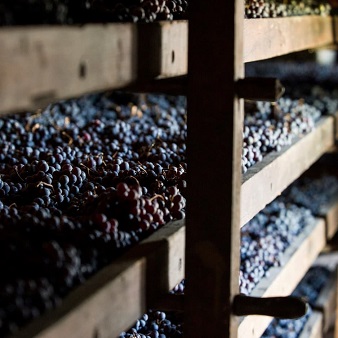
Amarone – Appassimento is only half the story
Amarone is one of Italy's most distinctive red wines. Its special character begins where the harvest ends for most wines: Selected grapes from the Valpolicella area are dried after picking and fermented only weeks later. This Appassimento does more than concentrate their components – the berries continue to change during the drying process. This creates the basis for the combination of richness, warmth, spice and depth that makes Amarone unmistakable.
Yet great Amarone cannot be explained by dried grapes alone. From the historic Valpolicella Classico in the west to Valpantena and the valleys east of Verona, altitude, exposure, soils and microclimate all vary. Added to this are the grape blend, Appassimento, fermentation, ageing and vintage. This is why Amarone can be powerful without feeling heavy, ripe without tasting sweet, and concentrated without losing its freshness.
- Origin: Amarone della Valpolicella is a DOCG from the province of Verona. "Classico" and "Valpantena" are protected geographical designations.
- Grape varieties: Corvina Veronese and/or Corvinone together with Rondinella form the backbone of the blend.
- Appassimento: Selected grapes are dried after harvest in suitable rooms known as "fruttai".
- Selection: No more than 65 percent of the permitted maximum yield per hectare may be selected for Amarone and subjected to Appassimento.
- Yield: The maximum yield from grapes destined for Amarone to finished wine is limited to 40 percent.
- Style: Amarone is a dry red wine with high natural concentration, yet its style can vary remarkably.
- Ageing: Amarone requires at least two years of ageing, while a Riserva requires at least four years from the respective legally defined dates.
What is Amarone della Valpolicella?
Amarone della Valpolicella is a red wine made from dried grapes that may only be produced within its delimited area of origin in the province of Verona. Amarone is therefore neither a grape variety nor a freely usable term for particularly powerful Italian red wine.
Its identity is based on two inseparable elements: its origin in the Valpolicella area and the Appassimento process. The grapes first ripen in the vineyard and are selected for drying after harvest. Only then does vinification begin.
Amarone della Valpolicella has held DOCG status since 2010. Amarone as a wine type within the former Valpolicella denomination was officially recognised as early as 1968. The tradition of producing wine from dried grapes in the Verona area, however, is considerably older.
The Valpolicella area
The Amarone production zone extends across the hills north and east of Verona and includes all or parts of 19 municipalities. From its western edge near Lake Garda, it stretches through Valpolicella Classico and Valpantena to the valleys of Mezzane, Illasi and Tramigna in the east.
This landscape is far less uniform than the famous wine name might suggest. Limestone and dolomite formations alternate with basaltic subsoil as well as morainic and fluvial deposits. Altitude, slope and exposure also vary considerably. The vineyards are located predominantly on the hills between the Veronese plain and the foothills of the Lessini Mountains.
In the west, Lake Garda has a moderating climatic influence, while the Lessini Mountains form a natural boundary to the north. Between them, several valleys open southwards towards the plain of Verona. Peaty or excessively damp valley-floor soils are expressly excluded from Amarone production.
For Amarone, this diversity is particularly important. Appassimento can only further develop what the vineyard has already produced. Acidity, phenolic ripeness, berry size and aromatic potential are not created in the drying room. The regulations define this quality decision unusually precisely: The grapes must come from vineyards that have reached at least their fourth vegetative cycle, and no more than 65 percent of the permitted maximum yield per hectare may be selected for Amarone and subjected to Appassimento. The quality of an Amarone therefore begins long before the grapes are dried.
Classico and Valpantena
"Amarone della Valpolicella Classico" comes from the historic core zone in the west. It comprises the five municipalities of Negrar di Valpolicella, Marano, Fumane, Sant'Ambrogio di Valpolicella and San Pietro in Cariano. "Classico" denotes a geographical origin and does not automatically indicate a higher quality level.
"Valpantena" is likewise an officially protected geographical designation. It refers to a clearly delimited area within the valley of the same name north of Verona and includes parts of the municipalities of Grezzana and Verona. Cerro Veronese belongs to the larger DOCG production zone, but not to the defined Valpantena area.
Beyond these lies the extensive remainder of the DOCG production zone, which includes areas around Verona as well as the valleys of Mezzane, Illasi and Tramigna. There is no third collective designation on Amarone labels comparable to "Classico" or "Valpantena" for these areas.
This geographical differentiation in particular shows why Amarone should not be understood solely through its production method. A higher-altitude, well-ventilated vineyard creates different conditions from a warmer site at lower elevation. How clearly these differences emerge in the finished wine then depends on the individual producer.
Corvina, Corvinone and Rondinella
Amarone does not follow a rigid grape-variety formula. Current regulations stipulate that Corvina Veronese and/or Corvinone must together account for 45 to 95 percent of the blend. Rondinella is required at 5 to 30 percent. Other permitted red grape varieties may be added within precisely defined limits, up to a total of 25 percent.
Corvina is the central grape variety of the Valpolicella area. It often combines ripe cherry fruit with lively acidity and has characteristics that make it particularly well suited to Appassimento. Corvinone is a distinct grape variety in its own right and may account for a substantial share of the blend. Rondinella completes the traditional framework.
Individual producers may also use varieties such as Oseleta, Croatina or Molinara alongside other permitted grapes. This freedom within clearly defined limits is one reason why Amarone cannot be reduced to a single stylistic formula.
A wine with a very high proportion of Corvina may taste quite different from a blend in which Corvinone or smaller local varieties play a more prominent role. What ultimately matters, however, is their interaction with origin, vintage and vinification.
Appassimento
After harvest, the grapes destined for Amarone are carefully selected and stored so that air can circulate around them. Traditionally, they were laid out on racks; today, shallow crates are frequently used. The rooms used for drying are known as "fruttai".
The Consorzio cites around 100 to 120 days as a typical Appassimento period. The actual production regulations, however, do not prescribe a general minimum number of drying days. Instead, they define the conditions under which drying may take place and stipulate that the grapes may generally not be vinified before 1 December. Under exceptional climatic circumstances, the Veneto region may authorise an earlier start.
During Appassimento, the grapes lose water. Sugar, polyphenols and other components are thereby concentrated. At the same time, further complex changes take place within the berries. Appassimento is therefore far more than simply producing "semi-raisins".
A further provision of the Disciplinare shows just how much this process reduces the quantity: The maximum yield from grapes destined for Amarone to finished wine may not exceed 40 percent. Concentration is therefore not merely a sensory impression, but is already embedded in the production framework through a very limited wine yield.
Temperature, humidity and air circulation play an important role. The regulations allow technical control of environmental conditions, provided these remain in line with the temperatures of traditional drying. Dehydration using heat, however, is prohibited.
How long and under what conditions a producer dries the grapes is one of the most important stylistic decisions in Amarone production. Longer Appassimento is not automatically better. The decisive question is what balance of concentration, freshness and healthy fruit should be achieved.
Amarone and Recioto
Amarone and Recioto della Valpolicella are closely related. Both are made from dried grapes and are based on the traditional range of grape varieties grown in the Valpolicella area.
The decisive difference lies in fermentation. In sweet Recioto, a substantial proportion of the grapes' natural sugar remains in the wine. In Amarone, alcoholic fermentation proceeds much further, producing a dry red wine.
This also explains the name: "Amarone" refers to "amaro", meaning bitter or austere, and historically marks the contrast with sweet Recioto. Numerous stories surround the origin of the first Amarone, often involving a Recioto that accidentally fermented completely dry. Charming as this anecdote may be, it cannot serve as a definitive explanation for the entire wine style.
Despite its dry style, an Amarone can taste remarkably soft and ripe. High alcohol, concentrated fruit and extract can create an impression of sweetness without Amarone actually being a sweet wine. The regulations also set a clear limit here, though not a blanket 9 g/l for every wine: At 14 percent vol., a maximum of 9 g/l residual sugar is permitted; as the alcohol level rises, the permitted maximum increases slightly according to a defined scale.
Why one Amarone is not like another
Few Italian wine classics offer as many variables during their creation as Amarone.
It begins with origin. Altitude, exposure, soil and microclimate determine the grapes' starting conditions. The vintage influences ripeness, acidity and grape health. The grape blend alters structure and aromatic profile.
Then comes Appassimento. Grape selection, duration, airflow and the progress of drying all influence how strongly the berries change. During vinification, fermentation, extraction and maceration come into play, followed by maturation and ageing.
This is why two Amarone wines from the same DOCG can taste strikingly different. One may show dark fruit, great density and pronounced warmth, while another may be more red-fruited, taut and driven by acidity. Some Amarone wines are approachable early, while others develop their true complexity only after extended bottle ageing.
Even a high alcohol level does not automatically result in a heavy wine. What matters is the balance between alcohol, fruit, acidity, tannin and extract.
The once popular distinction between "traditionalists" and "modernists" is no longer sufficient to explain this diversity. Large casks, tonneaux and barriques are tools. Their use alone does not allow any reliable conclusion about style or quality.
Vineyards and vintages
Amarone has no comprehensive official cru system comparable, for example, to the MGA of Barolo. Individual vineyards may nevertheless be explicitly named on the label.
The Disciplinare permits the use of "Vigna" together with a registered toponym, provided the relevant requirements are met and grapes, Appassimento, vinification and ageing are documented separately.
A single vineyard is therefore not automatically a higher quality category. Some producers use an individual parcel to express a particular place with greater precision. Others deliberately combine grapes from several vineyards in order to bring different characteristics together.
The vintage is by no means incidental either. Stating the harvest year is mandatory for Amarone. This also makes sense from a technical perspective: Temperature, rainfall and harvest conditions not only influence grape ripeness, but also determine their suitability and starting point for the subsequent Appassimento process.
Amarone Riserva
Amarone della Valpolicella must age for at least two years, calculated from 1 January following the harvest year. Amarone Riserva requires at least four years, calculated from 1 November of the harvest year.
"Riserva" therefore primarily denotes a legally defined longer ageing period. The term does not automatically imply a single vineyard, particular grape varieties or a prescribed type of barrel.
Many producers, however, go far beyond the legal minimum with their Riserva wines and combine the category with stricter selection or particularly long ageing periods. These are producer decisions rather than part of the general DOCG definition.
High-quality Amarone has considerable ageing potential. With time, fresh and dried fruit notes can develop into spicy, balsamic, tobacco and earthy aromas. How long a wine will mature beneficially, however, depends on vintage, producer, style and storage conditions. There is no universally applicable number of years.
From the Appassimento tradition to Amarone
The history of Amarone does not begin with Amarone itself. Drying grapes has been part of the wine culture of the Valpolicella area for centuries. Historical sources refer to sweet wines made from dried grapes long before today's Amarone emerged.
The dry wine style developed much later. The official Disciplinare dates the first commercial bottle of Amarone della Valpolicella to 1953. Amarone was officially recognised within the denomination in 1968. In 2010, Amarone della Valpolicella was granted DOCG status.
Amarone is therefore both old and young: old in its Appassimento tradition, young as a clearly defined dry wine classic.
This development explains much of its present-day diversity. Within just a few decades, a traditional regional technique gave rise to one of Italy's best-known red wines internationally. With this success, vineyard practices, drying techniques and cellar work also evolved. Today, the stylistic spectrum extends far beyond the old image of Amarone as simply an extremely powerful and opulent wine.
Amarone producers at SUPERIORE.DE
The SUPERIORE.DE range offers an excellent way to explore the diversity of Amarone:
- Bertani has an exceptionally long vintage history with its Amarone Classico. Our own stocks reach back to the 1958 vintage, offering a direct illustration of the ageing potential of this style.
- Giuseppe Quintarelli is one of the defining names of Amarone. The estate in Negrar combines rigorous selection with exceptionally long maturation and produces Amarone only in suitably favourable vintages. In other years, "Rosso del Bepi" may be produced instead.
- Tedeschi has vinified Monte Olmi separately since 1964. The vineyard in Pedemonte is therefore one of the early examples of a consistently site-focused approach within the Valpolicella area.
- Brigaldara demonstrates differences in origin particularly clearly within a single estate. Alongside wines from Valpolicella Classico, Case Vecie comes from high-altitude vineyards near Grezzana at around 450 metres.
- Romano Dal Forno represents the eastern Valpolicella area. The estate is located in the Illasi Valley, and its first own Amarone harvest dates from 1983. Precise vineyard work and highly controlled cellar techniques shape the estate's distinctive style.
- Allegrini complements its Amarone Classico with Fieramonte, a separately interpreted vineyard in the historic Valpolicella Classico zone that is bottled as Amarone Classico Riserva.
- Guerrieri Rizzardi owns its Valpolicella vineyards in the Valpolicella Classico area around Negrar and demonstrates with Calcarole just how strongly an individual vineyard can define itself within an Amarone portfolio.
- Zýmè uses a broad spectrum of traditional grape varieties in its Amarone Classico and complements the regular bottling with La Mattonara, a Classico Riserva.
Zenato, Tenuta Sant'Antonio, Campagnola, Graziano Prà and Ca' dei Frati add further interpretations and origins to the SUPERIORE.DE range. This selection shows particularly clearly that while the shared DOCG provides the framework, it by no means creates a uniform Amarone style.
Buy Amarone online at SUPERIORE.DE
When choosing Amarone, it therefore makes little sense to focus solely on alcohol, price or perceived power. Origin and producer are at least equally important.
"Classico" and "Valpantena" provide geographical orientation. Single vineyards can represent a more precisely defined approach to origin. Riserva indicates a longer legally prescribed ageing period. Beyond this, the grape blend, Appassimento and maturation determine whether an Amarone leans more towards density and richness or towards tension, freshness and long-term development.
At SUPERIORE.DE, you will find Amarone from historic estates as well as younger, highly individual producers, from Valpolicella Classico, Valpantena and the eastern parts of the Valpolicella area.
Discover Amarone della Valpolicella and find the style that matches your idea of this exceptional Italian red wine.
Questions and answers about Amarone
What is Amarone?
Amarone della Valpolicella is a dry red wine made from dried grapes grown within a delimited area in the province of Verona. It has held DOCG status since 2010. The special production method is known as Appassimento.
Which grape varieties are used to make Amarone?
Corvina Veronese and/or Corvinone must together account for 45 to 95 percent, with Rondinella making up 5 to 30 percent. Other permitted red grape varieties may be included within defined limits. Amarone therefore does not have one identical grape blend everywhere.
Is Amarone dry or sweet?
Amarone is the dry counterpart to sweet Recioto della Valpolicella. Because it is made from dried, very ripe grapes and combines high alcohol with substantial extract, it can nevertheless taste soft and slightly sweet. The regulations limit residual sugar to a maximum of 9 g/l at 14 percent vol.; at higher alcohol levels, the permitted maximum rises slightly according to a defined scale.
What does Appassimento mean?
Appassimento refers to the drying of selected grapes after harvest. For Amarone, the grapes are kept in well-ventilated "fruttai" before vinification. During this period, they lose water while their composition continues to change. This increases concentration and shapes the structure and aroma profile of the finished wine.
How long are Amarone grapes dried?
The Consorzio cites around 100 to 120 days as a typical period. The production regulations, however, do not prescribe a general minimum number of drying days. As a rule, the grapes may not be vinified before 1 December unless an earlier start is authorised due to exceptional climatic conditions.
How much of the grape harvest may be used for Amarone?
No more than 65 percent of the maximum yield per hectare permitted under the regulations may be selected for Amarone and subjected to Appassimento. Amarone is therefore already the result of a clear decision on quantity and selection in the vineyard.
What does Amarone Classico mean?
"Classico" refers to the historic core of the Valpolicella area, comprising the municipalities of Negrar di Valpolicella, Marano, Fumane, Sant'Ambrogio di Valpolicella and San Pietro in Cariano. It is a geographical designation and does not automatically indicate a higher level of quality.
What is Amarone Valpantena?
Amarone della Valpolicella Valpantena comes from a clearly delimited part of the Valpantena valley north of Verona within the municipalities of Grezzana and Verona. Alongside "Classico", "Valpantena" is the second geographical designation officially permitted for Amarone.
What is the difference between Amarone and Valpolicella Ripasso?
Amarone is made directly from dried grapes. Valpolicella Ripasso, by contrast, is a separate DOC wine: A previously fermented Valpolicella undergoes a second fermentation on the remaining pomace from Amarone or Recioto. This typically gives Ripasso more alcohol, extract and structure without it being vinified from dried grapes in the same way as Amarone.
What does Riserva mean for Amarone?
Amarone Riserva must age for at least four years, calculated from 1 November of the harvest year. Regular Amarone requires at least two years from 1 January following the harvest year. Riserva therefore primarily indicates the prescribed ageing period and does not automatically refer to a vineyard, grape varieties or type of barrel.
Why does Amarone have such a high alcohol content?
During Appassimento, the grapes lose water while sugar and other components become concentrated. When most of this sugar is subsequently fermented, a correspondingly high alcohol level is produced. The prescribed minimum actual alcohol content of finished Amarone is 14 percent vol.
Can Amarone age well?
Yes. High-quality Amarone can develop over many years and, in suitable cases, for decades. Vintage, producer, balance, structure and storage conditions are decisive. With bottle ageing, more complex spicy, balsamic and tertiary aromas often become increasingly pronounced.
What food goes well with Amarone?
Amarone is particularly well suited to rich meat dishes, braised dishes, game and mature cheeses. The style of the individual wine is important, however: More structured, fresher Amarone wines can be remarkably versatile at the table, while highly concentrated and mature examples tend to call for equally intense dishes.
Can Amarone be ordered online?
Yes. At SUPERIORE.DE, you can order Amarone online directly from our climate-controlled warehouse. Within Germany, delivery is free of charge for orders worth 120 euros or more.
How is Amarone shipped?
Amarone is carefully packed in certified shipping cartons designed specifically for glass bottles. Within Germany, insured delivery is handled by DHL.
Amarone – a wine landscape, not a stylistic formula
Amarone is far more than a concentrated red wine made from dried grapes. Only the interplay of origin, grape varieties, Appassimento, vintage and producer decisions explains its true diversity.
The legal framework is unusually strict: Not every young vineyard may supply grapes, only a limited proportion of the maximum yield may undergo Appassimento, and the yield of finished wine is also clearly restricted. Yet the regulations do not prescribe a uniform taste. This is precisely where the producer's individual signature begins.
Anyone who understands these factors discovers behind one of Italy's most famous names not a single style, but an entire wine landscape. SUPERIORE.DE
- 24 Years of Expertise
- 3,500+ Wines in Stock
- 350+ Winemakers
- 28,000+ Positive Reviews
- Fully Air-Conditioned Storage