


-
!["Rosalita" Rosato del Salento IGP 2025]()
“Rosalita” Rosato del Salento IGP 2025
Negroamaro and Malvasia Nera – the two great reds of Salento, this time in pink. Short cold maceration, fermentation at 15°C in steel tanks: a rosato that seeks freshness and avoids heaviness. The result is a pale, bright pink colour. Red berries, rose petals, a hint of iodine in the background – the sea, which is never far away in Salento. Fresh and saline on the palate, with a pleasant persistence. Not just for long summer evenings. SUPERIORE.DE
- Grape variety: Malvasia Nera, Negroamaro
- Cultivation: conventional
- Maturation: stainless steel
- Filtration: yes
- Alcohol content: 12,00 % vol
- Serving temperature: 8‑10 °C
- Storage potential: 2028+
- Closure: natural cork
- Food recommendations
risotto with courgette and scampi - Total extract: 29,68 g/l
- Total acidity: 6,15 g/l
- Residual sugar: 6,45 g/l
- Sulfite: 112 mg/l
- pH value: 3,49
- Allergens
contains sulphites - Nutritional Information per 100 ml
- Energy in kcal: 72 kcal
- Energy in kJ: 301 kJ
- Carbohydrates: 0,70 g
- Of which sugar: 0,60 g
- Salt: 0,02 g
!["Bagnara" Fiano del Salento IGP 2025]()
“Bagnara” Fiano del Salento IGP 2025
Bagnara is a village between Cellino San Marco and Campi Salentina. Limestone hills, Mediterranean scrub, figs, olive groves, the wind from the Adriatic Sea. Here, along the old "Limite dei Greci" – the historical borderline of the Greek colonies in Apulia – grows the Fiano of Due Palme. A grape variety with a long history in Salento, already known at the time of Frederick II. Hand-picked, cold maceration at 4°C for 24 hours, temperature-controlled fermentation in steel. Straw yellow in the glass, fresh. The nose opens with citrus, white peach, a hint of almond and Mediterranean herbal spice. Lively on the palate, with good acidity and a long, salty, mineral finish. SUPERIORE.DE
- Grape variety: 100% Fiano
- Cultivation: conventional
- Maturation: stainless steel
- Filtration: yes
- Alcohol content: 12,50 % vol
- Serving temperature: 10‑12 °C
- Storage potential: 2028+
- Closure: natural cork
- Food recommendations
burrata con pomodorini - Total extract: 23,85 g/l
- Total acidity: 5,65 g/l
- Residual sugar: 5,45 g/l
- Sulfite: 89 mg/l
- pH value: 3,48
- Allergens
contains sulphites - Nutritional Information per 100 ml
- Energy in kcal: 74 kcal
- Energy in kJ: 307 kJ
- Carbohydrates: 1,00 g
- Of which sugar: 0,40 g
- Salt: 0,02 g
!["SanGaetano" Primitivo di Manduria DOP 2023]()
“SanGaetano” Primitivo di Manduria DOP 2023
The name SanGaetano tells of the co-operative tradition: in 2012, Cantine Due Palme took over the small Cooperativa San Gaetano in Lizzano in order to expand the production of Primitivo di Manduria in a targeted manner. This DOC appellation has long been recognised as one of the most important red wine denominations in Apulia – appreciated both in Italy and internationally. The Primitivo vines grow on the characteristic red-coloured soils of Manduria, whose clay-limestone structure is rich in minerals and iron oxides. These soils with their rocky limestone subsoil have a decisive influence on the character of the wine. The grapes are harvested by hand in small crates at the end of August or beginning of September when they are slightly overripe to guarantee the highest quality. After temperature-controlled fermentation, the SanGaetano matures for six months in American oak barrels – an ageing process that refines the tannins and gives the wine additional complexity.
- Grape variety: 100% Primitivo
- Cultivation: conventional
- Maturation: 6 months in barrique
- Filtration: yes
- Alcohol content: 14,00 % vol
- Serving temperature: 18‑20 °C
- Storage potential: 2029+
- Closure: natural cork
- Food recommendations
matured pecorino with fig mustard - Total extract: 33,85 g/l
- Total acidity: 6,30 g/l
- Residual sugar: 9,78 g/l
- Sulfite: 144 mg/l
- pH value: 3,68
- Allergens
contains sulphites - Nutritional Information per 100 ml
- Energy in kcal: 84 kcal
- Energy in kJ: 347 kJ
- Carbohydrates: 1,20 g
- Of which sugar: 0,90 g
- Salt: 0,02 g
stored air-conditioned0,75 l · 10,53 €/l · Price (DE) incl. VAT, excl. Shippingavailable immediately
!["Don Cosimo" Primitivo del Salento IGP 2023]()
“Don Cosimo” Primitivo del Salento IGP 2023
Cantine Due Palme is one of the most successful co-operatives in southern Italy – founded in 1989 in Cellino San Marco, the cooperative now has over 1,200 members and around 3,000 hectares of vineyards between Brindisi, Lecce and Taranto. Under the management of Angelo Maci, Due Palme has developed into a pioneer of sustainable quality production, combining state-of-the-art cellar technology with traditional cultivation methods such as Alberello Pugliese. Don Cosimo epitomises the sun-drenched power of Salento. The Primitivo grapes ripen on calcareous, loamy soils that store sufficient water even in very hot weather. After a gentle harvest in mid-September, the grapes ferment at a controlled temperature in horizontal rotary fermenters before the wine matures for six months in French barriques and then comes to rest in the bottle.
- Grape variety: 100% Primitivo
- Cultivation: conventional
- Maturation: barrique
- Filtration: yes
- Alcohol content: 13,50 % vol
- Serving temperature: 18‑20 °C
- Storage potential: 2028+
- Closure: natural cork
- Food recommendations
roast, game, mature cheese - Total extract: 33,00 g/l
- Total acidity: 6,10 g/l
- Residual sugar: 9,50 g/l
- Sulfite: 149 mg/l
- pH value: 3,65
- Allergens
contains sulphites - Nutritional Information per 100 ml
- Energy in kcal: 82 kcal
- Energy in kJ: 342 kJ
- Carbohydrates: 1,70 g
- Of which sugar: 0,70 g
stored air-conditioned0,75 l · 10,53 €/l · Price (DE) incl. VAT, excl. Shippingavailable immediately
!["Serre" Susumaniello del Salento IGP 2022]()
“Serre” Susumaniello del Salento IGP 2022
Susumaniello is one of the indigenous grape varieties of Apulia that almost disappeared. Cantine Due Palme was one of the first wineries to recognise the potential of this historic variety from the Alto Salento region around Brindisi and saved it with foresight – vinified in purity to preserve its unique character. The name already reveals its speciality: "Carico come un somarello" – loaded like a donkey – refers to the exceptional fruitiness of the young vines. After around ten years, the yield drops significantly, and only then does Susumaniello produce grapes of astonishing quality. The grapes are easy to recognise: Their ink-blue coloured berries have an extremely high anthocyanin content, which is why Susumaniello was often used as a blending partner in the past to lend depth of colour to other wines. For the Serre, the grapes are harvested by hand in small crates late at the end of September, when they are slightly overripe for optimum concentration. Vinification takes place in horizontal rotary fermenters at a controlled temperature, followed by six months of ageing in French barriques.
- Grape variety: 100% Susumaniello
- Cultivation: conventional
- Maturation: 6 months barrique
- Filtration: yes
- Alcohol content: 13,50 % vol
- Serving temperature: 18‑20 °C
- Storage potential: 2029+
- Closure: natural cork
- Food recommendations
braised wild boar with polenta - Total extract: 39,65 g/l
- Total acidity: 6,15 g/l
- Residual sugar: 7,92 g/l
- Sulfite: 93 mg/l
- pH value: 3,59
- Allergens
contains sulphites - Nutritional Information per 100 ml
- Energy in kcal: 83 kcal
- Energy in kJ: 347 kJ
- Carbohydrates: 1,70 g
- Of which sugar: 0,70 g
- Salt: 0,02 g
stored air-conditioned0,75 l · 11,20 €/l · Price (DE) incl. VAT, excl. Shippingavailable immediately
!["Ettamiano 1876" Primitivo del Salento IGP 2021]()
“Ettamiano 1876” Primitivo del Salento IGP 2021
The grapes for Ettamiano are harvested when slightly overripe, a trick that the famous winegrowers' co-operative likes to use with great flair. The variety should show as much of its origin as possible, which is why they rely on short maturation and only use French barriques that have been used several times. Intense ruby red colour with violet reflections. At first sip, Ettamiano is a Primitivo that is characterised by its pleasantness, but at no time does it pander. The glass reveals hints of ripe but lively fruit, spicy notes of cinnamon, then cocoa and liquorice. The flavour is consistent and persistent, supported by a fresh and spicy note that keeps you coming back for more. Long finish. SUPERIORE.DE
- Grape variety: 100% Primitivo
- Cultivation: conventional
- Maturation: barrique
- Filtration: yes
- Alcohol content: 14,50 % vol
- Serving temperature: 18‑20 °C
- Storage potential: 2030+
- Closure: natural cork
- Food recommendations
lamb in sweet and sour sauce, wild boar stew - Total extract: 33,65 g/l
- Total acidity: 5,97 g/l
- Residual sugar: 8,78 g/l
- Sulfite: 128 mg/l
- pH value: 3,59
- Allergens
contains sulphites - Nutritional Information per 100 ml
- Energy in kcal: 88 kcal
- Energy in kJ: 367 kJ
- Carbohydrates: 1,70 g
- Of which sugar: 1,10 g
- Salt: 0,02 g
stored air-conditioned0,75 l · 18,53 €/l · Price (DE) incl. VAT, excl. Shippingavailable immediately
!["Selvarossa" Salice Salentino Riserva DOP 2021]()
“Selvarossa” Salice Salentino Riserva DOP 2021
For over three decades, this Salice Salentino Riserva has been the undisputed flagship of Cantine Due Palme – and a wine that proves year after year that greatness and a co-operative structure need not be a contradiction in terms. The Tre Bicchieri of the Gambero Rosso? For Selvarossa, this has long been a subscription. No other Apulian red wine has won this top award so consistently, and at a price-pleasure ratio that even cuvées four times more expensive regularly fail to achieve. The story of Selvarossa begins shortly after the turn of the millennium, when Angelo Maci – fourth generation of an old winemaking family and founder of Due Palme – realised his vision of uncompromising quality production. What began in 1989 with fifteen members now unites over a thousand winegrowers who together cultivate 2,500 hectares of vineyards in the provinces of Brindisi, Lecce and Taranto. The name Selvarossa – "red forest" – refers to the characteristic red-coloured, clayey soils around Cellino San Marco, rich in minerals, graphite and iron oxides, which give the terroir its unmistakable character.
- Grape varieties: 90% Negroamaro, 10% Malvasia Nera
- Cultivation: conventional
- Maturation: 9 months barrique
- Filtration: yes
- Alcohol content: 14,50 % vol
- Serving temperature: 18‑20 °C
- Storage potential: 2034+
- Closure: natural cork
- Food recommendations
game, dark meat, mature cheese - Total extract: 38,95 g/l
- Total acidity: 6,02 g/l
- Residual sugar: 8,58 g/l
- Sulfite: 102 mg/l
- pH value: 3,60
- Allergens
contains sulphites - Nutritional Information per 100 ml
- Energy in kcal: 86 kcal
- Energy in kJ: 360 kJ
- Carbohydrates: 1,00 g
- Of which sugar: 0,70 g
- Salt: 0,02 g
stored air-conditioned0,75 l · 21,20 €/l · Price (DE) incl. VAT, excl. Shippingavailable immediately
!["1943 Rosso del Fondatore" Salento DOC 2020]()
“1943 Rosso del Fondatore” Salento DOC 2020
The grapes for "del Fondatore" are harvested from historic Apulian Alberello vineyards in the Cellino San Marco region, which were planted in 1968 and are personally tended by President Angelo Maci. The carefully selected Primitivo and Aglianico grapes are harvested by hand in crates. Some of the grapes are dried in a well-ventilated drying room, and the high concentration of juice inside the grapes gives it extra body and an excellent structure. This exceptional wine, whose labels are numbered consecutively, matures for 9 months in new barriques and is further refined before being released in the bottle.
- Grape variety: Primitivo, Aglianico
- Cultivation: conventional
- Maturation: 9 months barrique
- Filtration: yes
- Alcohol content: 15,00 % vol
- Serving temperature: 16‑18 °C
- Storage potential: 2035+
- Closure: natural cork
- Food recommendations
chamois with polenta, roast lamb in potato and herb crust - Total extract: 39,65 g/l
- Total acidity: 6,22 g/l
- Residual sugar: 8,94 g/l
- Sulfite: 99 mg/l
- pH value: 3,59
- Allergens
contains sulphites
!["1943 Rosso del Fondatore" Salento DOC 2021]()
“1943 Rosso del Fondatore” Salento DOC 2021
1943 – the year in which Angelo Maci was born in Salento. It is therefore no coincidence that this wine bears his name: The "Rosso del Fondatore" is the personal project of the founder of Due Palme, an assemblage that he oversees himself and that expresses his own standards for Puglia. Primitivo and Aglianico in equal parts – two temperaments that complement each other. The Primitivo brings dark fruit and warmth, the Aglianico structure, acidity and length. The grapes are harvested late, fermented in steel and then aged for nine months in new barriques – followed by further bottle ageing. The numbered bottles are not a marketing gimmick: they are an expression of a wine that is owed and given attention.
- Grape variety: Primitivo, Aglianico
- Cultivation: conventional
- Maturation: 9 months barrique
- Filtration: yes
- Alcohol content: 15,00 % vol
- Serving temperature: 16‑18 °C
- Storage potential: 2036+
- Closure: natural cork
- Food recommendations
braised beef cheek with red wine reduction, roast lamb in a potato and herb crust - Total extract: 38,25 g/l
- Total acidity: 6,15 g/l
- Residual sugar: 8,51 g/l
- Sulfite: 98 mg/l
- pH value: 3,56
- Allergens
contains sulphites - Nutritional Information per 100 ml
- Energy in kcal: 93 kcal
- Energy in kJ: 385 kJ
- Carbohydrates: 1,50 g
- Of which sugar: 0,30 g
- Salt: 0,02 g
stored air-conditioned0,75 l · 44,00 €/l · Price (DE) incl. VAT, excl. Shippingavailable immediately
!["Selvarossa" Salice Salentino Riserva DOP 2020 <br>MAGNUM in OWC]()
“Selvarossa” Salice Salentino Riserva DOP 2020 · MAGNUM in OWC
Selvarossa is a tribute to the autochthonous grape varieties of Salento: the Negroamaro – "niuru maru" in the dialect, "black bitter" – has been rooted in this soil for three thousand years and provides the dark, almost black depth of colour, the solid tannins and the bitter spiciness that justify its name. The Malvasia Nera provides a counterpoint of elegance and soft, velvety fruit. Both grape varieties are cultivated using the traditional Alberello system, the archaic bush training method without wire frames, which offers the vines protection from the scorching heat and naturally limits the yield. The grapes for the Selvarossa come from the oldest, most select plots and are harvested by hand in small crates when perfectly ripe, some even slightly overripe – some even slightly overripe to maximise concentration and sugar content.
- Grape varieties: 90% Negroamaro, 10% Malvasia Nera
- Cultivation: conventional
- Maturation: 9 months barrique
- Filtration: yes
- Alcohol content: 14,50 % vol
- Serving temperature: 18‑20 °C
- Storage potential: 2035+
- Closure: natural cork
- Food recommendations
game, dark meat, mature cheese - Total extract: 40,95 g/l
- Total acidity: 6,15 g/l
- Residual sugar: 8,99 g/l
- Sulfite: 105 mg/l
- pH value: 3,66
- Allergens
contains sulphites - Nutritional Information per 100 ml
- Energy in kcal: 86 kcal
- Energy in kJ: 360 kJ
- Carbohydrates: 1,00 g
- Of which sugar: 0,70 g


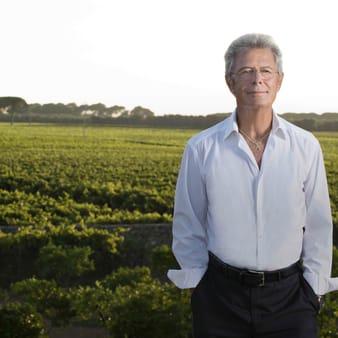
The Cantine Due Palme is a successful example of the fact that prejudices against large cooperatives are often wrong. Because the Cantine Due Palme is large. And incredibly successful. Worldwide. This is a man's "fault". Angelo Maci. A scion of a small winemaking family in Salento recognized the problems of the winegrowers in Puglia at the end of the 1980s. Instead of quality, quantity was produced and delivered mainly as cask wine at rock-bottom prices to better known wine regions as blended wine. But Angelo Maci began to convince small winegrowers to do better, to join the cooperative and gradually increase quality, investing in modern cellar technology and sustainable cultivation.
Over the decades, 15 members have grown to over 1,000, who nurture and care for the best grapes according to the strict quality guidelines of the agronomists and then deliver them to the Cantine Due Palme, where a team of experienced oenologists can apply the appropriate cellar technology to the individual sites and selected grapes to produce high-quality and authentic wines.
"To cultivate a good vineyard, you must first cultivate the person who works it. Wine exists only because there are people who cultivate the soil and look after the grapes every day," says long-term president Maci. But his visions and quite risky investments went much further. Because he was aware that you have to sell the wines. And at prices that are moderate, but which also secure the income of all members and create scope for new investments. These ideas and measures were so successful that other cooperatives joined Due Palme, such as the then much better known Cantine Riforma Fondiaria in Celline and Monteroni Arnesano or Angelini in San Pietro Vernotico and Cantina San Gaetano in Lizzano. Today they all sail under one flag. With a successful sales team they export to over 40 countries around the globe.
Today, the grapes come from over 2,500 hectares of cultivated land. The land between the Adriatic Sea and the Ionian Sea has long been a third sea, one of vines. Many companies outside the cooperative society still produce average mass goods for the discounters here. Due to the size that Cantine Due Palme has reached, one is in the comfortable situation to select and employ qualified personnel. Today the team of agronomists advises the members, among other things, on which soils the suitable grape varieties should be cultivated.
These soils are sandy, loamy and interspersed with clay, but in many places they are only a relatively thin layer on calcareous rocky ridges. Due to the constant sea breezes from both sides of the often only 50 km wide cultivation area, the grapes always remain healthy and hardly any chemical intervention is required. The hot daytime temperatures alternate with cool, windy nights, which makes fruit and good acidity structure possible. We pay close attention to all these influences and select the grapes from the best locations.
For some years now, Cantine Due Palme has also been using almost extinct, autochthonous grape varieties such as Susumaniello and Nero di Troja. In addition, there are of course the draught horses Primitivo and Negroamaro next to Malvasia Nera, Aglianico, Syrah and the white varieties Fiano, Falanghina, Vermentino, Malvasia, Chardonnay and Pinot Grigio. SUPERIORE.DE
"Cantine Due Palme ... is a good example that with good work and clear ideas a cooperative winery can become a safe haven for many small winegrowers."Gambero Rosso 2014
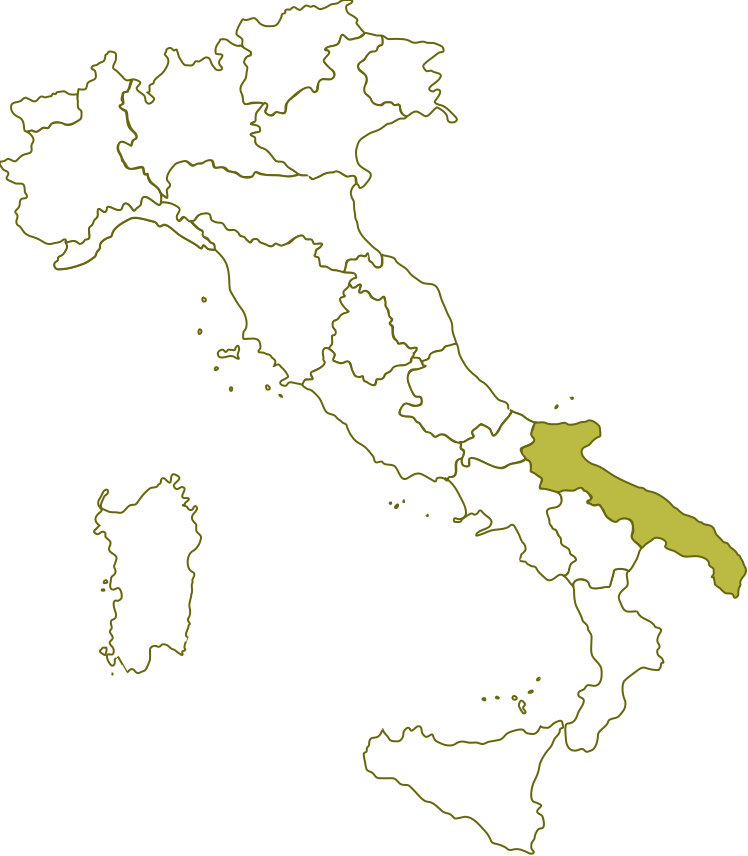
Facts
- Year of foundation: 1989
- President: Angelo Maci
- Oenologist: Nicola Scarano
- Annual production: approx. 12,000,000 bottles
- Vineyard: approx. 2,500 hectares | approx. 1.000 members
- Conventional cultivation
- 24 Years of Expertise
- 3,500+ Wines in Stock
- 350+ Winemakers
- 28,000+ Positive Reviews
- Fully Air-Conditioned Storage