


-
!["San Giovenale" Rosso Lazio VdT s.a.]()
“San Giovenale” Rosso Lazio VdT s.a.
Some wine projects are born out of calculation. This one was born out of one of those happy collisions between man and landscape that cannot be planned. Emanuele Pangrazi, a Roman and entrepreneur, travelled through the Tuscia hills north of Rome in 2006 and stayed. He bought land in Blera, a place whose name few people recognise, but whose history goes back to the Etruscans – the advanced civilisation that carved its necropolises into the tufa here. The winery is named San Giovenale after a nearby Etruscan ruined city. What fascinated him about this part of Lazio was the climatic tension: 300 to 400 metres above sea level, clay-rich soils with stone inclusions, dry winds from the nearby Tyrrhenian Sea. Not a location for Sangiovese, as the soils quickly made clear. But for the varieties of the southern Rhône – grenache, Syrah, Carignan, Tempranillo. Grown as Alberello with 11,000 vines per hectare. The vines fight, compete, plunge deep into the clay. Yield: 25 quintals per hectare.
- Grape variety: Grenache, Syrah, Carignano and Tempranillo
- Cultivation: close to nature
- Maturation: 20 months barrique
- Filtration: yes
- Alcohol content: 15,00 % vol
- Serving temperature: 18‑20 °C
- Storage potential: 2037+
- Closure: natural cork
- Food recommendations
braised veal cheeks with capers and lemon zest - Total extract: 32,85 g/l
- Total acidity: 6,42 g/l
- Residual sugar: 1,95 g/l
- Sulfite: 85 mg/l
- pH value: 3,44
- Allergens
contains sulphites
stored air-conditioned10072600 · 0,75 l · 78,67 €/l · Price (DE) incl. VAT, excl. Shippingavailable immediately
!["Habemus Etichetta Bianca" Rosso Lazio IGT 2023]()
“Habemus Etichetta Bianca” Rosso Lazio IGT 2023
The name was no coincidence. "Habemus" – we have it. The phrase that falls from the balcony of St Peter's Basilica when the cardinals have reached an agreement. Emanuele Pangrazi chose it deliberately: Viterbo, the capital of Tuscia, was itself a papal residence in the 13th century when Rome was too dangerous – when Rome was too dangerous. The same city, the same history, only the wine was different back then. Pangrazi set out to change that in 2006. The vineyards are located at 300 to 400 metres in Blera, on heavy, stony clay soils with southern exposure. No artificial fertilisers, no chemicals – only spring water and plant-based products. All vines are trained as Alberello, the bushy single vine training of the Mediterranean region, with 11,000 plants per hectare. The yield remains at 25 quintals – two small, loose grapes per vine, with thick skins and little pulp. Concentration as a natural principle.
- Grape variety: Grenache, Syrah, Carignano and Tempranillo
- Cultivation: close to nature
- Maturation: 20 months barrique
- Filtration: yes
- Alcohol content: 15,00 % vol
- Serving temperature: 18‑20 °C
- Storage potential: 2045+
- Closure: natural cork
- Food recommendations
roast leg of lamb with rosemary, garlic and white beans - Total extract: 32,98 g/l
- Total acidity: 6,21 g/l
- Residual sugar: 1,98 g/l
- Sulfite: 74 mg/l
- pH value: 3,42
- Allergens
contains sulphites
stored air-conditioned10072123 · 0,75 l · 105,33 €/l · Price (DE) incl. VAT, excl. Shippingavailable immediately
!["Habemus Etichetta Rossa" Rosso Lazio IGT 2020]()
“Habemus Etichetta Rossa” Rosso Lazio IGT 2020
Emanuele Pangrazi is probably Lazio's most ambitious winemaker at the moment. With his extreme planting density and radical yield restriction, he is following a path that is trend-setting for Lazio. After he had fundamentally analysed his terroir and also the climatic conditions, it was clear to him in 2006 that he would plant mainly French grape varieties here according to the principle of the great wines of the Rhone. In addition to his famous Cuvée Habemus (Etichetta Bianca) and the San Giovenale Rosso (assemblage from two vintages of Habemus), he also vinifies four single-varietal Habemus wines, but these are absolutely small.
- Grape variety: 100% Cabernet Franc
- Cultivation: close to nature
- Maturation: 30 months barrique
- Filtration: yes
- Alcohol content: 15,00 % vol
- Serving temperature: 18‑20 °C
- Storage potential: 2049+
- Closure: natural cork
- Total extract: 34,85 g/l
- Total acidity: 6,24 g/l
- Residual sugar: 1,86 g/l
- Sulfite: 74 mg/l
- pH value: 3,39
- Allergens
contains sulphites
stored air-conditioned10072320 · 0,75 l · 172,00 €/l · Price (DE) incl. VAT, excl. Shipping5 units available
!["Habemus Etichetta Rossa" Rosso Lazio IGT 2019]()
“Habemus Etichetta Rossa” Rosso Lazio IGT 2019
Emanuele Pangrazi is probably Lazio's most ambitious winemaker at the moment. With his extreme planting density and radical yield restriction, he is following a path that is trend-setting for Lazio. After he had fundamentally analysed his terroir and also the climatic conditions, it was clear to him in 2006 that he would plant mainly French grape varieties here according to the principle of the great wines of the Rhone. In addition to his famous Cuvée Habemus (Etichetta Bianca) and the San Giovenale Rosso (assemblage from two vintages of Habemus), he also vinifies four single-varietal Habemus wines, but these are absolutely small.
- Grape variety: 100% Cabernet Franc
- Cultivation: close to nature
- Maturation: 30 months barrique
- Filtration: yes
- Alcohol content: 15,00 % vol
- Serving temperature: 18‑20 °C
- Storage potential: 2048+
- Closure: natural cork
- Total extract: 35,25 g/l
- Total acidity: 6,30 g/l
- Residual sugar: 1,99 g/l
- Sulfite: 75 mg/l
- pH value: 3,40
- Allergens
contains sulphites
stored air-conditioned10072319 · 0,75 l · 172,00 €/l · Price (DE) incl. VAT, excl. Shipping< 24 units available
!["Habemus Etichetta Rossa" Rosso Lazio IGT 2021]()
“Habemus Etichetta Rossa” Rosso Lazio IGT 2021
Emanuele Pangrazi is probably Lazio's most ambitious winemaker at the moment. With his extreme planting density and radical yield restriction, he is following a path that is trend-setting for Lazio. After he had fundamentally analysed his terroir and also the climatic conditions, it was clear to him in 2006 that he would plant mainly French grape varieties here according to the principle of the great wines of the Rhone. In addition to his famous Cuvée Habemus (Etichetta Bianca) and the San Giovenale Rosso (assemblage from two vintages of Habemus), he also vinifies four single-varietal Habemus wines, but these are absolutely small.
- Grape variety: 100% Cabernet Franc
- Cultivation: close to nature
- Maturation: 30 months barrique
- Filtration: yes
- Alcohol content: 15,00 % vol
- Serving temperature: 18‑20 °C
- Storage potential: 2050+
- Closure: natural cork
- Total extract: 34,15 g/l
- Total acidity: 6,29 g/l
- Residual sugar: 1,89 g/l
- Sulfite: 71 mg/l
- pH value: 3,37
- Allergens
contains sulphites
stored air-conditioned10072321 · 0,75 l · 181,33 €/l · Price (DE) incl. VAT, excl. Shipping7 units available
!["Habemus Etichetta Blu" Rosso Lazio IGT 2020]()
“Habemus Etichetta Blu” Rosso Lazio IGT 2020
Emanuele Pangrazi is probably the most ambitious winemaker in Lazio at the moment. With his extreme planting density and radical yield restriction, he is following a path that is pioneering for Lazio. After thoroughly analysing his terroir and the climatic conditions, it was clear to him in 2006 that he would plant primarily French grape varieties based on the principle of the great wines of the Rhone. In addition to his famous Cuvée Habemus (Etichetta Bianca) and the San Giovenale Rosso (assemblage of two vintages of Habemus), he also vinifies four single-varietal Habemus wines, albeit in very small quantities.
- Grape variety: 100% Grenache
- Cultivation: close to nature
- Maturation: 30 months barrique
- Filtration: yes
- Alcohol content: 15,00 % vol
- Serving temperature: 18‑20 °C
- Storage potential: 2049+
- Closure: natural cork
- Total extract: 35,30 g/l
- Total acidity: 6,50 g/l
- Residual sugar: 1,81 g/l
- Sulfite: 75 mg/l
- pH value: 3,35
- Allergens
contains sulphites
stored air-conditioned10072520 · 0,75 l · 181,33 €/l · Price (DE) incl. VAT, excl. Shipping10 units available
!["Habemus Etichetta Nera" Rosso Lazio IGT 2020]()
“Habemus Etichetta Nera” Rosso Lazio IGT 2020
Text to follow shortly. SUPERIORE.DE
- Grape variety: 100% Syrah
- Cultivation: close to nature
- Maturation: 30 months barrique
- Filtration: yes
- Alcohol content: 15,00 % vol
- Serving temperature: 18‑20 °C
- Storage potential: 2049+
- Closure: natural cork
- Total extract: 35,87 g/l
- Total acidity: 6,45 g/l
- Residual sugar: 2,10 g/l
- Sulfite: 75 mg/l
- pH value: 3,36
- Allergens
contains sulphites
stored air-conditioned10072420 · 0,75 l · 181,33 €/l · Price (DE) incl. VAT, excl. Shipping4 units available
!["Habemus Etichetta Blu" Rosso Lazio IGT 2021]()
“Habemus Etichetta Blu” Rosso Lazio IGT 2021
Emanuele Pangrazi is probably the most ambitious winemaker in Lazio at the moment. With his extreme planting density and radical yield restriction, he is following a path that is pioneering for Lazio. After thoroughly analysing his terroir and the climatic conditions, it was clear to him in 2006 that he would plant primarily French grape varieties based on the principle of the great wines of the Rhone. In addition to his famous Cuvée Habemus (Etichetta Bianca) and the San Giovenale Rosso (a blend of two vintages of Habemus), he also produces four single-varietal Habemus wines, albeit in very small quantities.
- Grape variety: 100% Grenache
- Cultivation: close to nature
- Maturation: 30 months barrique
- Filtration: yes
- Alcohol content: 15,00 % vol
- Serving temperature: 18‑20 °C
- Storage potential: 2050+
- Closure: natural cork
- Total extract: 34,75 g/l
- Total acidity: 6,39 g/l
- Residual sugar: 1,85 g/l
- Sulfite: 77 mg/l
- pH value: 3,36
- Allergens
contains sulphites
stored air-conditioned10072521 · 0,75 l · 185,33 €/l · Price (DE) incl. VAT, excl. Shipping8 units available
!["Habemus Etichetta Nera" Rosso Lazio IGT 2021]()
“Habemus Etichetta Nera” Rosso Lazio IGT 2021
Text to follow shortly. SUPERIORE.DE
- Grape variety: 100% Syrah
- Cultivation: close to nature
- Maturation: 30 months barrique
- Filtration: yes
- Alcohol content: 15,00 % vol
- Serving temperature: 18‑20 °C
- Storage potential: 2050+
- Closure: natural cork
- Total extract: 35,27 g/l
- Total acidity: 6,41 g/l
- Residual sugar: 1,99 g/l
- Sulfite: 76 mg/l
- pH value: 3,34
- Allergens
contains sulphites
stored air-conditioned10072421 · 0,75 l · 185,33 €/l · Price (DE) incl. VAT, excl. Shipping< 24 units available
!["Habemus Etichetta Nera" Rosso Lazio IGT 2023]()
“Habemus Etichetta Nera” Rosso Lazio IGT 2023
Around 300 bottles. No more. Anyone who knows the Etichetta Nera knows: you don't just buy it like that – you get it if you're lucky. The Syrah on the black label grows on a single hectare in Blera, 380 metres above sea level, exposed to the south-east, on heavy clay with rock inclusions. The same vineyard from which Emanuele Pangrazi and Marco Casolanetti have always distilled their Syrah fraction for the Habemus blend – the part that Pangrazi once described as the "mouth of Habemus": the fleshy, the dark, the substantial. What used to carry the body of the blend stands alone here for the first time.
- Grape variety: 100% Syrah
- Cultivation: close to nature
- Maturation: 30 months barrique
- Filtration: yes
- Alcohol content: 15,00 % vol
- Serving temperature: 18‑20 °C
- Storage potential: 2051+
- Closure: natural cork
- Food recommendations
wild boar ragout with black olives and pappardelle - Total extract: 34,77 g/l
- Total acidity: 6,38 g/l
- Residual sugar: 1,82 g/l
- Sulfite: 72 mg/l
- pH value: 3,33
- Allergens
contains sulphites
stored air-conditioned10072423 · 0,75 l · 185,33 €/l · Price (DE) incl. VAT, excl. Shipping11 units available
!["Habemus Etichetta Rossa" Rosso Lazio IGT 2022]()
“Habemus Etichetta Rossa” Rosso Lazio IGT 2022
One hectare. 13,000 vines. 1,000 bottles. You don't really need to say more – and yet that would be too little. The Cabernet Franc of Etichetta Rossa grows on a single vineyard in Blera, south-east facing, 380 metres above sea level, heavy clay soils with stone inclusions. The planting density – 13,000 vines per hectare – exceeds even the already extreme density of the other San Giovenale plots. Each plant fights for water, light and space. The yield is 12 quintals per hectare – half as much as the Habemus Bianca. What remains is concentrated to the limit of what is possible.
- Grape variety: 100% Cabernet Franc
- Cultivation: close to nature
- Maturation: 30 months barrique
- Filtration: yes
- Alcohol content: 15,00 % vol
- Serving temperature: 18‑20 °C
- Storage potential: 2051+
- Closure: natural cork
- Food recommendations
braised beef brisket with truffle butter sauce and potato gratin - Total extract: 33,89 g/l
- Total acidity: 6,18 g/l
- Residual sugar: 1,69 g/l
- Sulfite: 73 mg/l
- pH value: 3,36
- Allergens
contains sulphites
stored air-conditioned10072322 · 0,75 l · 185,33 €/l · Price (DE) incl. VAT, excl. Shipping< 24 units available
!["Habemus Etichetta Blu" Rosso Lazio IGT 2023]()
“Habemus Etichetta Blu” Rosso Lazio IGT 2023
If Syrah is the mouth of Habemus, then Grenache is its nose. This is how Emanuele Pangrazi himself described it one afternoon in the Bottaia of Blera, when he drew directly from the barrel with a pipette and placed two glasses next to each other: one almost black, the other bright ruby red, almost transparent. Two worlds, one terroir. The Etichetta Blu is pure Grenache – and it is the most sensitive, aromatically rich and surprising wine in the San Giovenale portfolio. The same vineyards in Blera, the same clay soils with stone inclusions, the same altitude of 300 to 400 metres, the same oceanic breeze from the Tyrrhenian Sea. The same extreme planting density, the same organically certified work without chemicals or synthesis. And yet: a completely different result.
- Grape variety: 100% Grenache
- Cultivation: close to nature
- Maturation: 30 months barrique
- Filtration: yes
- Alcohol content: 15,00 % vol
- Serving temperature: 18‑20 °C
- Storage potential: 2051+
- Closure: natural cork
- Food recommendations
tournedos rossini with truffle and foie gras parfait - Total extract: 33,22 g/l
- Total acidity: 6,29 g/l
- Residual sugar: 1,75 g/l
- Sulfite: 75 mg/l
- pH value: 3,35
- Allergens
contains sulphites
stored air-conditioned10072523 · 0,75 l · 185,33 €/l · Price (DE) incl. VAT, excl. Shipping11 units available
!["Habemus Etichetta Oro" Bianco Lazio IGT 2023]()
“Habemus Etichetta Oro” Bianco Lazio IGT 2023
A white wine as a final. Production: 500 bottles per vintage. Anyone who only knows San Giovenale from its reds will pause for a moment here – and then realise that this winery has always thought bigger than the obvious answer. The story of "Oro" begins in 2013, not in the vineyard, but in a laboratory. Emanuele Pangrazi collaborated with ARSIAL, the scientific research institute of the Lazio region, to test whether Marsanne and Roussanne – the great white grape varieties of the northern Rhône, home to Hermitage and Crozes-Hermitage – could thrive in Tuscia. The result of this experiment was clear: yes. The dry climate of Blera, ventilated by the Tyrrhenian Sea, the heavy clay soils, the altitude – everything fitted. It was the first time that these varieties had ever been planted in Lazio.
- Grape variety: Marsanne, Roussanne
- Cultivation: close to nature
- Maturation: 16 months large oak barrel
- Filtration: yes
- Alcohol content: 14,50 % vol
- Serving temperature: 10‑12 °C
- Storage potential: 2036+
- Closure: natural corks
- Food recommendations
breton lobster with tarragon butter and baguette - Total extract: 25,22 g/l
- Total acidity: 6,59 g/l
- Residual sugar: 3,47 g/l
- Sulfite: 106 mg/l
- pH value: 3,36
- Allergens
contains sulphites
stored air-conditioned10070123 · 0,75 l · 193,33 €/l · Price (DE) incl. VAT, excl. Shipping< 24 units available
Limitation of 3 articles per customer!["Habemus Etichetta Bianca" Rosso Lazio IGT 2023 <br>MAGNUM]()
“Habemus Etichetta Bianca” Rosso Lazio IGT 2023 · MAGNUM
The name was no coincidence. "Habemus" – we have it. The phrase that falls from the balcony of St Peter's Basilica when the cardinals have reached an agreement. Emanuele Pangrazi chose it deliberately: Viterbo, the capital of Tuscia, was itself a papal residence in the 13th century when Rome was too dangerous – when Rome was too dangerous. The same city, the same history, only the wine was different back then. Pangrazi set out to change that in 2006. The vineyards are located at 300 to 400 metres in Blera, on heavy, stony clay soils with southern exposure. No artificial fertilisers, no chemicals – only spring water and plant-based products. All vines are trained as Alberello, the bushy single vine training of the Mediterranean region, with 11,000 plants per hectare. The yield remains at 25 quintals – two small, loose grapes per vine, with thick skins and little pulp. Concentration as a natural principle.
- Grape variety: Grenache, Syrah, Carignano and Tempranillo
- Cultivation: close to nature
- Maturation: 20 months barrique
- Filtration: yes
- Alcohol content: 15,00 % vol
- Serving temperature: 18‑20 °C
- Storage potential: 2047+
- Closure: natural cork
- Food recommendations
roast leg of lamb with rosemary, garlic and white beans - Total extract: 32,98 g/l
- Total acidity: 6,21 g/l
- Residual sugar: 1,98 g/l
- Sulfite: 74 mg/l
- pH value: 3,42
- Allergens
contains sulphites
stored air-conditioned10072223 · 1,5 l · 119,33 €/l · Price (DE) incl. VAT, excl. Shipping6 units available


Contrary to expectations, Emanuele Pangrazi presses his award-winning premium wines in an area of Lazio where many – given the lack of wine tradition – tend to produce olive oil. What does the courageous newcomer do differently in his organic winery San Giovenale? Our impression is: simply everything, because despite his still very young vines, he is already creating amazingly expressive red wines that are among the best-rated in the country.
Without any previous oenological knowledge, the winemaker's success story up to this point turned out to be a true voyage of discovery. In 2006, a spontaneous family trip led him to Blera, in the picturesque province of Viterbo. In the midst of this untouched nature, the Roman entrepreneur decided to harmonise the idea of his own winery with the hilly landscape of the historic Tuscia region and to preserve the natural area.
His land is surrounded by several natural parks and seems to be made for wine growing. The Sabatini Mountains to the south and the Monti Cimini to the north form a kind of corridor for a dry sea breeze blowing in from the Tyrrhenian Sea. But since local varieties such as Sangiovese find it difficult to thrive on the clayey subsoil, the winemaker worked with various consultants to find suitable grape varieties that would grow more effortlessly in this environment.
The encounter with the talented oenologist Marco Casolanetti from the renowned Oasi degli Angeli winery ultimately led to a groundbreaking insight: the soils, the breezy climate and the many hours of sunshine immediately reminded Casolanetti of the French Rhone Valley. In view of the similar conditions, it seemed most sensible to Emanuele to cultivate the typical varieties from the other side of the Mediterranean coast in order to produce the wines of San Giovenale from scratch according to his natural and environmentally friendly vision.
At an altitude of 400 metres, he planted Carignan, Grenache, Syrah, Tempranillo and Cabernet Franc according to the Alberello system – that is, without the typical wires connecting the vines. Starting with the choice of Marco Casolanetti as advisor, every decision is made in favour of sustainability and quality. Instead of chemicals, natural products based on garlic, algae or propolis are used in these vineyards.
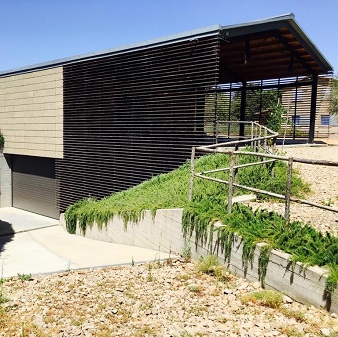
In the wine cellar – an architectural work of art that completely dispenses with fossil fuels – his hand-picked grapes macerate for about two weeks in the most modern steel tanks. Emanuele is also particularly fond of spontaneous fermentation, initiated by indigenous yeasts, and at the end of this process he transfers all the wines to new French barriques, where they mature over a period of 20 months.
"I think it's the small details that distinguish a good wine from a great one," Emanuele tells us in conversation, explaining why he scrutinises every step of production, no matter how small. No wonder, then, that he manages to impress even the most demanding wine lovers with his Habemus wines, not only as a qualitative pioneer of the region. SUPERIORE.DE

Facts
- Year of foundation: 2006
- Owner: Emanuele Pangrazi
- Oenologist: Emanuele Pangrazi
- Consultant: Marco Casolanetti
- Annual production: approx. 12,000 bottles
- Vineyard area: approx. 15 hectares
- Organic & biodynamic viticulture (not certified)