


-
!["Granbruno" Rosso Toscana IGT 2023 (BIO)]()
“Granbruno” Rosso Toscana IGT 2023 (BIO)
An uncomplicated Tuscan from the organically cultivated vineyards of Castello di Radda, which are south-facing on the hills behind the winery. The cuvée of 60% Merlot and 40% Sangiovese grows on clay-rich soils with a limestone content, which gives the wine its fruity and accessible character. After manual harvesting, the wine is vinified in temperature-controlled stainless steel tanks with a maceration period of around ten days. The wine is matured partly in steel and partly in tonneaux, with bottling taking place in the summer after the harvest.
- Grape varieties: 60% Merlot, 40% Sangiovese
- Cultivation: biological
- Maturation: 6 months large wooden barrel/stainless steel tank
- Filtration: yes
- Alcohol content: 14,00 % vol
- Serving temperature: 16‑18 °C
- Storage potential: 2029+
- Closure: natural cork
- Total extract: 29,17 g/l
- Total acidity: 5,65 g/l
- Residual sugar: 2,45 g/l
- Sulfite: 79 mg/l
- pH value: 3,47
- Eco-Control-No.: IT‑BIO‑015
- Allergens
contains sulphites
stored air-conditioned29132523 · 0,75 l · 14,53 €/l · Price (DE) incl. VAT, excl. Shippingavailable immediately
![Chianti Classico DOCG 2022 (BIO)]()
Chianti Classico DOCG 2022 (BIO)
Radda in Chianti is one of the coolest municipalities in the appellation. Here, at an altitude of 400 metres, where dense forests surround the vineyards and stone-walled country lanes run through the hills, Sangiovese thrives in ideal conditions. The strong day-night temperature fluctuations give the grapes the freshness and aromatic clarity that make Radda wines unmistakable. Castello di Radda has been cultivating its vineyards in a fully certified organic way since 2020, with each parcel vinified separately and only brought together at the time of blending. The cuvée of 95% Sangiovese and 5% Canaiolo is destemmed after manual harvesting and fermented in temperature-controlled stainless steel tanks. Maceration on the skins lasts two to three weeks – this is made possible by the perfect physiological ripeness of the grapes. Malolactic fermentation takes place in both steel and wood before the wine matures partly in 500-litre Liters and partly in 20-hectolitre French and Slavonian oak barrels. Several months of bottle ageing round off the harmonious development.
- Grape varieties: 95% Sangiovese, 5% Canaiolo
- Cultivation: biological
- Maturation: 12 months 80/20 tonneau/large oak barrel
- Filtration: yes
- Alcohol content: 14,00 % vol
- Serving temperature: 16‑18 °C
- Storage potential: 2031+
- Closure: natural cork
- Total extract: 29,78 g/l
- Total acidity: 6,26 g/l
- Residual sugar: 0,10 g/l
- Sulfite: 68 mg/l
- pH value: 3,46
- Eco-Control-No.: IT‑BIO‑015
- Allergens
contains sulphites - Nutritional Information per 100 ml
- Energy in kcal: 84 kcal
- Energy in kJ: 347 kJ
- Carbohydrates: 1,00 g
- Of which sugar: 0,60 g
stored air-conditioned29132122 · 0,75 l · 19,87 €/l · Price (DE) incl. VAT, excl. Shippingavailable immediately
![Chianti Classico Riserva DOCG 2021 (BIO)]()
Chianti Classico Riserva DOCG 2021 (BIO)
Two names characterise this Riserva: Il Corno and Poggio Selvale. The Sangiovese grapes from which Castello di Radda creates its classic Riserva style come from these two top vineyards, situated between 350 and 450 metres above sea level. The clayey-calcareous soils with their high proportion of Galestro and Alberese – the characteristic limestone slate of the region – give the wine mineral depth and structural complexity. In this coolest zone of the Chianti Classico, where dense forests surround the vineyards and the temperature fluctuations between day and night are particularly pronounced, the Sangiovese reveals its most elegant side. After manual harvesting, the grapes are destemmed and fermented in 50-hectolitre stainless steel tanks. Maceration on the skins lasts three to four weeks – a luxury that only fully ripe grapes from top vineyards allow. Malolactic fermentation takes place in wood before the wine begins its 20-month maturation: in French second and third passage tonneaux and in 20-hectolitre Slavonian oak barrels. A nine-month bottle maturation completes the development.
- Grape variety: 100% Sangiovese
- Cultivation: biological
- Maturation: 20 months tonneau/large oak barrel
- Filtration: yes
- Alcohol content: 14,50 % vol
- Serving temperature: 18‑20 °C
- Storage potential: 2035+
- Closure: natural cork
- Total extract: 29,96 g/l
- Total acidity: 5,92 g/l
- Residual sugar: 1,15 g/l
- Sulfite: 84 mg/l
- pH value: 3,45
- Eco-Control-No.: IT‑BIO‑015
- Allergens
contains sulphites
stored air-conditioned29132221 · 0,75 l · 32,00 €/l · Price (DE) incl. VAT, excl. Shippingavailable immediately
!["Vigna il Corno" Chianti Classico Gran Selezione DOCG 2016]()
“Vigna il Corno” Chianti Classico Gran Selezione DOCG 2016
The strictly selected grapes come from the vineyard "Il Corno" of approx. 400 m altitude with ideal southern exposure. Bright, sparkling ruby red. Well structured nose of blackberries, cassis, some cedar and shoe polish. Medium ripe, quite fresh fruit on the palate, yet supple and well balanced with all the volume. In the rest of the drink with great finesse, coolness and liveliness, the finish is long with well integrated wood, red fruitiness, with a slightly salty vein and lots of spice. A harmonious and well-proportioned top wine of the house, which can rightly bear the highest quality level Gran Selezione. SUPERIORE.DE
- Grape variety: 100% Sangiovese
- Cultivation: conventional
- Maturation: 25 months 500l wooden barrel
- Filtration: yes
- Alcohol content: 14,50 % vol
- Serving temperature: 18‑20 °C
- Storage potential: 2036+
- Closure: natural cork
- Total extract: 29,85 g/l
- Total acidity: 6,15 g/l
- Residual sugar: 1,25 g/l
- Sulfite: 75 mg/l
- pH value: 3,35
- Allergens
contains sulphites
stored air-conditioned29132316 · 0,75 l · 60,00 €/l · Price (DE) incl. VAT, excl. Shippingavailable immediately


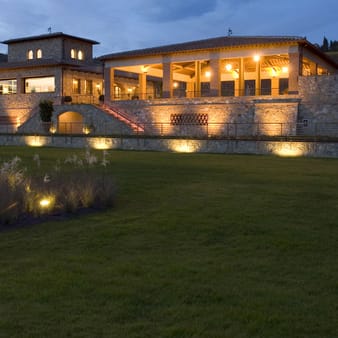
The charming winery Castello di Radda is situated on a hill west of the village that gave its name to it, directly below the Castello di Volpaia. Next to the wineries Orlandi Contucci Ponno in Abruzzo and Lo Sparviere in the Lombard region of Franciacorta, famous for its sparkling wines, it is another ambitious wine project of the industrial dynasty Gussalli Beretta. With great ambition and spurred on by their love of fine wines, the family rebuilt the old estate not far from Volpaia, another top location in the Chianti region, which comprises 170 hectares of land. The loamy and calcareous soils with a high skeleton content, combined with favourable south-west and south-east locations, provide ideal conditions for Sangiovese and Canaiolo vines, which are reflected in authentic Chianti Classico wines.
When building the cellar, the Beretta family consistently followed their traditional path, opting for an underground installation designed by the architect Spartaco Mori and against the construction of a production plant in the middle of the picturesque Tuscan countryside. In 'sanctum' of the Castello di Radda winery, the harvested grapes are first carefully sorted in order to rule out the slightest mistake from the outset. During the vinification only minimal interventions are made. The IGT wines, ripened in small French oak barrels, which also include pure and blended IGT wines made from Merlot and/or Sangiovese, should develop according to their nature - also called controlled idleness in technical jargon.
The exquisite elegant Chianti Classico wines present themselves rich in finesse and possess a fine fullness of aroma. The terroir comes into its own in the glass - an achievement that is also appreciated by established wine guides and critics as Gambero RossoRobert Parkerappropriate. The fact that the products of the Chianti Classico winery are increasingly becoming the focus of wine lovers is by no means a matter of course in view of the still young history of the winery. The oenologist Maurizio Castelli, however, is a graduate and very experienced agricultural engineer in the Beretta family's boat, who was involved in the great success of the Supertoscans and who possesses the same high sensitivity of the estate owners towards the environment and high-quality cultivation techniques. SUPERIORE.DE

Facts
- Year of foundation: 2003
- Owner: Family Gussalli Beretta
- Oenologist: Maurizio Castelli
- Annual production: approx. 100,000 bottles
- Vineyard: approx. 45 hectares
- Conventional cultivation