


-
!["Pietraluna" Negroamaro del Salento IGP 2021]()
“Pietraluna” Negroamaro del Salento IGP 2021
Felline in Manduria stands for Puglia's indigenous grape varieties and the pioneering work of Gregory Perrucci, who has been shaping the region since 1992. Pietraluna is a single-varietal Negroamaro from Salento – strong, spicy, authentic. The grapes come from vineyards around Manduria, where calcareous soils with iron oxide deposits form the typical terra rossa. After manual harvesting, fermentation takes place in stainless steel tanks, followed by brief ageing to preserve the fruit.
- Grape variety: 100% Negroamaro
- Cultivation: conventional
- Maturation: stainless steel
- Filtration: yes
- Alcohol content: 14,50 % vol
- Serving temperature: 16‑18 °C
- Storage potential: 2029
- Closure: Diam
- Total extract: 37,55 g/l
- Total acidity: 5,85 g/l
- Residual sugar: 6,82 g/l
- Sulfite: 142 mg/l
- pH value: 3,48
- Allergens
contains sulphites
stored air-conditioned15082521 · 0,75 l · 10,53 €/l · Price (DE) incl. VAT, excl. Shippingavailable immediately
!["Sum" Susumaniello Salento IGP 2021]()
“Sum” Susumaniello Salento IGP 2021
Medium-bodied ruby red. On the nose, rich, dark berry fruit, forest floor and hints of chocolate. On the palate, it spreads softly and creamily, flanked by fresh berry aromas and a taut acidity that forms a wonderful harmony with the fruit and tannin. A drop full of character from an almost extinct, autochthonous grape variety. SUPERIORE.DE
- Grape variety: 100% Susumaniello
- Cultivation: close to nature
- Maturation: 12/18 months stainless steel/bottle ageing
- Filtration: yes
- Alcohol content: 14,00 % vol
- Serving temperature: 16‑18 °C
- Storage potential: 2028+
- Closure: natural cork
- Food recommendations
meat dishes - Total extract: 31,65 g/l
- Total acidity: 5,90 g/l
- Residual sugar: 2,85 g/l
- Sulfite: 86 mg/l
- pH value: 3,36
- Allergens
contains sulphites
stored air-conditioned15083621 · 0,75 l · 15,87 €/l · Price (DE) incl. VAT, excl. Shippingavailable immediately
!["Felline" Primitivo di Manduria DOP 2022]()
“Felline” Primitivo di Manduria DOP 2022
Gregory Perrucci has given Primitivo di Manduria back its dignity. When he founded the Felline winery in 1992, Primitivo was still a mass-produced commodity for tanker exports – cheap blended wine without prestige. Perrucci recognised the potential of the grape variety and began to systematically investigate the terroirs around Manduria. With his Accademia dei Racemi, founded in 1996, he became a pioneer in the valorisation of indigenous Apulian varieties. Today, Felline is considered a reference for Primitivo di Manduria – thanks to its work on different types of soil (terra rossa, white earth, black earth, sand) and its uncompromising focus on quality. This basic Primitivo comes from different plots of the 120 hectares of vineyards, which are organically farmed. Hand-picked, vinified separately according to soil type, matured for six months in French barriques – a classic interpretation of the variety.
- Grape variety: 100% Primitivo
- Cultivation: close to nature
- Maturation: 6 months in barrique
- Filtration: yes
- Alcohol content: 14,00 % vol
- Serving temperature: 16‑18 °C
- Storage potential: 2029+
- Closure: Diam
- Food recommendations
salami, medieval cheese, pasta - Total extract: 38,00 g/l
- Total acidity: 6,00 g/l
- Residual sugar: 7,00 g/l
- Sulfite: 140 mg/l
- pH value: 3,50
- Allergens
contains sulphites
stored air-conditioned15083022 · 0,75 l · 17,20 €/l · Price (DE) incl. VAT, excl. Shippingavailable immediately
!["Giravolta" Primitivo di Manduria DOP 2020 (BIO)]()
“Giravolta” Primitivo di Manduria DOP 2020 (BIO)
Giravolta – a name with a history. This was the name of the racehorse that once galloped across the Pozzopalo stud farm and always turned round abruptly in front of the old tuff quarry. This "U-turn" gave the wine its name, but it is the terra bianca, the white earth, that characterises it. While the basic Primitivo comes from the Terra Rossa, the Giravolta grows on calcareous, white soil, created by the breaking up of limestone. The tuffy, stony composition ensures rapid water drainage, but the porous stones also store moisture for the roots.
- Grape variety: 100% Primitivo
- Cultivation: biological
- Maturation: 9 months in barrique
- Filtration: yes
- Alcohol content: 14,50 % vol
- Serving temperature: 18‑20 °C
- Storage potential: 2030
- Closure: natural cork
- Food recommendations
salami, meat, offal, terrines - Total extract: 35,80 g/l
- Total acidity: 7,10 g/l
- Residual sugar: 8,00 g/l
- Sulfite: 120 mg/l
- pH value: 3,40
- Eco-Control-No.: IT‑BIO‑004
- Allergens
contains sulphites
stored air-conditioned15082220 · 0,75 l · 18,53 €/l · Price (DE) incl. VAT, excl. Shippingavailable immediately
!["Zinfandel" Terra Nera Primitivo di Manduria DOP 2020 (BIO)]()
“Zinfandel” Terra Nera Primitivo di Manduria DOP 2020 (BIO)
A Zinfandel with an Italian soul: Terra Nera Primitivo comes from organically farmed plots around Manduria, where old vines are rooted in red soil with limestone veins – a terroir that allows Primitivo (internationally: Zinfandel) to develop to its full potential. Rich purple in the glass with a garnet-red centre. The bouquet is dark, dense and multi-layered: blackcurrant, dried figs, dark chocolate, tobacco leaf, clove and a hint of graphite. Full-bodied on the palate, but not overloaded, with ripe fruit, balanced acidity and finely polished tannins. The use of wood remains discreet, the structure firm and the finish remarkably clear. An expressive, organically produced Primitivo from 60 to 70-year-old vines that skilfully combines power and precision! SUPERIORE.DE
- Grape variety: 100% Primitivo
- Cultivation: biological
- Maturation: stainless steel and barrique
- Filtration: yes
- Alcohol content: 14,50 % vol
- Serving temperature: 18‑20 °C
- Storage potential: 2031+
- Closure: natural cork
- Food recommendations
grilled, braised meat - Total extract: 36,78 g/l
- Total acidity: 6,09 g/l
- Residual sugar: 6,57 g/l
- Sulfite: 95 mg/l
- pH value: 3,45
- Eco-Control-No.: IT‑BIO‑004
- Allergens
contains sulphites
stored air-conditioned15082320 · 0,75 l · 22,53 €/l · Price (DE) incl. VAT, excl. Shippingavailable immediately
!["Dunico" Primitivo di Manduria DOP 2019]()
“Dunico” Primitivo di Manduria DOP 2019
Dunico – unique in the dunes. The name already reveals what distinguishes this wine from all other Primitivo: It comes from vineyards right on the coast, where sandy soils turn into dunes and the vines still grow on their original rootstock, ungrafted, ungrafted, like before the phylloxera catastrophe. It is an absolute rarity today, as most of these coastal vineyards fell victim to the "holiday home building frenzy". What remains are a few plots with ancient bush vines and extremely low yields, which produce a Primitivo of exceptional intensity and concentration. Sandy soil protects against phylloxera – and gives the wine a unique minerality and elegance that is rarely found in Primitivo. The grapes are harvest at the end of August, earlier than all other crus, as the grapes ripen more quickly here due to the proximity to the sea and the warmth of the sand.
- Grape variety: 100% Primitivo
- Cultivation: close to nature
- Maturation: 9‑12 months in barrique
- Filtration: yes
- Alcohol content: 15,50 % vol
- Serving temperature: 16‑18 °C
- Storage potential: 2035+
- Closure: natural cork
- Food recommendations
piquant cheeses, meat dishes - Total extract: 39,25 g/l
- Total acidity: 6,05 g/l
- Residual sugar: 7,87 g/l
- Sulfite: 106 mg/l
- pH value: 3,48
- Allergens
contains sulphites
stored air-conditioned15082719 · 0,75 l · 38,67 €/l · Price (DE) incl. VAT, excl. Shippingavailable immediately


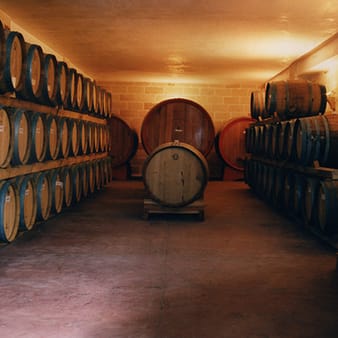
When Gregory Perrucci is mentioned that he is celebrated by the international press as the "Saviour of the Primitivo", he just smiles and replies: "Oh, that was a long time ago, we are now pursuing completely different ideas! And there's no shortage of ideas. Maybe because the creative guy actually wanted to become a pianist. But after the conservatory, he and his siblings were to take over his father's huge business. Because father Costantino Perrucci was one of the biggest cask wine producers in Apulia, who blended wines from different producers in the 1970s and 80s and delivered them to large wineries or to the famous vermouth producer Martini & Rossi.
However, Gregory did not find this type of business forward-looking, so in 1994 he bought his first 9 hectares and a vineyard named after the archaeological site near his home town of Manduria: Felline. Already with the first two vintages, of which there were only 6,000 bottles, he achieved quite a reputation with his Primitivo. From the very beginning, his vision was to focus on autochthonous grape varieties in a classic tree-like upbringing. Economically quite risky, because these "Albarello" vines, as they are called here, can only be cultivated manually in a complicated way, which is why many of these older vineyards were no longer cultivated and were available at low prices. Thus, the Felline winery was able to grow rapidly.
This inspired some young winemakers in the area, so in 1996 Gregory Perrucci and his wife Elisabetta decided to found the "Accademia dei Racemi". At first simply as an exchange of ideas between the winegrowers. This resulted in a unique strategy that made all of them successful together, as the small businesses could afford to call in agronomists and geologists for advice and to adapt the grape varieties specifically to the soil and location.
This is because this region of Puglia has various soils of sand, loam, tuff or clay, all of which are, however, only a relatively thin layer on a limestone rock. The Masseria Pepe, Primitivo on warm sandy soils near the sea, Sinfarosa with black soil, the Tenuta Pozzopalo with soils of tuff and dark soil, Torre Guaceto, where the almost extinct grape varieties Ottavianello and Susumaniello are replanted, and Casale Bevagna in Guagnano, where the reddish-brown soils typical of Puglia predominate.
The wines of the individual estates are vinified separately, the vineyards are mostly managed in a natural/organic way and the emphasis is placed on autochthonous grape varieties. In addition to the red grape varieties Primitivo di Manduria, Negroamaro, Malvasia Nera, Ottavianello and Susumaniello, white wine varieties such as Verdeca, Vermentino and Fiano have also become highly successful.
Gregory Perrucci discovered with Robert Cipresso at the end of the nineties the almost disappeared grape variety Fiano Minutolo in the hills of Martina Franca, where the Verdeca also comes from. Presumably both were grown there at that time for the production of vermouth. However, Fiano Minutolo is not related to the Fiano known from Campania, but to Moscato. The result is now a white wine, which consists of 70% Fiano Camano and 30% Fiano Minutolo - and has become the new hit. Because, as I said, Gregory Perrucci and his partner in the Accademia, Salvatore Mero, never run out of ideas. And while they are still chatting and tasting with Salvatore, Gregory is already playing his piano again. Or he disappears to the nearby sea and "picks" sea urchins and mussels for dinner. SUPERIORE.DE
"Accedemia dei Racemi is not an academy, but rather the fruit of an idea of Gregorio Perrucci. The son of a great producer of blended wine, Gregorio founded Pervini with his siblings in 1993. The aim was to select and bottle the most interesting wines from his father's stock. But after a short time the three of them realized that pure bottling without their own grapes was unsatisfactory. In 1994 the Felline estate was bought with nine hectares and for the first time it was possible to produce wine from own grapes. Gregorio was so enthusiastic about the results that he was able to win over a number of winemakers for his project 'Accedemia dei Racemi', which develops the wines of the individual estates separately and pays particular attention to producing well-tended grapes. The likeable thoroughbred entrepreneur and pianist - his grand piano stands next to his desk - has made a decisive contribution to paving the way for the Primitivo to go abroad with his commitment". Merum
"Gregory Perrucci created here a kind of rescue company for small traditional wineries that were threatened with extinction: the Masseria Pepe, whose Primitivo vines grow on sandy soils near the sea, the Sinfarosa estate with black, deep soil, the Tenuta Pozzopalo on a wind-blown hill of tuff and dark soil, Torre Guaceto, where Ottovianello and Susumaniello vines found a new home, and Casale Bevagna with red soils of medium density in the municipality of Guagnano." Gambero Rosso 2010
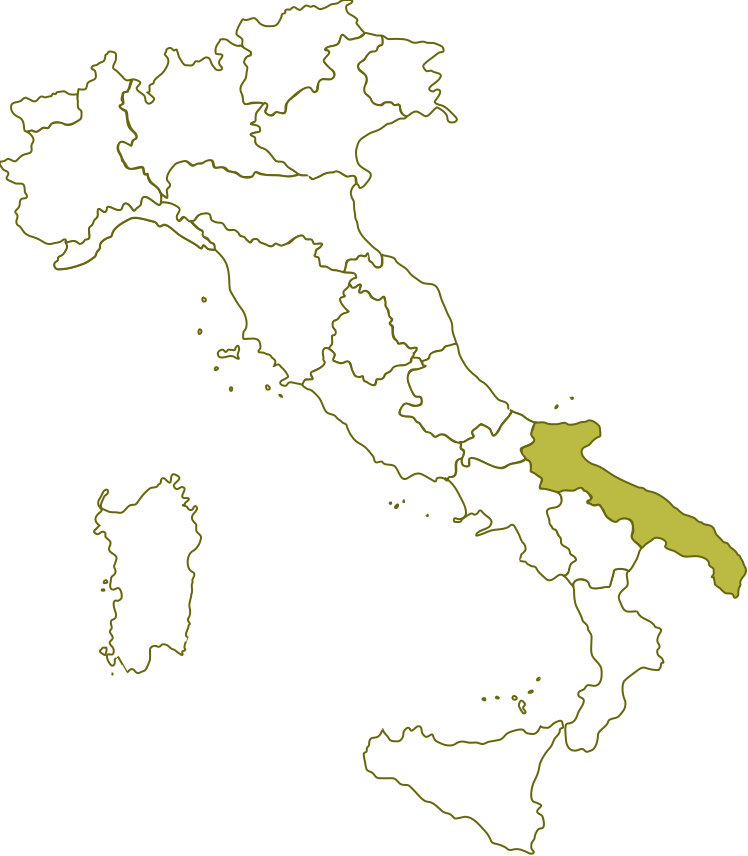
Facts
- Year of foundation: 1993
- Owner: Gregory Perrucci
- Oenologist: Salvatore Mero
- Annual production: approx. 1,200,000 bottles
- Vineyard: approx. 150 hectares
- Conventional, partly organic cultivation